Deciding between built-in controls and a dedicated security module is a common fork in the road for AI rollouts.
OpenController provides foundational security through governance and observability, not by replacing your security stack. It's designed to work with, not instead of, tools like DLP and UEBA.
OpenController by Lyzr, the governance layer for production AI agents, focuses on controlling what agents can do.
Your specialized security tools focus on detecting how they do it. They are complementary layers.
Lyzr's Security is Governance, Not a Firewall
OpenController's security features are not a replacement for a firewall or an intrusion detection system.
They are a purpose-built set of controls for the unique risks of autonomous AI agents.
This is security through governance.
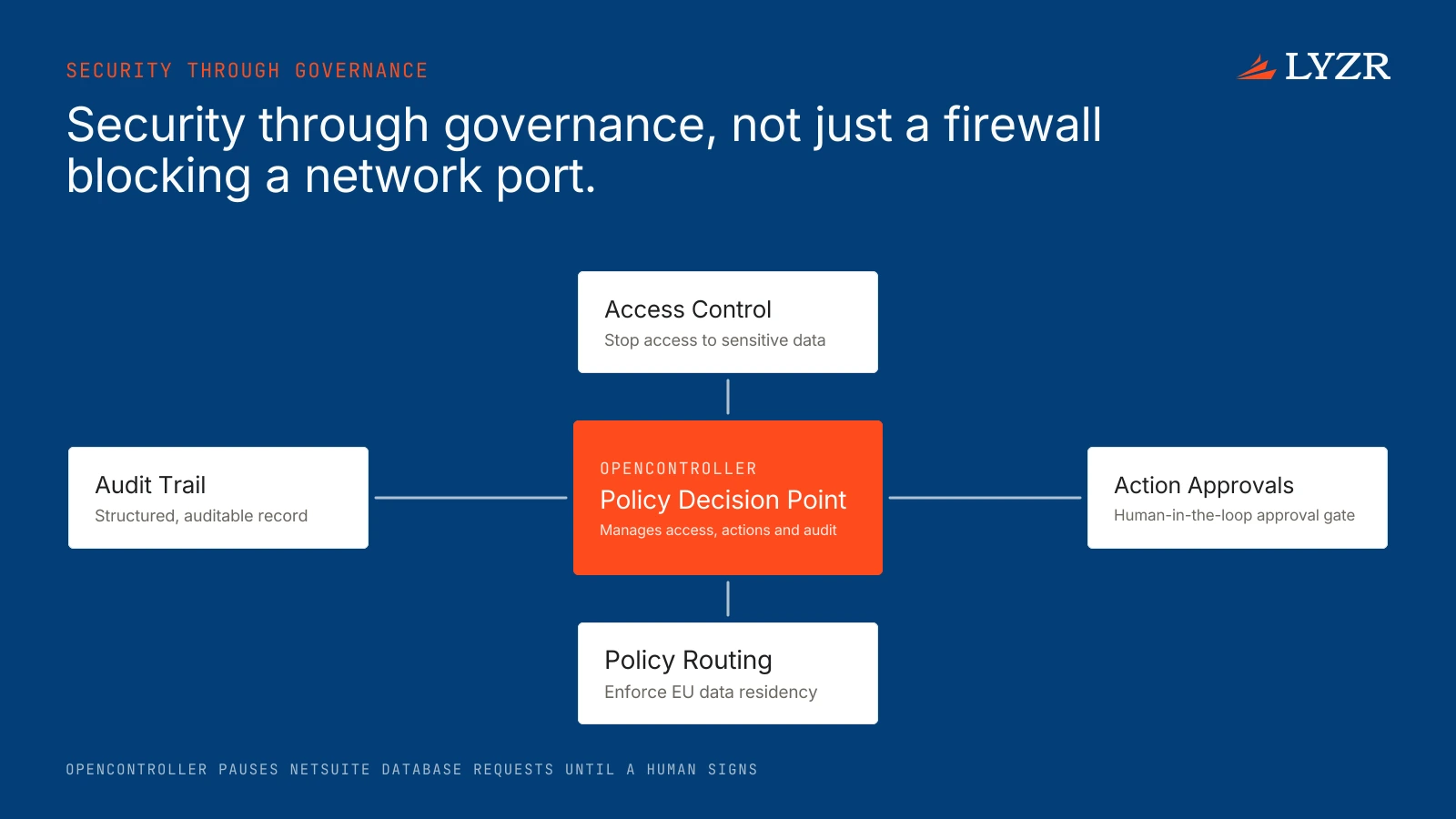
It works by managing three areas: access, actions, and audit.
Access Control: You define which agents can access which tools, APIs, and data stores. This is a core function.
You can stop an agent from accessing sensitive finance data in NetSuite with a policy, not by hoping the LLM behaves.
Action Approvals: For high-stakes actions, OpenController enforces a human-in-the-loop approval gate. The agent proposes an action, like sending an email or updating a database, and execution is paused until a human signs off.
Policy-Driven Routing: You can enforce compliance rules at the infrastructure level. For example, you can ensure an agent handling EU user data only ever uses LLMs hosted within the EU to satisfy data residency requirements.
Audit Trail: Every prompt, tool call, model response, and final output is captured in a comprehensive, traceable log. This isn't just a log file; it's a structured, auditable record of the agent's entire lifecycle.
How OpenController Feeds Your Security Stack
OpenController doesn't just work alongside your security tools. It makes them more effective.
Your existing DLP (Data Loss Prevention) and UEBA (User and Entity Behavior Analytics) tools were not built for the speed and autonomy of AI agents. They need high-fidelity data to work.
OpenController provides that data.
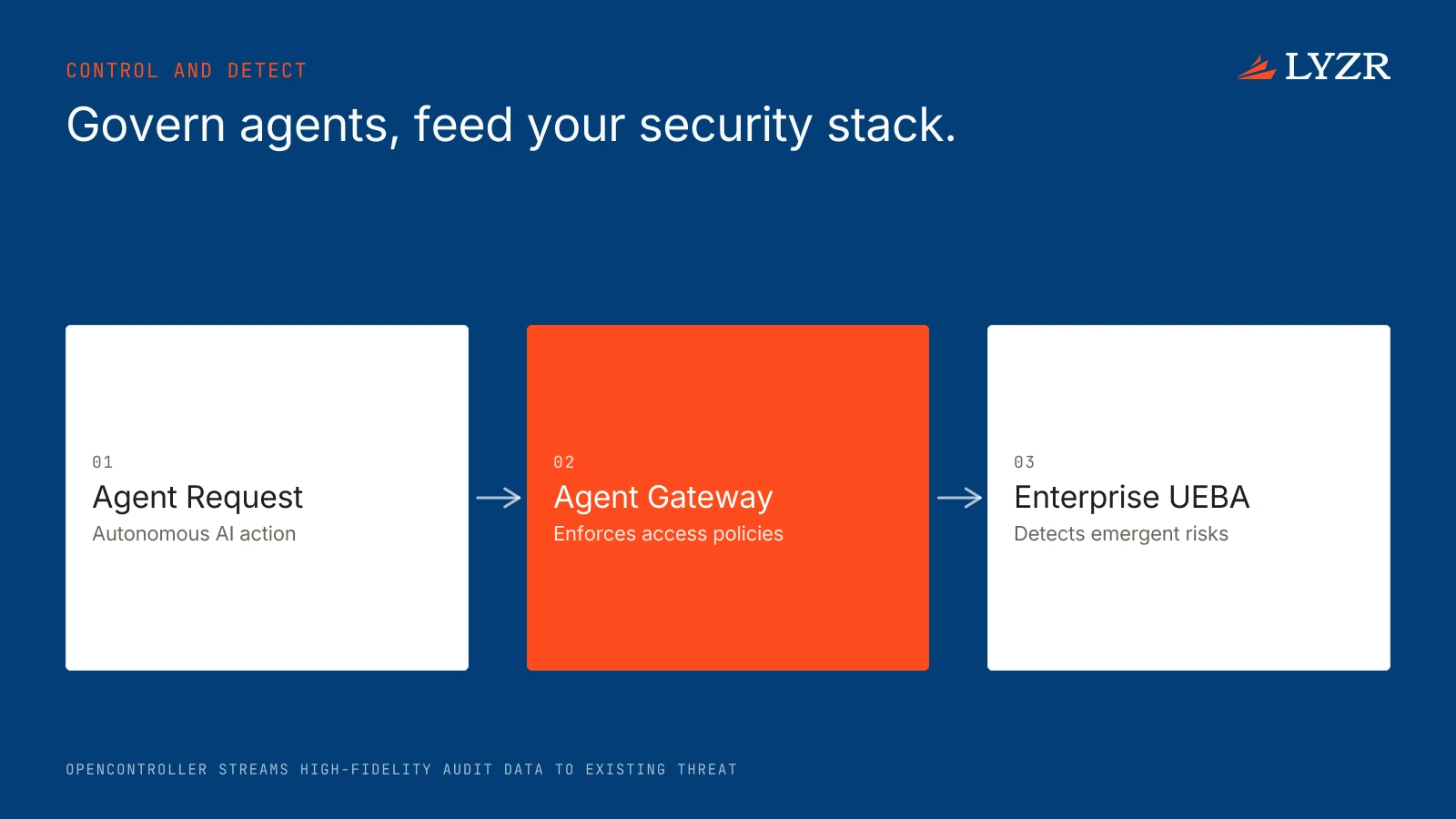
The integration is a clear, one-way flow of information.
-
OpenController sits between your agents and your enterprise systems, capturing every interaction.
-
It generates detailed, structured observability data for every transaction: the input, the agent's reasoning steps, the tools it called, and the final output.
-
This data is exported via standard protocols (like OpenTelemetry or log forwarding) to your security information and event management (SIEM) platform.
-
Your DLP tool ingests these logs and scans them for patterns, like credit card numbers or PII, that violate policy.
-
Your UEBA tool analyzes the sequence of agent actions, building a baseline of normal behavior and flagging anomalies that could indicate a compromised agent or a novel attack.
Without the control plane, your security team is blind. With OpenController, they have the ground truth they need to apply their specialized tools.
So, Do You Still Need a Separate AI Security Module?
Yes, for specialized threat detection.
Think of it this way:
OpenController governs known risks. You write a policy to prevent an agent from accessing a specific database because you know that's a risk.
A dedicated AI security module, like a UEBA, is built to detect unknown and emergent risks by analyzing behavior. It doesn't know the specific rule, but it knows a sales-focused agent suddenly trying to access engineering code repositories is anomalous.
OpenController provides the building's access card system. It determines who can open which doors.
Your UEBA is the security guard watching the camera feeds for someone using their keycard in a strange pattern.
You need both for a complete security posture.
The Takeaway: Control and Detect
Your AI security strategy needs two distinct functions: control and detection.
OpenController provides the control. It enforces the rules of the road for your agents.
In doing so, it generates the high-fidelity audit trail that makes detection by your existing security stack possible.
Ready to see how governance enables security? Let's talk.
Related questions
- Can Lyzr add a security layer to agents built on Azure and deploy them on-premises?
- How would Lyzr-built agents integrate with a firm’s existing systems and internal agents?
Want to see how it fits your stack? Talk to us about OpenController by Lyzr.
Got a use case in mind?
8 weeks from use case to agents running in production.
Platform, people and FDEs, all in. Bring your environment. We'll co-build and stay until it's live.
Talk to UsFree resource
101 AI Agents Use Cases
100+ production-ready AI agent use cases across Marketing, Sales, HR, Banking, Insurance, Operations and a lot more
Download now