Connecting new AI agents to your existing infrastructure shouldn't mean rebuilding what already works.
You don't integrate "Lyzr-built agents" because Lyzr doesn't build your agents. You do.
Our job is to provide the control plane that lets your agents, built on any framework, connect to your systems and other agents safely and transparently.
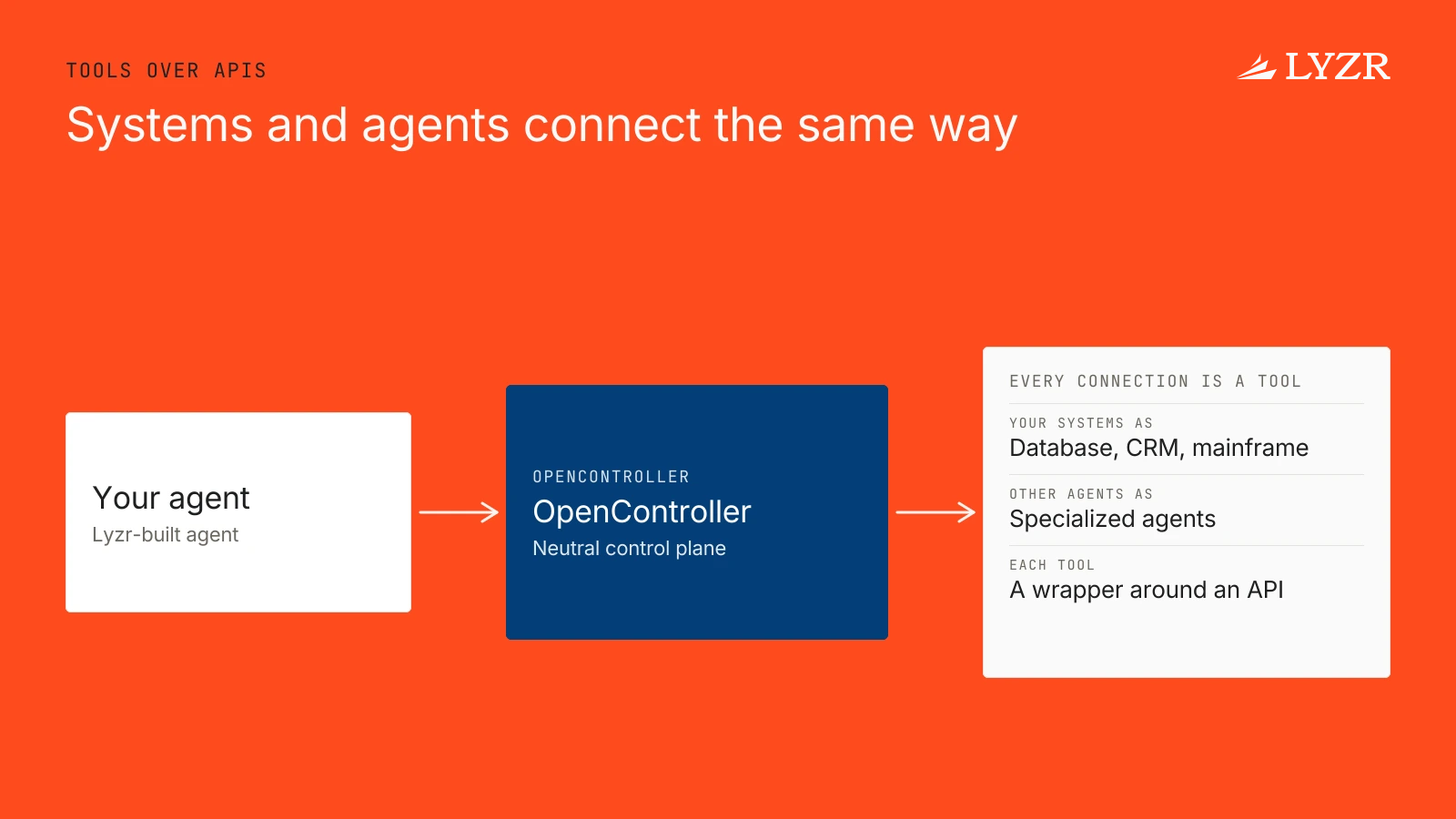
Integration happens at the tool level, governed by OpenController by Lyzr, the control plane for enterprise AI agents. Nothing needs to be rebuilt.
A control plane is the neutral layer that governs everything beneath it. For AI agents, OpenController is that layer.
It’s framework-agnostic, designed to orchestrate agents built with LangChain, CrewAI, LangGraph, or a raw SDK.
How do agents connect to my systems?
An agent in OpenController integrates with your systems by calling a Tool.
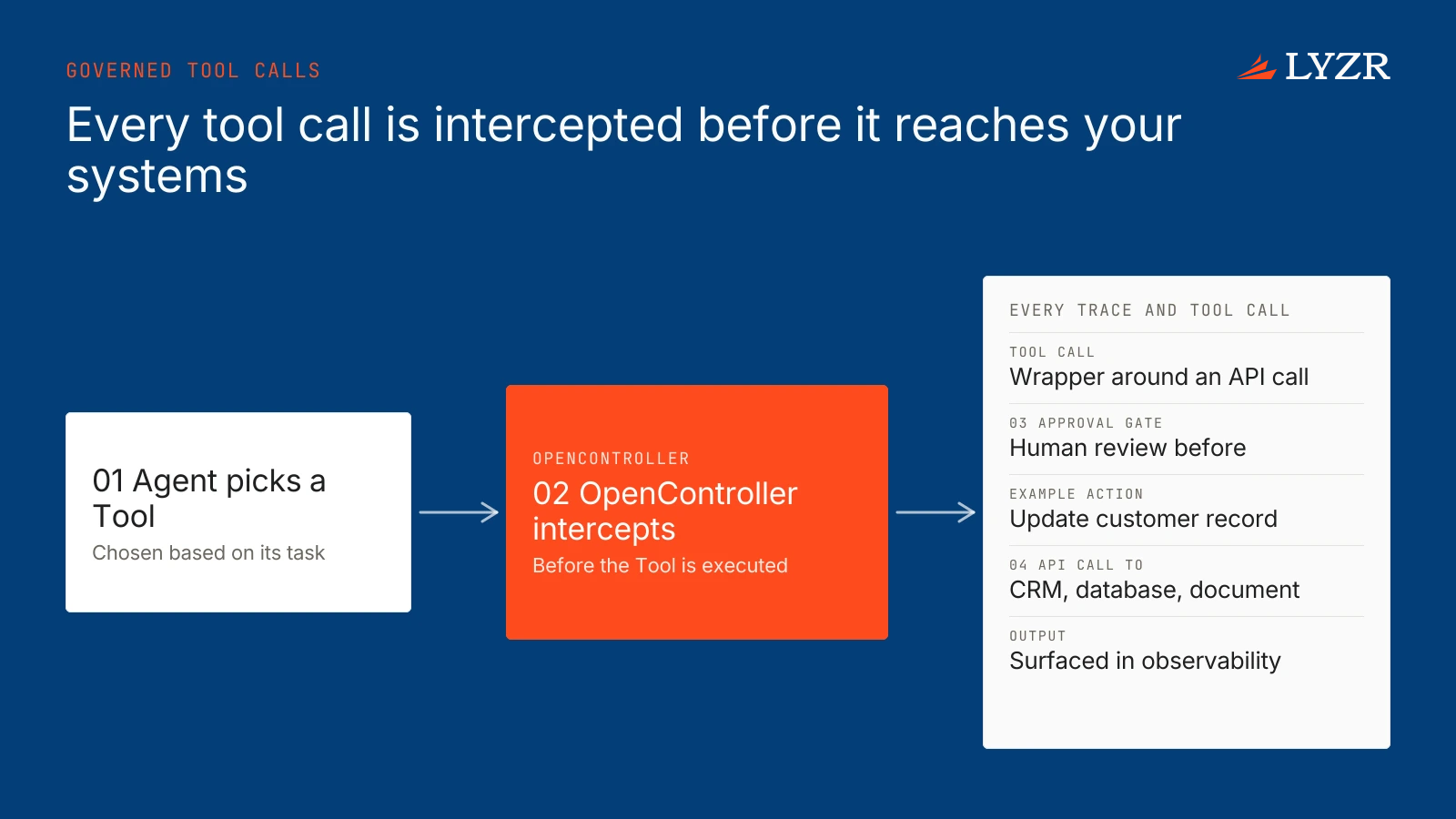
A Tool is simply a function your agent can use.
That function is a wrapper around an API call to your internal systems. A database, a CRM, a document store, a legacy mainframe.
If it has an API, you can create a Tool for it.
The agent decides which Tool to use based on its task.
But before the Tool is executed, OpenController intercepts the call.
This is where governance happens.
OpenController's observability layer surfaces every trace, every tool call, and every output. You see exactly what the agent is trying to do.
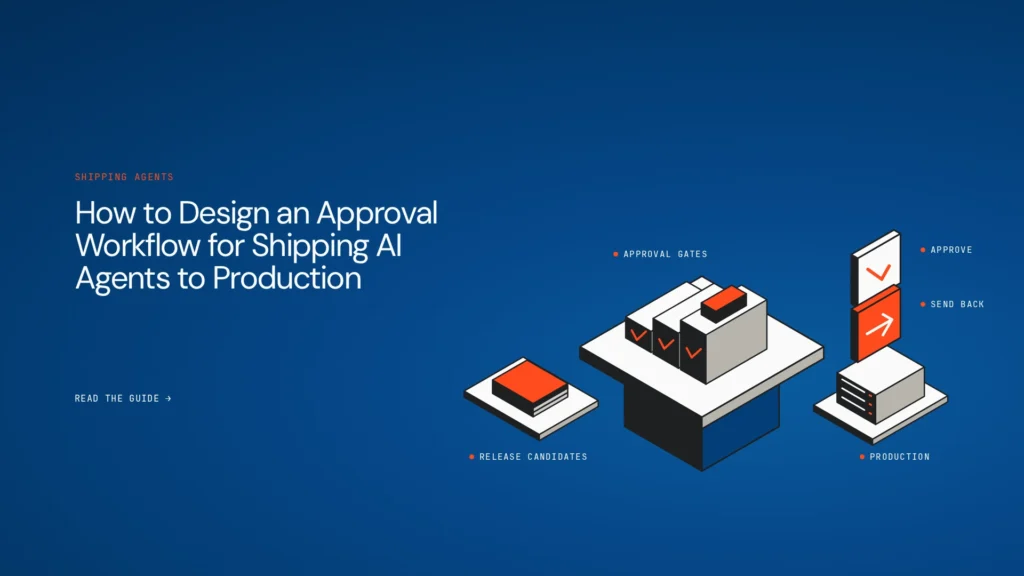
Approval gates can enforce human-in-the-loop review before an agent takes a consequential action, like updating a customer record or sending an email.
This decouples the agent's logic from the integration's implementation. Your agent team can focus on the task, while your platform team retains control over how systems are accessed.
How do agents work with each other?
The same principle applies. One agent can call another agent as a Tool.
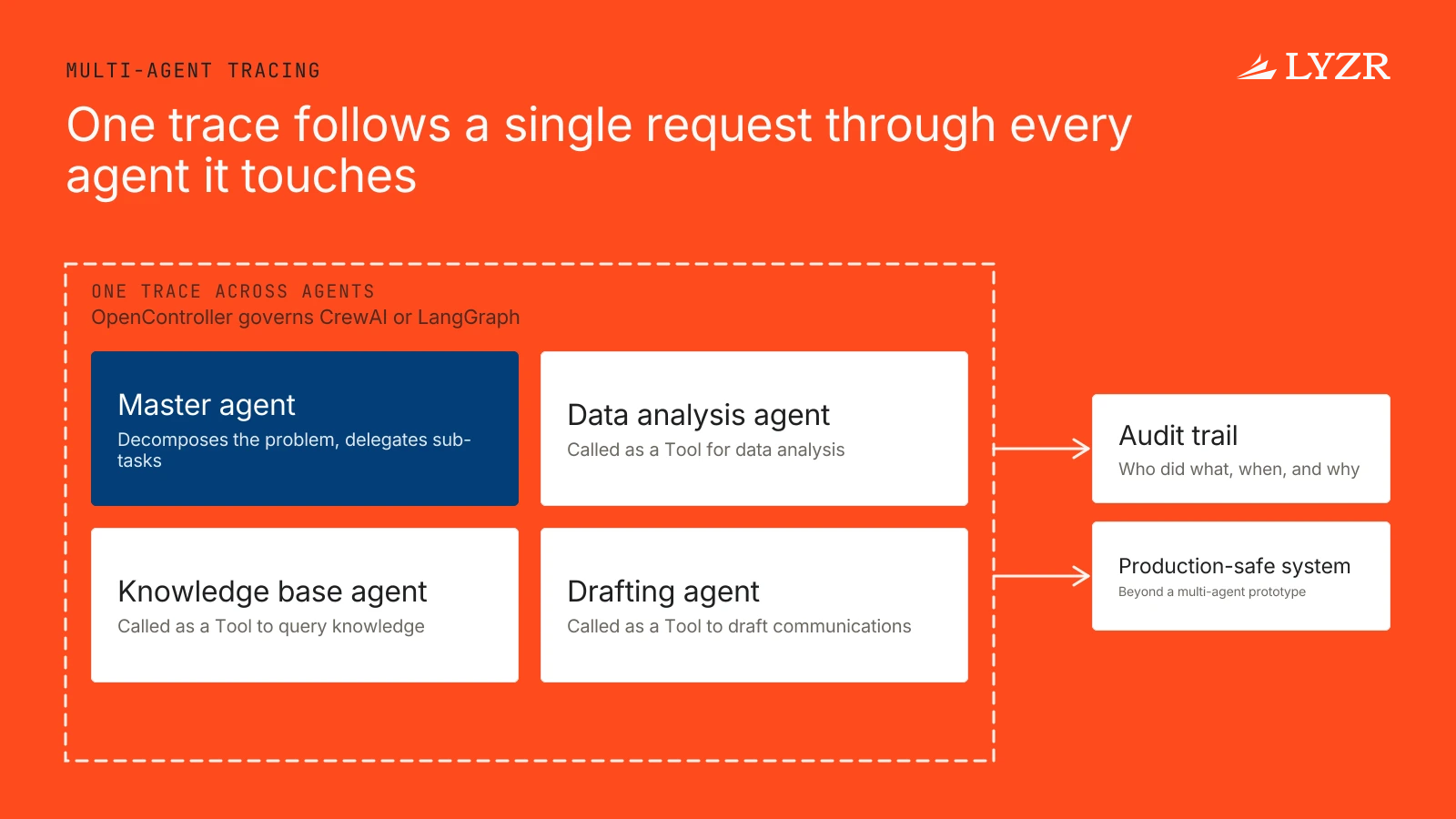
This is a common pattern for building complex, multi-agent workflows.
You might have a "master" agent that decomposes a large problem. It then delegates sub-tasks to specialized agents: one that's an expert in data analysis, another that queries a knowledge base, and a third that drafts communications.
OpenController doesn't replace the frameworks that enable this, like CrewAI or LangGraph.
It governs them.
Lyzr's control plane provides the unified observability to trace a single request as it flows through multiple agents. It generates the audit trail that proves who did what, when, and why, even in a complex, distributed agent system.
This closes the gap between a multi-agent prototype and a production-safe system you can actually deploy.
The Takeaway
The key isn't a special integration for "Lyzr agents."
It's a standard, API-driven approach for your agents, governed by a neutral control plane that gives you visibility and control.
Let's talk about the specific systems and agents you need to connect.
Want to see how it fits your stack? Talk to us about OpenController by Lyzr.
Got a use case in mind?
8 weeks from use case to agents running in production.
Platform, people and FDEs, all in. Bring your environment. We'll co-build and stay until it's live.
Talk to UsFree resource
101 AI Agents Use Cases
100+ production-ready AI agent use cases across Marketing, Sales, HR, Banking, Insurance, Operations and a lot more
Download now