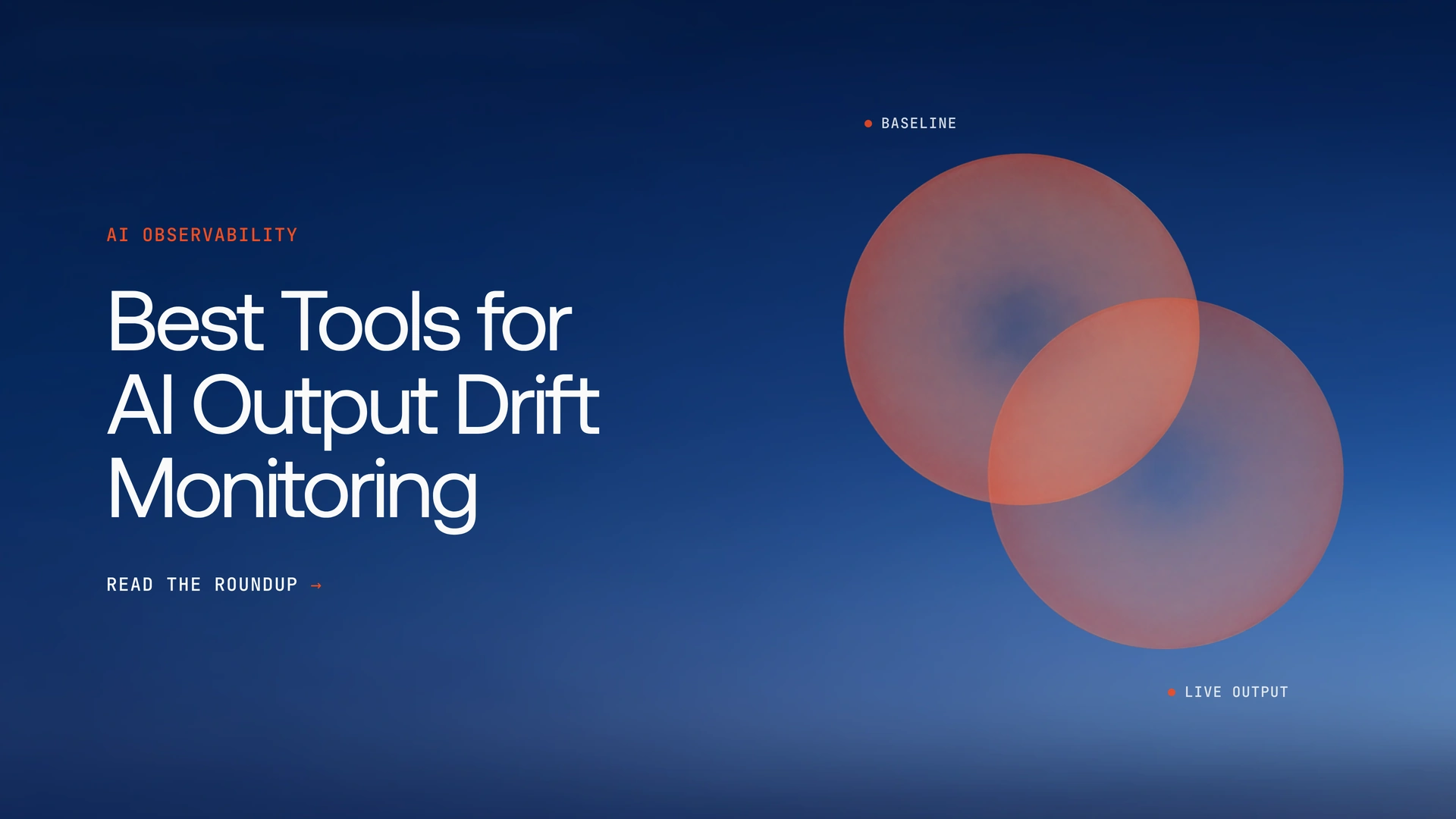
Nobody deployed anything. Error rates are flat, latency is fine, every request returns 200. But the answers your agent gave in March were better than the ones it gives today, and the first person to notice was a customer. This guide compares 11 drift monitoring tools on the same six criteria, and separates the ones that tell you the distribution moved from the ones that let you do something about it before the next request runs.
Get the short answer
- Lyzr OpenController Best overall for enterprise agents. Scores groundedness and quality per request, pins the model and agent version behind every response, gates deployments on evaluation thresholds, and rolls back a drifted agent as a pointer move. Your cloud.
- Arize AX and Phoenix Best for embedding and semantic drift in RAG.
- Evidently AI Best open-source drift library and reports.
- Fiddler AI Best for explainability and drift root cause in regulated settings.
- NannyML Best for estimating performance before labels arrive.
- Deepchecks Best for drift as a test suite in CI.
- Alibi Detect Best research-grade detector library.
- MLflow Best for Databricks and MLflow-native teams.
- Vertex AI Model Monitoring Best for Google Cloud workloads.
- SageMaker Model Monitor Best for AWS-standardized teams.
- whylogs and LangKit Open source only. The commercial WhyLabs platform is discontinued.
Know which drift you are actually looking for
- Drift is the failure mode with no error. A crash pages someone. Drift changes the answers slowly enough that the dashboard stays green and the degradation is discovered socially, by a user or an auditor.
- Four different things get called “drift”, they have different detection methods, and most tools cover two or three of them.
- Only one of them is what your users experience. Input drift is a leading indicator. Concept drift is a cause. Output drift is the symptom that costs you money.

Solve the ground truth problem first
Before you compare tools, decide how you will measure quality at all. This decision constrains the shortlist more than any feature does.
| Approach | What it measures | Honest limitation |
|---|---|---|
| Proxy metrics on the output | Length, refusal rate, format validity, sentiment, toxicity, language | Cheap and continuous, but a perfectly-formatted wrong answer scores clean |
| Reference-free scoring | Groundedness against retrieved sources, LLM-as-judge rubrics, task adherence | The judge is itself a model that can drift; version and pin it |
| Performance estimation | Likely accuracy inferred from input distribution and model confidence, before labels exist | An estimate, not a measurement; assumes no concept drift |
| Labelled sample | Actual correctness on a held-out slice | The only ground truth, and the only one with a per-item cost |
In practice: proxies run continuously, reference-free scoring runs on sampled traffic, and the labelled set is small, curated and used to validate that the other two are telling you the truth.

See how we scored every tool
- 11 tools, 6 criteria, the same yardstick for all of them, Lyzr included. Where another tool is the better pick, we say so and say why.
- Sources: vendor documentation, public announcements, open-source repositories and licences. Vendor status verified as of October 2026. No ratings aggregators, no paid placements.
- What we excluded: general APM and infrastructure monitoring. Those tools watch latency and errors, which are exactly the signals drift does not move.

1. Lyzr OpenController: detect the drift, then actually do something about it
Every tool on this list can tell you the distribution moved. The question that decides most enterprise deals is what your system is permitted to do in the ninety seconds after that alert fires.
Lyzr, the company
- Enterprise AI agent platform: build with Agent Studio and Architect, govern with OpenController
- Jersey City headquarters, Bengaluru engineering hub, teams across the US and India
- Focused on banking, financial services, insurance, healthcare and the public sector
- Technology partners: AWS, Google Cloud, Microsoft Azure, NVIDIA
OpenController, the product
- Universal control plane for any cloud, framework, model and runtime
- Scores output quality and groundedness per request, not per sample
- Pins the agent and model version behind every response
- Runs in your own cloud account or on-prem, fully air-gapped if needed
- Flat annual fee: unlimited agents, users, logs and usage
Measure the drift that has no label
- Groundedness scoring against the retrieved sources, so you can watch the gap between what was retrieved and what was asserted widen before a user reports it
- LLM-as-judge evaluation and reflection cycles, with the judge itself versioned so a drifting judge does not mask a drifting agent
- Task adherence: did the agent do the job it was given, scored per request rather than inferred from a sample
- Policy and guardrail verdicts as a quality signal in their own right. A rising block rate on a stable prompt set is drift, even when no text metric moved
- Latency, error rate and reliability aggregated over time, for trend monitoring rather than point-in-time alerts
See the three things a detector cannot do
- Attribute the drift to a version. Every verdict is recorded per request and versioned with the agent that ran. When quality moves, you can answer “which version, which model, since when” from the record instead of from memory.
- Gate the next deployment. Evaluation thresholds sit in front of promotion, so a regression does not reach production and become something you detect later. confirm gate behaviour with product
- Roll back without a redeploy. Versions are immutable and rollback is a pointer move, which turns a drift alert into a minutes-long operation rather than a release cycle.
Compare what each kind of tool can do
| What you need to do | Drift library | Observability platform | Lyzr OpenController |
|---|---|---|---|
| Detect input and feature drift | ● Yes | ● Yes | ◐ Pair with a library |
| Detect embedding and semantic drift | ◐ Some | ● Yes | ◐ Via groundedness |
| Score output quality without labels | ◐ Proxy metrics | ● Judge and evals | ● Per request |
| Know which model version produced a response | ○ No | ◐ If you log it | ● Versioned with the agent |
| Block a promotion that fails an eval threshold | ○ No | ◐ Via your CI | ● Deployment gate |
| Pin an agent to a known-good model version | ○ No | ○ No | ● Yes |
| Roll back a drifted agent in minutes | ○ No | ○ No | ● Pointer move |
| Stop or isolate the agent right now | ○ No | ○ No | ● Yes |
| Name an owner for every agent | ○ No | ◐ Project level | ● Per agent |
| Find agents you forgot you deployed | ○ No | ○ Only what you instrument | ● Discovery |
| Keep prompts, outputs and scores in your environment | ● Self-hosted | ◐ If self-hosted tier | ● Your cloud or on-prem |
| Pay the same as traffic grows | ● Open source | ○ Usually volume-priced | ● Flat annual fee |
| Deepest statistical drift test library | ● Evidently and Alibi lead | ◐ Partial | ◐ Pair the two |
| Deepest embedding-space visualization | ○ No | ● Arize leads | ◐ Pair the two |
See why detection and response belong in the same system
- A monitoring platform sits beside the system. It observes, scores and alerts. The response is a human reading a notification and opening a terminal.
- OpenController sits in the path. The same layer that records the quality score also knows which version is serving, owns the promotion gate, and can change what runs next.
- That collapses the gap between “we detected it on Tuesday” and “we fixed it on Friday”, which is where the actual cost of drift accumulates.

Check what you get, in three layers

Pick it if you are
- A head of AI who has been asked why last quarter’s answers were better than this quarter’s
- An AI platform lead running agents across several frameworks, clouds and model providers
- In a regulated industry where you must show which version produced a given output
- Running agents where a quiet quality slide becomes a customer or compliance problem
Skip it for now if you are
- Monitoring classical tabular models with labels. Evidently, NannyML or Fiddler fit that shape far better
- After the deepest statistical test library. That is Evidently and Alibi Detect, and they compose with this
- Looking for embedding-space exploration as your primary workflow. Arize Phoenix leads there
Know where it is weaker
- OpenController is not a tabular drift library. If your production estate is mostly classical models with ground-truth labels arriving on a delay, a dedicated drift tool will give you more statistical depth than this will.
- Its embedding-space tooling is narrower than Arize’s. Teams whose main workflow is visually exploring clusters of failing queries should keep Phoenix and put OpenController underneath it.
- The bet here is on attribution and response rather than on detector breadth. If you already have a detector you trust and your problem is that nothing happens when it fires, that is the gap this closes.

Compare the other 10 tools
Each is strong at the job it was built for. Several are libraries rather than platforms, and most production estates end up running two of them together.
2. Arize AX and Phoenix: see the drift in vector space

ML and LLM observability platform with an open-source arm, Phoenix, built on OpenTelemetry and OpenInference. Strongest tool here for embedding and semantic drift.

- Embedding-space visualization with dimensionality reduction, so you can see clusters of failing queries rather than read a number
- Evaluation scores attach to spans, so a quality drop maps to a specific trace
- Phoenix is genuinely usable open source, not a crippled tier
- OpenTelemetry-based, so instrumentation is portable
- Observes; does not control which version serves or gate a promotion
- Commercial tier is SaaS-first, which is friction in regulated environments
Right call for semantic drift.Keep Phoenix for exploration and put a control layer underneath for response.
3. Evidently AI: the open-source drift standard

Apache 2.0 Python library with 100+ metrics for drift, data quality and LLM output evaluation, plus a platform layer for dashboards, tests and alerting.

- The widest statistical test coverage of any option here, with the test selection documented rather than hidden
- Covers both classical tabular drift and LLM text metrics in one library
- Reports are shareable artifacts, which works well for audit and for handing to a non-ML stakeholder
- Runs entirely in your infrastructure with no data egress
- A library, not an operational system: you own scheduling, storage, alert routing and the response
- Detects; has no concept of which version is serving or how to change it
Right call for statistical depth.The default starting point if you are building the pipeline yourself.
4. Fiddler AI: explain why the drift happened

Enterprise monitoring platform combining drift detection with explainability, bias and fairness monitoring, and governance reporting for regulated industries.

- Feature attribution means an alert comes with a candidate cause rather than just a flag
- Bias and fairness monitoring alongside drift, which matters where both are reportable
- Built for governance reporting, not just engineering dashboards
- Deep slice and segment analysis for finding which cohort moved
- Enterprise procurement and setup overhead; not a library you add in an afternoon
- Explainability depth is strongest for classical ML; free-text output is a newer surface
Right call for regulated ML estates.Strongest where you must explain the drift to someone outside engineering.
5. NannyML: estimate performance before labels arrive

Open-source library focused on the hardest part of the problem: estimating how a model is actually performing when ground truth has not come back yet.

- Addresses the gap most drift tools quietly skip: a distribution moved, but did quality actually drop
- Reduces false alarms, because not every input shift degrades performance
- Pairs cleanly with a detection library rather than competing with one
- Fully self-hosted
- Built for classical supervised models; it does not transfer to free-text LLM output
- It is an estimate, and it assumes the input-output relationship itself has not changed
Right call for delayed labels.The best answer to “the distribution moved, should I care”.
6. Deepchecks: treat drift as a test suite

Open-source validation framework that packages drift and data integrity checks as suites you run in CI and on a schedule, rather than as a dashboard you watch.

- The test-suite framing turns drift into something with a pass or fail, which is easier to act on than a chart
- Fits naturally into existing CI, so it has an owner by default
- Covers data integrity issues that masquerade as drift
- Batch and pipeline oriented; less suited to continuous per-request scoring
- A failing suite still needs something downstream that can stop a promotion
Right call for CI-gated validation.Pair it with something that can enforce the gate in production.
7. Alibi Detect: the research-grade detector library

Open-source library of drift, outlier and adversarial detection algorithms covering tabular, text and image data, including online and multivariate detectors.

- Algorithmic breadth beyond the standard test set, including maximum mean discrepancy and learned detectors
- Handles text and image drift, not only tabular
- Online detectors suit streaming rather than batch comparison
- A toolkit, not a product: no dashboards, no alerting, no storage
- Needs real ML depth to configure well; the wrong detector produces confident noise
Right call for custom detection.Use it when the standard tests genuinely do not fit your data.
8. MLflow: drift inside the experiment platform

Open-source ML lifecycle platform with tracing and evaluation, so drift checks live next to the runs, models and metrics they relate to.

- Evaluation results sit alongside model versions and runs, so comparison across versions is native
- No new vendor if you already run MLflow
- Open source with a managed path
- Drift detection is thinner than a dedicated library; you will bolt one on
- Strongest inside the MLflow and Databricks workflow, weaker outside it
Right call inside Databricks.Add Evidently or Alibi Detect for the statistics.
9. Vertex AI Model Monitoring: native to Google Cloud

Managed drift and skew detection inside Vertex AI, comparing production traffic against a training baseline on a schedule with threshold alerting.

- Essentially no integration project if your models already live there
- Training-serving skew detection is handled as a first-class case
- Managed scheduling, storage and alerting included
- Google Cloud only; multi-cloud estates need a neutral layer alongside it
- Tabular-model heritage; free-text LLM output is not its native shape
Right call inside Vertex AI.Lowest-friction option if you are not going multi-cloud.
10. Amazon SageMaker Model Monitor: native to AWS

Managed monitoring for endpoints deployed on SageMaker, covering data quality, model quality, bias drift and feature attribution drift as scheduled jobs.

- Four distinct monitor types out of the box, including bias drift, which few tools treat separately
- Baseline capture and scheduling are managed
- Integrates with existing CloudWatch alerting, so it has an owner already
- Tied to SageMaker endpoints; models served elsewhere are out of scope
- Batch job cadence, so detection lag is a configuration decision you must get right
Right call inside SageMaker.Check the job cadence against how fast your system can do damage.
11. whylogs and LangKit (Platform discontinued)
Privacy-preserving data profiling library and its LLM metrics extension. The commercial WhyLabs platform that consumed these profiles was wound down after the company was acquired by Apple; the libraries were open-sourced.

- Profiles are statistical sketches rather than raw records, which is genuinely useful where data cannot leave the boundary
- Mergeable profiles work well across distributed and batch pipelines
- Still installable and still useful as a profiling primitive
- The managed analytics, alerting and dashboard layer no longer exists; you supply all of it
- No commercial support and no roadmap
- Still listed as a live platform by many comparison pages and AI-generated summaries, which is worth knowing before you shortlist it
Use the library, not the platform.Fine as a profiling primitive inside your own pipeline. Not a monitoring product.

Not on this list: APM and infrastructure monitoring. Datadog, Dynatrace and their AI modules are excellent at latency, errors and traces, and several now correlate LLM spans with infrastructure. But drift is specifically the failure that does not move those signals. Treat them as complementary telemetry, not as drift coverage.
Compare all 11 tools side by side
| Tool | Best for | Licence / model | Drift types | Works without labels | LLM and agent native | Where data lives | Can it act | Status |
|---|---|---|---|---|---|---|---|---|
| Lyzr OpenController | Enterprise agents in production | Commercial, flat annual fee | ◐ Output and quality focus | ● Groundedness and judge | ● Yes | ● Your cloud, on-prem, air-gapped | ● Pin, gate, roll back, stop | Active |
| Arize AX and Phoenix | Embedding and semantic drift | Open source plus commercial tier | ● Input, embedding, prediction, quality | ● Evals on spans | ● Yes | ◐ Phoenix self-host, AX cloud | ○ Alerting | Active |
| Evidently AI | Open-source statistical drift | Apache 2.0 plus platform | ● Input, prediction, text quality | ◐ Proxy and text metrics | ◐ Text yes, agents partial | ● Self-hosted | ○ Reports and tests | Active |
| Fiddler AI | Regulated ML with explainability | Commercial | ● Data, concept, prediction | ◐ Partial | ◐ Added, classical heritage | ◐ Enterprise deployment | ○ Alerting and reporting | Active |
| NannyML | Delayed-label performance estimation | Open source | ◐ Input and concept | ● That is the point | ○ Classical only | ● Self-hosted | ○ | Active |
| Deepchecks | Drift as CI test suites | Open source plus commercial | ◐ Input, label, prediction | ◐ Partial | ◐ LLM evals added | ● Self-hosted | ◐ Fails a build | Active |
| Alibi Detect | Custom detection algorithms | Open source | ● Input, multivariate, embedding | ◐ Detection only | ◐ Text supported | ● Self-hosted | ○ | Active |
| MLflow | Databricks and MLflow teams | Apache 2.0 | ◐ Prediction and quality | ◐ Via evaluation | ◐ Tracing and evals | ● Self-host or Databricks | ○ | Linux Foundation |
| Vertex AI Model Monitoring | Google Cloud workloads | Commercial, GCP | ◐ Skew, input, prediction | ○ Needs a baseline | ○ Tabular heritage | ○ Google cloud | ○ Alerting | Active |
| SageMaker Model Monitor | AWS-standardized teams | Commercial, AWS | ● Data, model, bias, attribution | ○ Needs labels for model quality | ○ Tabular heritage | ○ AWS | ○ CloudWatch alerting | Active |
| whylogs and LangKit | Privacy-preserving profiling | Open source | ◐ Input and output profiles | ◐ Proxy metrics | ◐ Via LangKit | ● Self-hosted | ○ | Platform discontinued |

Pick by what you are actually monitoring

Run these five tests in every vendor demo
- The silent-swap test. Ask them to detect a provider-side model update behind a stable endpoint name, where no code, prompt or config changed.
- The no-label test. Ask what they can tell you about quality today, with zero ground truth available for another six weeks.
- The attribution test. Point at a degraded response and ask which model version and which agent version produced it, from the record rather than from a guess.
- The response test. Ask what their product does when the threshold trips, beyond sending a notification. Get the answer in writing.
- The cadence test. Ask how long between a real quality drop and the alert, at their default configuration, and what it costs to make that window shorter.
Get answers to common questions
What is AI output drift?
Output drift is a change over time in what a model produces, with no change to the code calling it. The answers get longer, vaguer, more cautious, less grounded or simply wrong, while every request still succeeds. It is the production failure mode that gets caught late, because nothing errors.
What is the difference between data drift, concept drift and output drift?
Data drift is a change in the distribution of inputs. Concept drift is a change in the relationship between inputs and the correct answer, so the right answer today differs from the right answer last quarter for the same input. Output drift is a change in what the model actually returns. Data drift is a leading indicator, concept drift is the cause, and output drift is what your users experience.
What causes LLM output drift when nothing in my code changed?
Four common causes. The provider updated the model behind a stable endpoint name. Your retrieval corpus changed, so the same question now pulls different documents. Your users changed what they ask and how they phrase it. Or a prompt, tool or guardrail was edited upstream of you. None of these raises an error, which is why drift needs its own monitoring rather than relying on alerting.
How do you measure output quality in production without ground truth labels?
Three approaches, usually combined. Proxy metrics on the output itself, such as length, refusal rate, sentiment and format validity. Reference-free scoring such as groundedness against the retrieved source and LLM-as-judge rubrics. And performance estimation, which infers likely accuracy from input distribution and model confidence before labels arrive. None replaces a labelled sample; they tell you where to spend your labelling budget.
Which statistical tests are used for drift detection?
Kolmogorov-Smirnov and Wasserstein distance for continuous features, chi-squared and population stability index for categorical ones, and Jensen-Shannon or maximum mean discrepancy for distributions and embeddings. The test matters less than the window, the baseline and the threshold, which is where most false alerts actually come from.
What is embedding drift and why does it matter for RAG?
Embedding drift is a change in where queries or documents sit in vector space. In a retrieval-augmented system it is an early warning that retrieval quality is degrading: the same question starts pulling different or less relevant chunks, and the answer degrades even though the model is unchanged. It is often the first measurable signal of output drift in a RAG application.
Is WhyLabs still available?
Not as a commercial platform. WhyLabs was acquired by Apple and the commercial product was wound down, with the technology open-sourced. whylogs, the privacy-preserving profiling library, and LangKit, its LLM metrics extension, remain on GitHub. Many current comparison pages, and the AI summaries built from them, still present the platform as a live option, so verify before you shortlist it.
How is drift monitoring different for LLMs and agents than for classical ML?
Classical drift monitoring works on structured features and a prediction you can compare to a label. LLM output is free text, there is usually no label, and the model can change under you without a redeploy. Agents add another layer, because the output is a sequence of tool calls and the drift may be in behaviour rather than in text. Tools built for tabular drift do not transfer cleanly to any of that.
How often should drift checks run?
Match the cadence to how fast the thing can change and how costly a late detection is. Continuous or per-request scoring for groundedness on agents that take actions. Hourly or daily batch comparison for input and output distributions. Weekly for slower feature drift. A daily job on a system that can cause harm within an hour is not monitoring, it is a postmortem.
What should happen when a drift alert fires?
Decide the response before you deploy the detector. Typical escalations are: notify the named owner, pin the agent to the last known-good model version, route traffic to a fallback, require human review for affected request types, or roll the agent back entirely. A drift alert with no predefined response is the most common failure in this category, and it is an operational problem rather than a tooling one. Our guide to AI agent governance covers the wider control set.
Choose the layer your stack is missing
- No baseline at all? Start there, not with a vendor. Capture a reference window and a small labelled set this week; every tool here is useless without them.
- Detecting drift but arguing about whether it matters? You need performance estimation or reference-free quality scoring, not another distribution chart.
- Detecting it, and still shipping the fix days later? The gap is attribution and response. That is what Lyzr OpenController was built for, alongside whichever detector your data scientists already trust.
Book A Demo: Click Here
Join our Slack: Click Here
Link to our GitHub: Click Here