Your agent passed every test in the demo. Then someone renamed a field in the order API, and the cancellation workflow started confirming refunds it never processed.
Nobody caught it for four days.
That’s the gap golden datasets for AI agent evaluation exist to close. Not a spreadsheet of sample questions, but a governed, expert-validated reference point that tells you, on every single change, whether the agent got better, worse, or just different. Without one, every prompt tweak and model swap is a guess dressed up as a deployment.
This piece covers what a golden dataset actually is, what it has to contain for an agent (not a chatbot), how to build one from real traces instead of imagined scenarios, how to keep it alive instead of letting it rot, and where it sits relative to broader AI agent evaluation and governance work.
What is a golden dataset for AI agent evaluation?
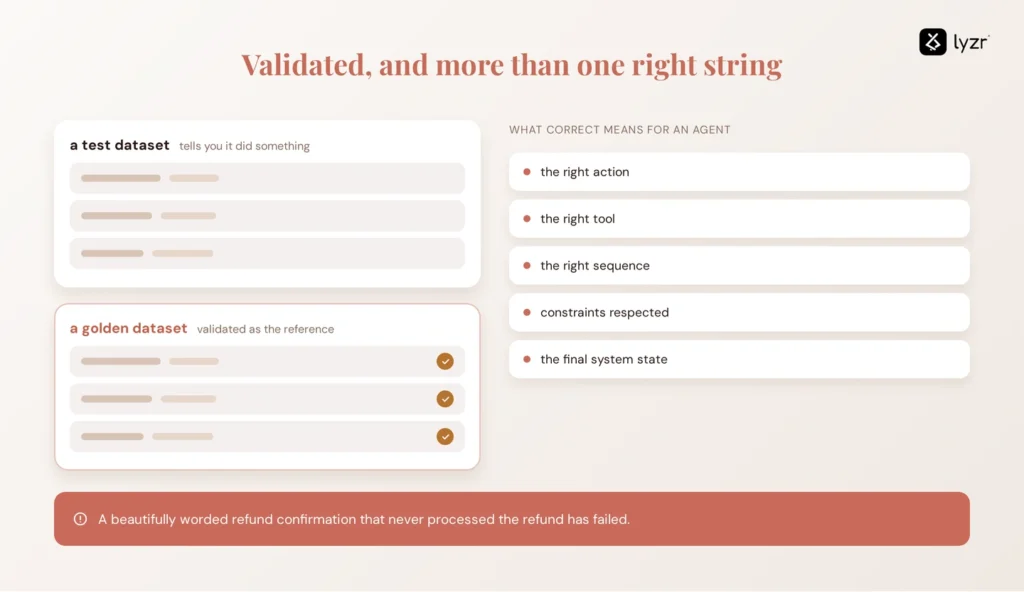
A golden dataset for AI agent evaluation is a curated, expert-validated set of representative agent tasks, expected outcomes, and evaluation criteria, used as a consistent benchmark for testing an agent over time.
The distinction from a generic test dataset is not academic.
A normal test dataset gives you examples to run against. It tells you the agent did something.
A golden dataset is validated and trusted as the reference point. The evaluation system uses it to determine whether the agent’s behavior matches what domain experts have defined as correct.
For agents, the expected result rarely lands on one exact string. It might be the correct action, the correct tool selection, a specific sequence of steps, a set of constraints that must not be violated, or a final system state. That’s a materially different bar than scoring a single LLM response, and it’s why AI agent observability and evaluation have to assess behavior and task completion, not just text quality. An agent that writes a beautifully worded refund confirmation while never actually processing the refund has failed, no matter how the sentence reads.
Why do AI agents need golden datasets?
AI agents need golden datasets because their outputs are not stable, and multi-step workflows fail in more places than a single model response ever could.
Run the same input through an agent twice and you can get two different tool sequences. Add a second or third step (retrieve, decide, call a tool, confirm) and you’ve multiplied your failure surface. A model swap, a prompt edit, or a silent change to a tool’s schema can alter what the agent does without anyone noticing until a customer does.
Human reviewers cannot manually regression-test every change. Nobody has the hours. Teams need a repeatable benchmark before they’ll trust an agent enough to move it toward taking AI agents to production.
Here’s the reframe worth sitting with: the value of a golden dataset isn’t that it makes an agent correct. It gives teams a consistent way to determine whether a change made the agent better, worse, or simply different. That’s a much lower bar to clear than “prove the agent is right,” and it’s the bar that actually makes shipping changes safe.
What should an agent golden dataset contain?
n agent golden dataset should contain the input, expected outcome, tool expectations, evaluation criteria, required context, risk tags, and metadata, not just a question and an answer. These fields become especially important when evaluating AI agents across multi-step workflows.
Golden dataset record structure
| Component | What it captures |
| Input | User query, task, context, or scenario |
| Expected outcome | Correct answer, action, state, or result |
| Tool expectations | Tools the agent should or shouldn’t use |
| Evaluation criteria | Accuracy, task completion, safety, policy adherence, etc. |
| Context | Documents, data, permissions, or environment required |
| Risk tags | Edge case, sensitive data, adversarial input, high-risk workflow |
| Metadata | Version, owner, category, difficulty, timestamp |

The point worth repeating: agent ground truth isn’t necessarily a single ideal response. For an agent, “correct” may mean using the right tool, respecting constraints, and reaching the right state. Score only the final text and you’ll pass agents that got the right answer by taking an unauthorized shortcut.
If you’re building this from scratch, a structured starting point saves weeks. The How to Take Agents to Production playbook covers the evaluation gates that a golden dataset feeds into, alongside the fields worth tracking per test case (agent, input, expected tool, expected action, risk level, actual result, pass/fail, reviewer, and dataset version).
What is a golden dataset example?
A golden dataset example is a single record showing exactly what “correct” looks like for one real task, not an abstract description of correctness.
Take a customer-support agent handling: “Cancel my order and refund the payment.”
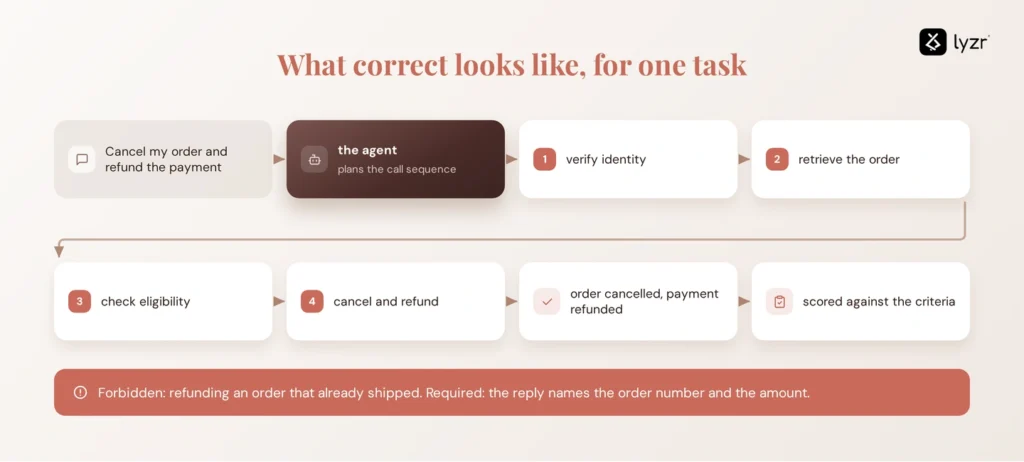
Expected behavior for this one input:
- Verify the customer’s identity.
- Retrieve the correct order.
- Check whether the order is eligible for cancellation.
- Call the cancellation and refund tool.
- Confirm the resulting order state.
- Tell the customer what happened.
The golden record for this case would capture the expected tool calls in order (verify, retrieve, check, cancel), a forbidden action (never refund an order that’s already shipped), the final state (order status: cancelled, payment status: refunded), a response requirement (must include the order number and refund amount), and the evaluation criteria used to score a pass.
That level of detail is what turns a golden dataset into a regression benchmark rather than a collection of examples someone approved once.
How do you build a golden dataset?
You build a golden dataset by starting from real agent traces, prioritizing the workflows that matter most, deliberately adding edge cases, getting experts to validate ground truth, defining evaluation criteria beyond the final answer, and versioning the result.
Step 1: Start with real agent traces
Use production or realistic test traces instead of inventing every scenario from a whiteboard. Start with a small set of reviewed production or realistic test traces, perhaps 20 to 50 for an initial benchmark, covering your most important behaviors. Treat that as a practical starting point, not a rule. A high-stakes workflow with dozens of branches will need more coverage than a narrow internal tool. Coverage of distinct failure modes matters more than raw count: 100 diverse items beat 1,000 near-duplicates.
Step 2: Select representative workflows
Prioritize high-volume tasks, business-critical workflows, known failure modes, high-risk actions, and common user journeys. This is where you decide what “important” means for your business, not a vendor’s default list.
Step 3: Add edge cases
Ambiguous requests, missing information, adversarial prompts, tool failures, permission failures, unexpected inputs, and anything that has already broken production once. If it broke once, it will try again.
Step 4: Establish ground truth
Domain experts, not engineers alone, validate the expected answer, action, or outcome. An engineer knows what the code does. A domain expert knows what it should do.
Step 5: Define evaluation criteria
Don’t evaluate only the final response. Include task completion, tool selection, tool-call parameters, policy compliance, factual accuracy, safety, and final state.
Step 6: Version the dataset
Treat the golden dataset itself as a controlled artifact, tracked the same way you’d track code in an agent registry. Record what changed, why it changed, and which agent version was evaluated against it.
How do you maintain a golden dataset?
You maintain a golden dataset by feeding it real production failures, retiring scenarios that no longer reflect the business, revalidating expected outcomes when policy changes, and versioning every revision. This is part of the broader discipline of AI agent observability, where production behavior feeds continuous improvement.
Practices worth locking in:
- Add failed production traces to the dataset as soon as they’re understood.
- Retire outdated scenarios instead of letting them accumulate as noise.
- Revalidate expected outcomes whenever a business process changes, not just when the agent changes.
- Version every dataset revision, tied to the agent version it evaluated.
- Track performance across agent and model versions so drift shows up early, not after a support ticket.
- Prevent teams from quietly rewriting ground truth just to make evaluation scores look better.
The same principle applies to governance: changes to the benchmark should be traceable, reviewable, and tied to a reason.
Golden dataset vs evaluation dataset vs test dataset
The three terms get used interchangeably, but they’re not the same thing. See our AI agent evaluation guide for how these benchmarks fit into a broader evaluation workflow.
Comparing test, evaluation, and golden datasets
| Dimension | Test dataset | Evaluation dataset | Golden dataset |
| Purpose | Find failures | Measure performance | Establish trusted benchmark |
| Validation | Varies | Defined criteria | Expert-validated |
| Used for regression? | Sometimes | Yes | Yes |
| Expected outcome | May be broad | Usually defined | Explicitly governed |
| Version controlled | Recommended | Recommended | Essential |
A test dataset asks “does this break?” An evaluation dataset asks “how well does this perform?” A golden dataset asks “is this still doing what we agreed it should do?” and carries the authority to block a release if the answer is no.
How does a golden dataset fit into AI agent evaluation?
A golden dataset provides the benchmark that sits inside a larger lifecycle: build, evaluate, compare, approve, deploy, observe, and re-evaluate.
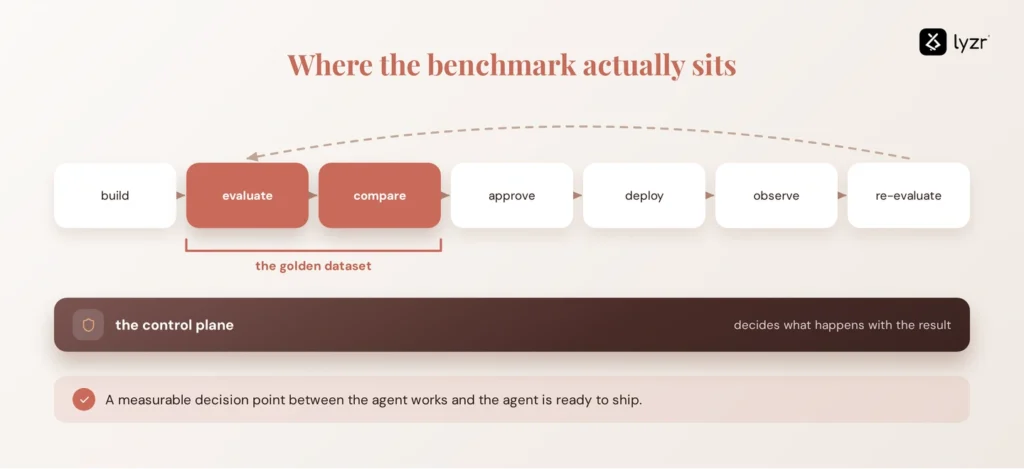
The golden dataset sits primarily in the evaluation and regression layer. A broader AI Control Plane connects that evaluation to the rest of the agent lifecycle, deciding what happens with the result.
That connection matters more than it sounds. A golden dataset doesn’t solve every production risk. What it does provide is a measurable decision point between “the agent works” and “the agent is ready to ship.” Without that benchmark, teams have no consistent evidence for deciding whether a new model, prompt, tool, or workflow change is actually an improvement.
How does Lyzr’s Opencontroller fit?
Lyzr’s Opencontroller sits around the evaluation process as the governance layer; it doesn’t replace the golden dataset or the evaluation system itself.
It provides an agent registry, evaluation gates ahead of promotion, version and configuration tracking, runtime observability once an agent is live, and an audit trail across all of it. You can read more about the underlying design in the Opencontroller architecture overview.
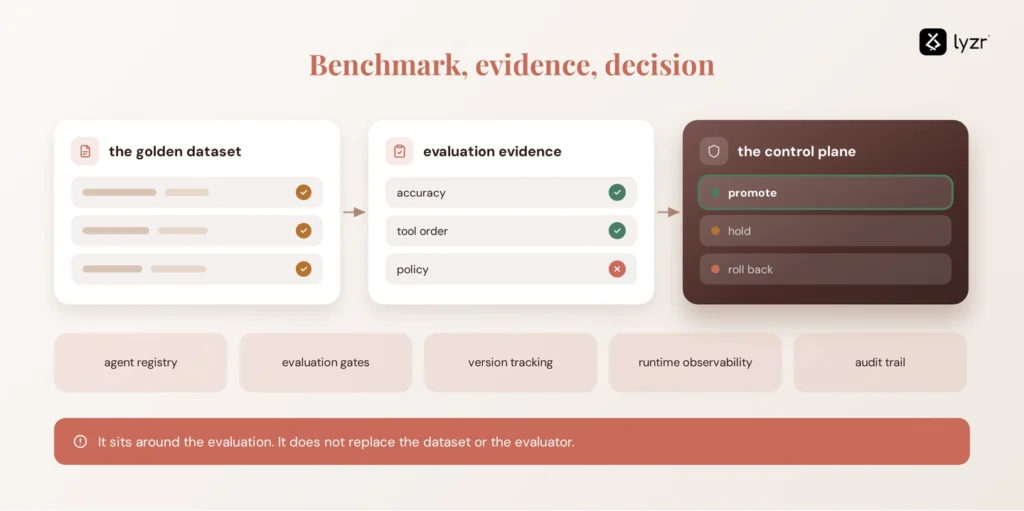
When an agent is updated, a golden dataset can provide the benchmark for evaluating whether the new version performs as expected. OpenController can then use that evaluation as part of the decision to promote the agent into production, while continuing to track its version and runtime behavior after deployment.
Explore Opencontroller to see how evaluation gates connect golden dataset results to promotion decisions, or book a demo to walk through how it would fit your current agent stack.
Frequently asked questions
A golden dataset in AI is a curated, expert-validated set of inputs and expected outcomes used as the trusted benchmark for measuring model or agent performance. It’s the reference point every other evaluation gets compared against.
It’s used to catch regressions when a prompt, model, or pipeline changes. Instead of guessing whether an update helped, you replay the same golden cases and get a measured pass rate.
Start with real agent traces, prioritize business-critical and high-risk workflows, add edge cases, have domain experts validate the expected outcome, define evaluation criteria beyond the final answer, and version every change.
Input, expected outcome, tool expectations, evaluation criteria, required context, risk tags, and metadata. For agents specifically, the expected outcome usually includes the correct action and final state, not just a correct sentence.
You evaluate an AI agent by running it against a golden dataset and scoring task completion, tool selection, tool-call parameters, policy compliance, factual accuracy, safety, and final state, not just the wording of its final response.
A concrete record like a customer-support cancellation request, with the expected tool sequence (verify, retrieve, check eligibility, refund), a forbidden action, the required final order state, and the criteria used to score a pass.
A test dataset finds failures and validation can vary. A golden dataset is expert-validated, explicitly governed, and treated as essential to version control because it’s the reference point for regression decisions.
Update it when the business process it reflects changes, or when a real production failure reveals a gap, not every time an agent produces a result someone finds inconvenient. Revalidation should follow policy changes, not preference.
Yes. For retrieval-augmented generation, a golden dataset for RAG typically pairs a question with a verified answer and the specific source passages that should have grounded it, letting you score both retrieval accuracy and answer faithfulness.
AI agent evaluation tools automate the replay: they run the agent against every case in the golden dataset, log the actual behavior, and compare it to the expected tool calls and outcomes to generate a pass or fail report.
Book A Demo: Click Here
Join our Slack: Click Here
Link to our GitHub: Click Here