If you’re reading this, there’s a good chance you’re already using Fiddler AI, or evaluating it, and something isn’t quite sitting right. Maybe it’s the pricing conversation that came up at renewal.
Maybe it’s the feeling that your dashboards were built for a world of tabular models and drift charts, not the multi-step, tool-calling agents your team is actually shipping in 2026. Either way, you’re not alone, and it’s worth walking through what a genuine alternative looks like.
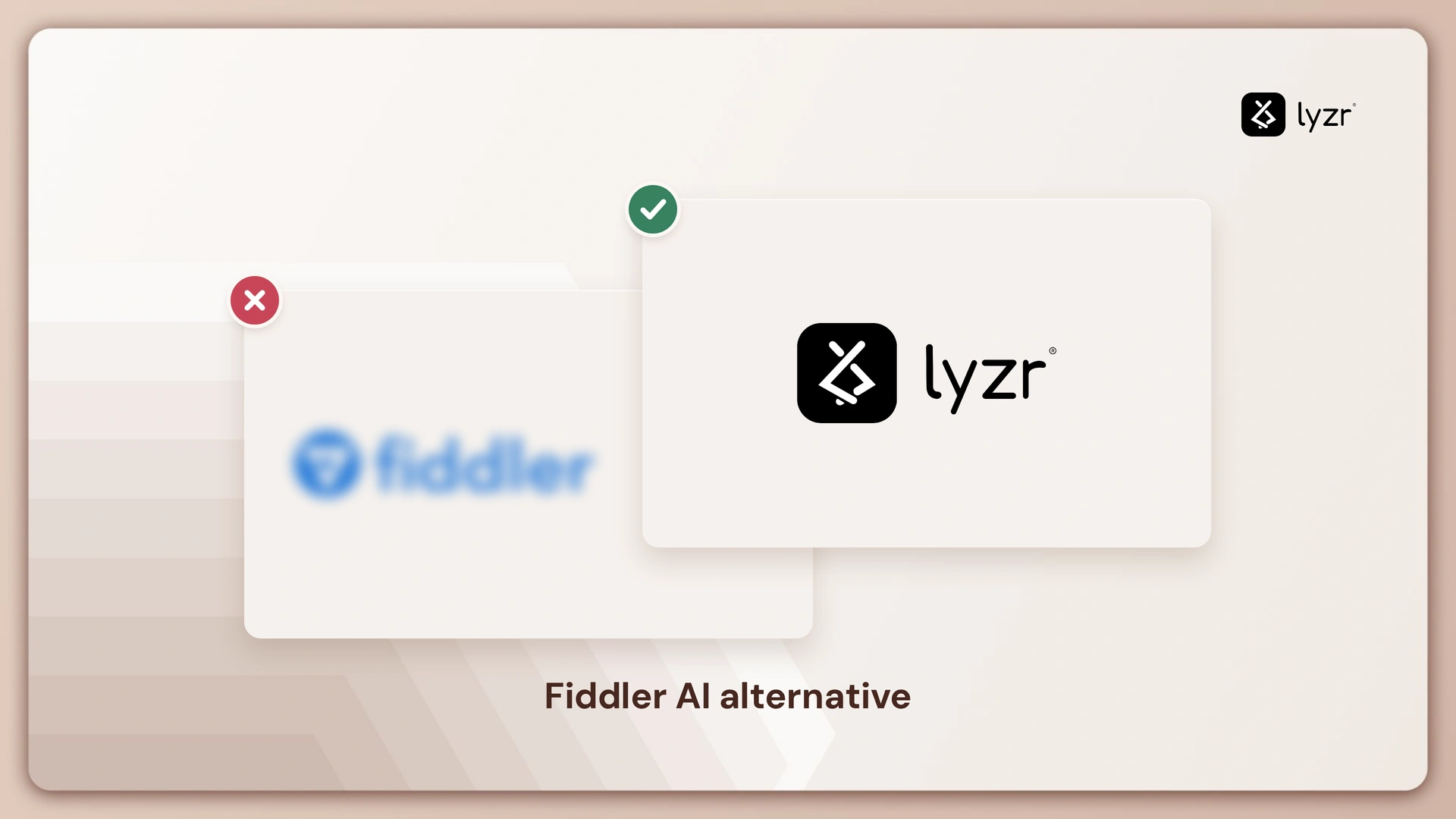
Let’s start with a fair look at where Fiddler stands today, then talk about why Lyzr Control Plane has become the go-to switch for teams running AI agents in production.
Where Fiddler AI Starts to Show Friction for Agentic AI
Fiddler AI built its reputation around AI observability for traditional machine learning, with strengths in model monitoring, drift detection, bias analysis, and explainability. More recently, it has expanded into LLM observability and guardrails to support generative AI.
The challenge is that these capabilities were added to a platform originally designed for tabular, single-inference ML models, while agentic AI follows a very different execution pattern.
| Traditional ML | Agentic AI |
| Single inference | Multi-step reasoning |
| Flat traces | Nested agent and tool execution |
| Feature drift | LLM-judge evaluations |
| ML metrics | Rubric-based quality evaluation |
As a result, teams may find that trace visualization, drift detection, and evaluation workflows feel better suited to traditional ML than complex AI agent workflows involving tool calls, retrieval, and agent handoffs.
None of this makes Fiddler a weak platform, it remains a strong choice for enterprise ML observability.
But organizations focused on deploying and governing AI agents may find themselves using a model-first platform for problems that are increasingly agent-first. Pricing is also enterprise-oriented, with annual contracts and usage-based costs that can grow as trace volume and evaluations increase.
What to Actually Look for in an Alternative
Before jumping to a recommendation, it’s worth being clear-eyed about what “better” should mean here. A genuine Fiddler alternative for agent-first teams should offer:
- Native agent lifecycle management: not observability retrofitted onto agents, but a platform built around how agents are actually deployed, versioned, and governed.
- Framework and cloud flexibility: the ability to manage agents built on different frameworks and deployed across different cloud environments from one place.
- Built-in governance, not bolted-on: security validation, approvals, and rollback as part of the deployment path itself, not a separate monitoring layer applied after the fact.
- Transparent, predictable operations: a clear registry of what’s running, who owns it, and what changed, without needing a dozen dashboards stitched together.
This is exactly the gap Lyzr Control Plane was built to close.
Why Lyzr Control Plane Is the Best Fiddler AI Alternative
Lyzr Control Plane takes a fundamentally different starting point than Fiddler. Instead of beginning with model monitoring and extending toward agents, it was designed from the ground up as a deployment and governance layer specifically for enterprise AI agents. Here’s what that looks like in practice.

A unified deployment layer across frameworks and clouds. Rather than forcing every team to build custom deployment pipelines for each framework or cloud environment they use, Lyzr Control Plane standardizes how agents move through the production lifecycle — regardless of which framework they were built on or which cloud they’re deployed to. For organizations running a mix of homegrown agents, third-party frameworks, and multiple cloud providers, this alone removes a huge amount of operational overhead.
Governance built into the deployment path, not layered after. Every agent deployment through Lyzr Control Plane follows a defined path: security validation, evaluation checkpoints, and approvals happen as part of shipping the agent, not as a separate audit process discovered after something’s already live. That includes deployment versioning and rollback capabilities baked directly into the workflow, so teams can move fast without losing the ability to step back if something goes wrong.
The Agent Registry: full visibility from one place. Once an agent is deployed, it’s automatically registered in the Lyzr Agent Registry, giving teams a single, centralized record of everything running across the organization, version, framework, target cloud, current status, and complete deployment history.

For platform teams and AI Centers of Excellence trying to answer “what agents do we actually have in production, and who’s accountable for them,” this is the kind of visibility Fiddler’s tabular-rooted architecture simply wasn’t designed to provide.
Identity-mapped governance. Agents aren’t just deployed — they’re evaluated, approved, and identity-mapped before going live, which matters enormously for security and compliance teams that need to know exactly what an agent can access and on whose authority it’s acting.
Built for the production gap, not the pilot phase. A lot of enterprise AI programs have proven they can build agents. The harder problem — the one that’s stalled progress for many teams — is reliably shipping those agents, securing them, and proving what they do once they’re live. Lyzr Control Plane was purpose-built to close that specific gap, rather than trying to stretch a classical ML monitoring tool to cover it.
Fiddler AI vs. Lyzr Control Plane: At a Glance
| Fiddler AI | Lyzr Control Plane | |
| Core design origin | Tabular ML observability, extended to LLMs | Purpose-built for AI agent deployment & governance |
| Best suited for | Classical ML monitoring, regulated model explainability | Multi-agent, multi-framework, multi-cloud production environments |
| Agent trace handling | Single-inference-oriented trace views | Native support for multi-step, tool-using agent workflows |
| Governance model | Monitoring and guardrails layered on top | Security validation, approvals, and rollback built into deployment |
| Visibility | Dashboards and drift/bias reporting | Centralized Agent Registry with full deployment history |
| Identity & access | Not a core focus | Identity-mapped governance by design |
| Pricing structure | Annual enterprise contracts with usage-based add-ons that scale with trace volume | Structured around agent deployment and governance needs |
Making the Switch
If your organization is still primarily scoring tabular models and occasionally dipping into LLM monitoring, Fiddler’s roots in classical ML observability may still serve you fine. But if your roadmap is agent-first, multiple frameworks, multiple clouds, and a growing need to prove governance and control over what’s actually running in production, Lyzr Control Plane is built for exactly that reality, not adapted to it after the fact.
The clearest sign it’s time to evaluate a switch: if you find yourself explaining to your team why a dashboard built for tabular drift doesn’t quite capture what your agents are doing, that’s not a configuration problem. It’s an architecture problem. And it’s the exact problem Lyzr Control Plane was designed to solve.
Book A Demo: Click Here
Join our Slack: Click Here
Link to our GitHub: Click Here