A customer support agent refunds the wrong customer. A finance agent approves an expense that violates policy. A procurement agent suddenly starts making 20 API calls instead of 3 ?
The problem isn’t that the agent made a mistake. The problem is that nobody knows WHY
Traditional software leaves behind logs. AI agents leave behind decisions.
And decisions are much harder to investigate.
A modern AI agent may:
- Call multiple LLMs
- Query a vector database
- Use external APIs
- Interact with other agents
- Execute workflows
- Store and retrieve memory
- Generate dynamic plans
When something goes wrong, the final response tells only part of the story.
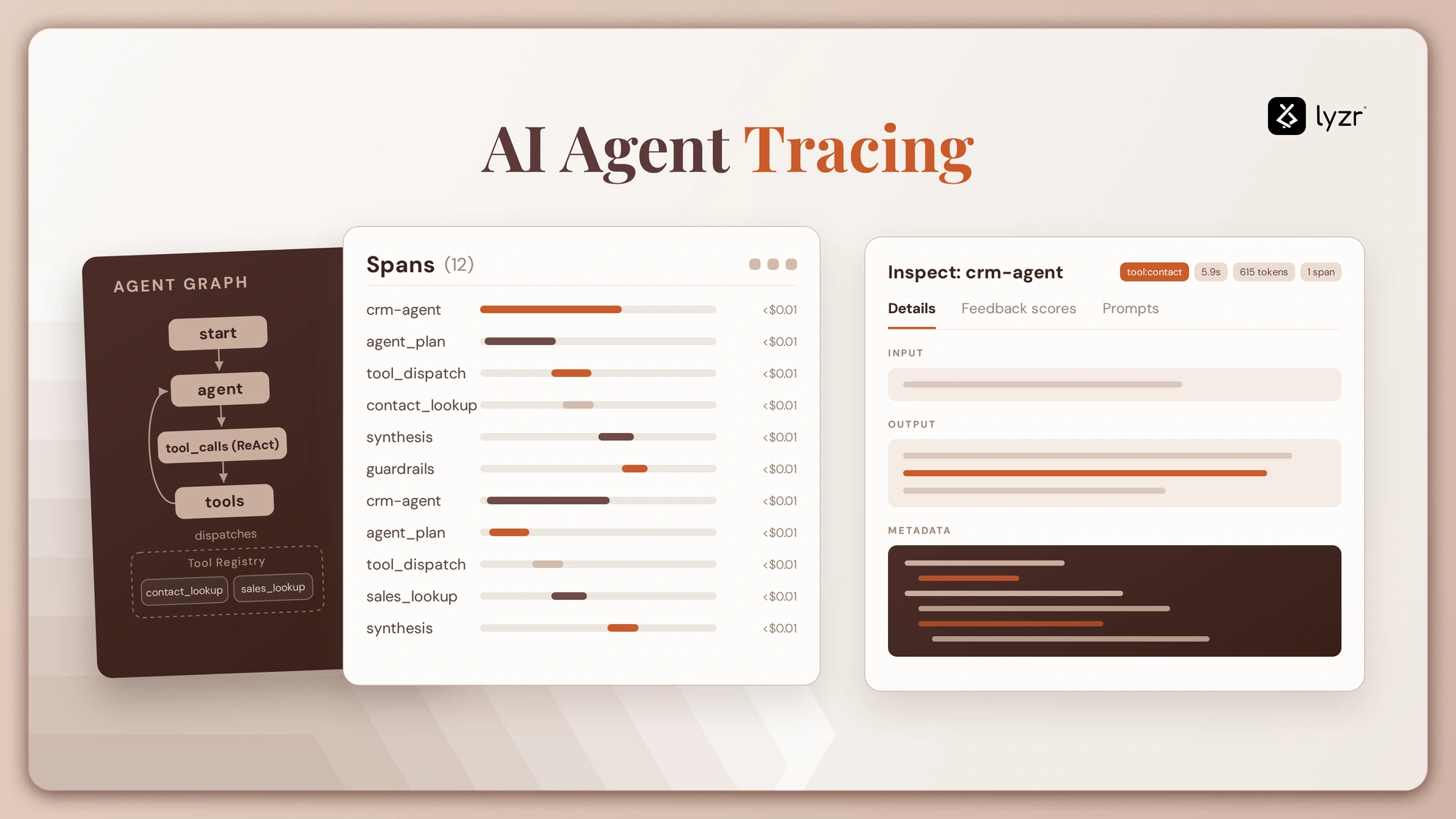
AI Agent Tracing exposes everything that happened between the user’s request and the agent’s output.
So What is AI Agent Tracing?
AI Agent Tracing records every action an agent takes while completing a task.
Think of it as the equivalent of distributed tracing for AI systems.
Instead of tracking requests across microservices, tracing tracks requests across:
- Models
- Agents
- Tools
- Retrieval systems
- APIs
- Memory layers
- Human approval checkpoints
Example

Why AI Agents Need a Different Observability Model
Traditional applications follow predictable execution paths. AI agents do not.
Two users can ask the same question and trigger entirely different workflows.
| Traditional Application | AI Agent |
| Fixed logic | Dynamic reasoning |
| Predictable workflow | Adaptive workflow |
| Same input → same path | Same input → different path |
| Debug with logs | Debug with traces |
| Limited decision making | Continuous decision making |
This is why conventional monitoring platforms often struggle with AI workloads. The challenge is no longer tracking infrastructure. The challenge is tracking decisions.
What Does an AI Agent Trace Actually Capture?
A production-grade trace typically captures five layers.
1. Request Context
| Field | Example |
| Request ID | req_9183 |
| Agent | Customer Support Agent |
| User Type | Enterprise Customer |
| Timestamp | 12:34 PM |
2. Planning & Reasoning

This layer explains why actions were selected.
3. Tool Execution
| Tool | Purpose | Latency |
| CRM API | Customer lookup | 400ms |
| Vector Database | Policy retrieval | 120ms |
| Billing API | Payment verification | 800ms |
4. Model Activity
| Metric | Value |
| Model | GPT-5 |
| Input Tokens | 2,100 |
| Output Tokens | 620 |
| Cost | $0.03 |
| Latency | 3.2 sec |
5. Final Outcome
| Event | Status |
| Workflow Completed | ✓ |
| Escalated to Human | No |
| Tool Failures | None |
| Confidence Score | 94% |
The Four Biggest Problems AI Agent Tracing Solves
Problem #1: Hallucinations

Problem #2: Tool Failures

Problem #3: Token Cost Explosions

AI Agent Tracing vs Traditional Application Tracing
| Capability | Traditional Tracing | AI Agent Tracing |
| API Monitoring | ✓ | ✓ |
| Service Dependencies | ✓ | ✓ |
| Tool Tracking | Limited | ✓ |
| Prompt Visibility | ✗ | ✓ |
| LLM Monitoring | ✗ | ✓ |
| Agent Decisions | ✗ | ✓ |
| Multi-Agent Handoffs | ✗ | ✓ |
| Token Analytics | ✗ | ✓ |
| Reasoning Visibility | ✗ | ✓ |
The Metrics Engineering Teams Monitor Most
| Metric | Why Teams Track It |
| Latency | Identify slow steps |
| Token Usage | Control cost |
| Tool Success Rate | Improve reliability |
| Agent Accuracy | Evaluate decisions |
| Escalation Rate | Measure workflow quality |
| Retrieval Quality | Reduce hallucinations |
| Agent Handoff Rate | Monitor multi-agent systems |
AI Agent Tracing Is Quickly Becoming a Production Requirement
As organizations move from pilots to production deployments, the questions change.
| Before Deployment | After Deployment |
| Can the agent complete the task? | Why did the agent make that decision? |
| Which model performs best? | Which tool caused the failure? |
| Does the workflow work end-to-end? | Why did latency increase? |
| Is the output accurate? | Why did costs spike? |
| Can we launch this agent? | Can we explain and audit this agent? |
The challenge shifts from building agents to operating them.
Tracing provides the visibility required to do that safely and efficiently.
What to Look for in an AI Agent Tracing Platform
Not every observability platform was designed for AI workloads.
Enterprise teams should evaluate whether a platform supports:
| Capability | Why It Is Needed |
| End-to-End Traces | View complete workflows |
| Prompt Tracking | Understand model behavior |
| Token Analytics | Monitor spending |
| Agent Version Correlation | Compare releases |
| Multi-Agent Visibility | Track handoffs |
| Audit Logs | Support governance |
| Real-Time Monitoring | Detect issues quickly |
Where Lyzr Fits
Tracing becomes significantly more valuable when it is connected to the broader AI agent lifecycle.
Organizations typically don’t just need to know:
What happened?
They also need to know:
Which version caused it?
Which agent owns it?
When was it deployed?
Which workflow is affected?
Lyzr approaches this through a combination of:
- Agent Registry
- Agent Versioning
- Governance Controls
- Enterprise Deployment Infrastructure
- Agent Monitoring and Observability
This gives teams visibility across the full lifecycle of an AI agent, from development and deployment to debugging and governance.
Final Thoughts
The evolution of AI agents is following a familiar pattern.
Applications needed logging.
Microservices needed distributed tracing.
AI agents need execution visibility.
As agents become responsible for customer interactions, operational workflows, compliance checks, and business decisions, organizations need a way to inspect every action, every tool call, and every reasoning step.
That’s exactly what AI Agent Tracing provides.
Book A Demo: Click Here
Join our Slack: Click Here
Link to our GitHub: Click Here