You have agents built on specific, powerful platforms and need to bring them under a single governance umbrella.
The direct answer is no. You cannot bring agents built inside closed platforms like SAP Joule or Salesforce’s Agentforce into OpenController by Lyzr, the control plane for enterprise AI agents.
Those systems are designed as walled gardens. Their agentic features are deeply integrated and not designed to be managed externally.
A control plane is the neutral layer that governs everything beneath it. For AI agents, OpenController is that layer.
But it needs something to hook into. It needs to see the agent’s code, its tool calls, and its decision-making process to do its job.
Closed platforms don't expose this.
Open Frameworks vs. Closed Platforms
This isn’t a limitation. It’s a fundamental distinction in architecture.
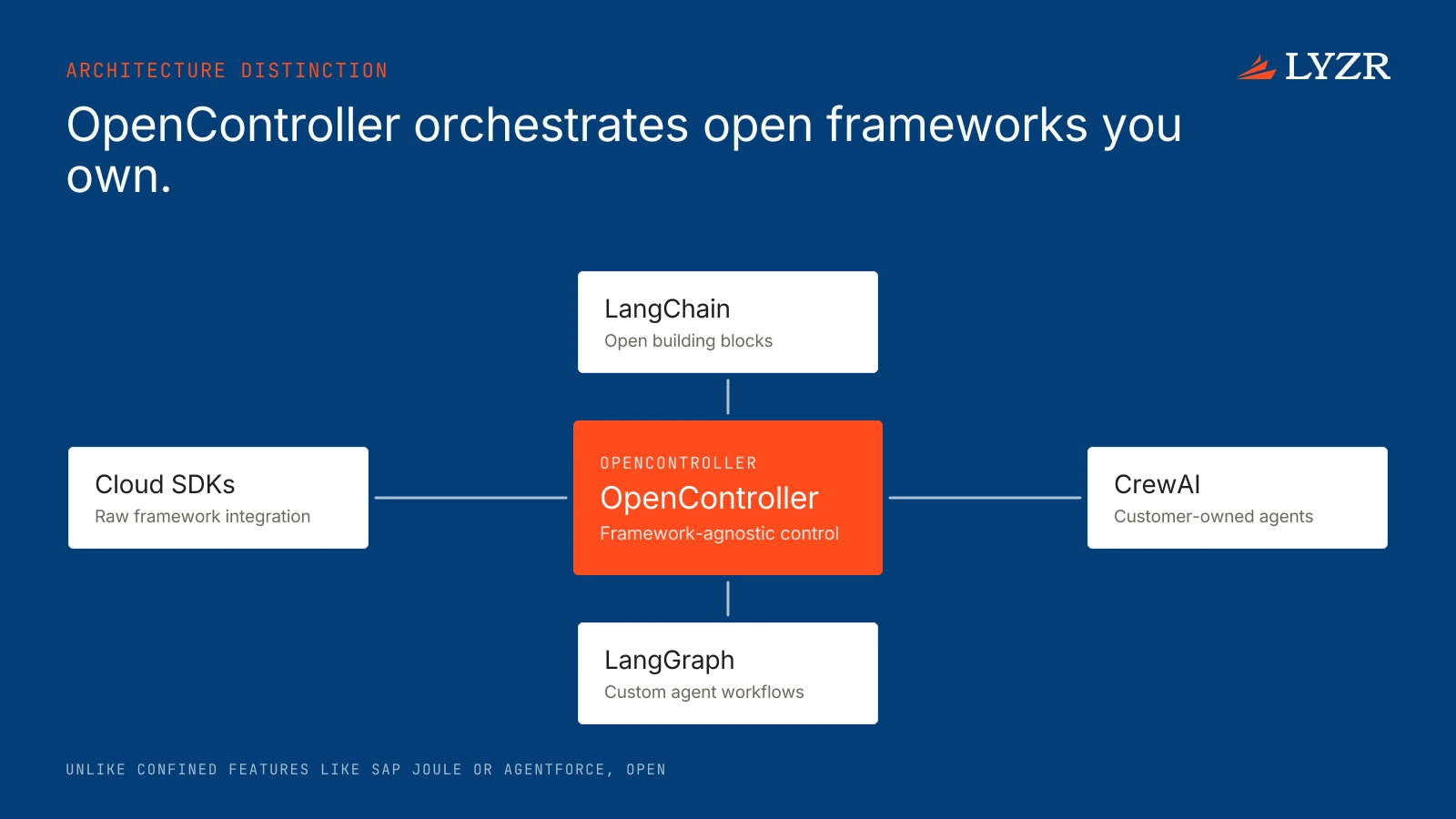
OpenController is framework-agnostic. It orchestrates agents built with LangChain, CrewAI, LangGraph, or even a raw cloud SDK.
These frameworks are open. They give you the building blocks.
You own the agent you build with them. Because you own it, you can choose to have it governed by a control plane.
SAP Joule is an embedded feature of SAP. It's part of the product.
Agentforce is part of Salesforce. They are powerful because they are pre-integrated.
But that integration is also what confines them. You can't take a feature from one product and ask another product to manage it.
Think of it like an iPhone app. You can’t take Apple's Maps app and run it on an Android phone.
The code is tied to the operating system.
The Right Way to Govern Interactions
Your goal isn't to literally move the agent. It's to ensure the work the agent does is observable, compliant, and controlled.
You can achieve this. Just not by importing the agent itself.
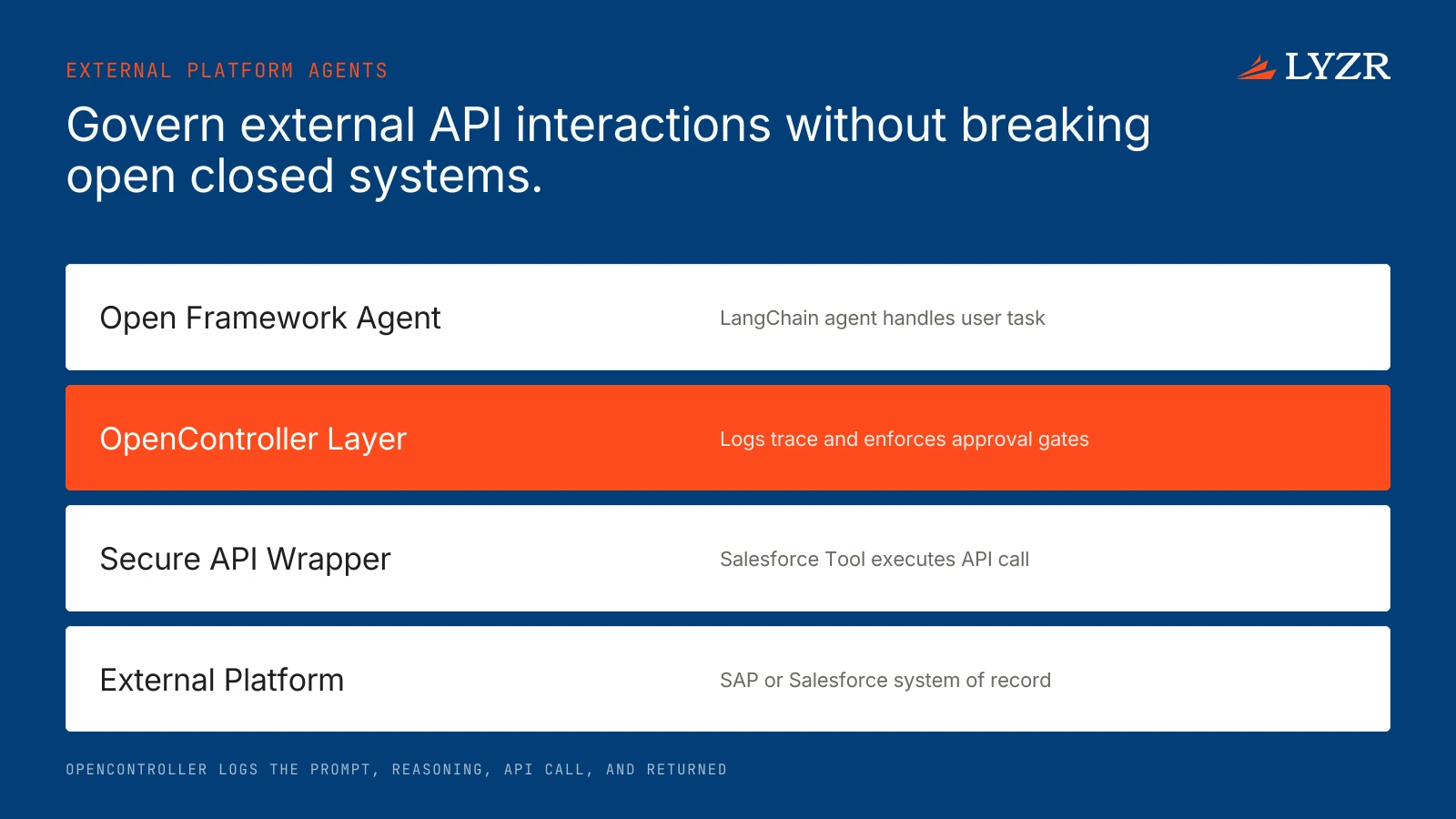
Instead, you build an agent on an open framework that OpenController can manage. Then, you give that agent a tool to call the SAP or Salesforce API.
The flow looks like this:
- A business user gives a task to an agent managed by OpenController.
- The agent, built on LangChain for example, determines it needs data from Salesforce.
- It uses a "Salesforce Tool" which is just a secure API wrapper.
- OpenController’s observability layer logs the entire trace: the initial prompt, the agent's reasoning, the exact API call made to Salesforce, and the data that came back.
- OpenController's governance rules can even enforce an approval gate before the agent is allowed to write data back to the platform.
Your agent remains governed. The interaction with the closed system becomes a fully-auditable event.
You get the control you need, without needing to break open a system that was never designed to be.
What to do next
Don't think about importing closed agents.
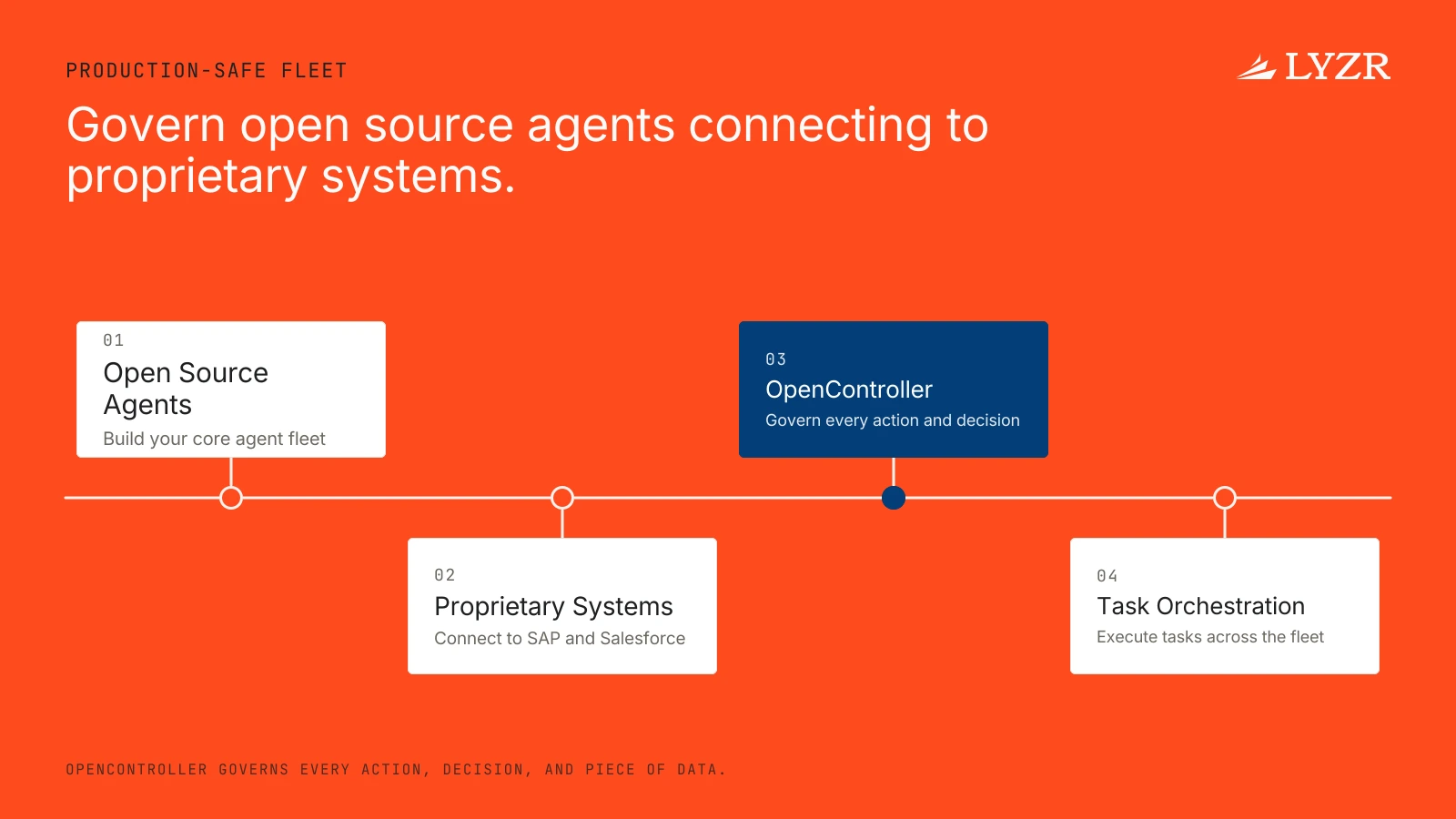
Think about orchestrating tasks.
Build your agents on open source. Give them tools to talk to your proprietary systems.
And place OpenController over the top to govern every action, every decision, and every piece of data.
That’s how you build a production-safe agent fleet.
If you’re trying to connect your agent strategy to platforms like SAP and Salesforce, let’s talk. We can show you exactly how it works.
Related questions
- Should a contact-center AI platform like Cognigy run alongside the control plane, or be built on Lyzr instead?
- How does Lyzr’s Control Plane connect to and govern external agents built on frameworks like LangChain?
Want to see how it fits your stack? Talk to us about OpenController by Lyzr.
Got a use case in mind?
8 weeks from use case to agents running in production.
Platform, people and FDEs, all in. Bring your environment. We'll co-build and stay until it's live.
Talk to UsFree resource
101 AI Agents Use Cases
100+ production-ready AI agent use cases across Marketing, Sales, HR, Banking, Insurance, Operations and a lot more
Download now