Connecting AI agents to your homegrown systems is fundamentally an integration challenge.
Especially when those systems lack a modern API gateway.
Lyzr integrates by governing "tools", custom connectors or SDK wrappers that you build to talk to your legacy systems. The data itself is staged in your own operational data store (ODS) or any environment you control, not ours.
OpenController by Lyzr, the control plane for enterprise AI agents, provides the governance framework for this exact scenario.
It's designed to secure the access layer, giving you full control over your data's location and preparation.
OpenController is Lyzr's answer to the control plane problem in enterprise AI: the governance layer between agent development and production.
How Do Agents Connect to a Legacy System?
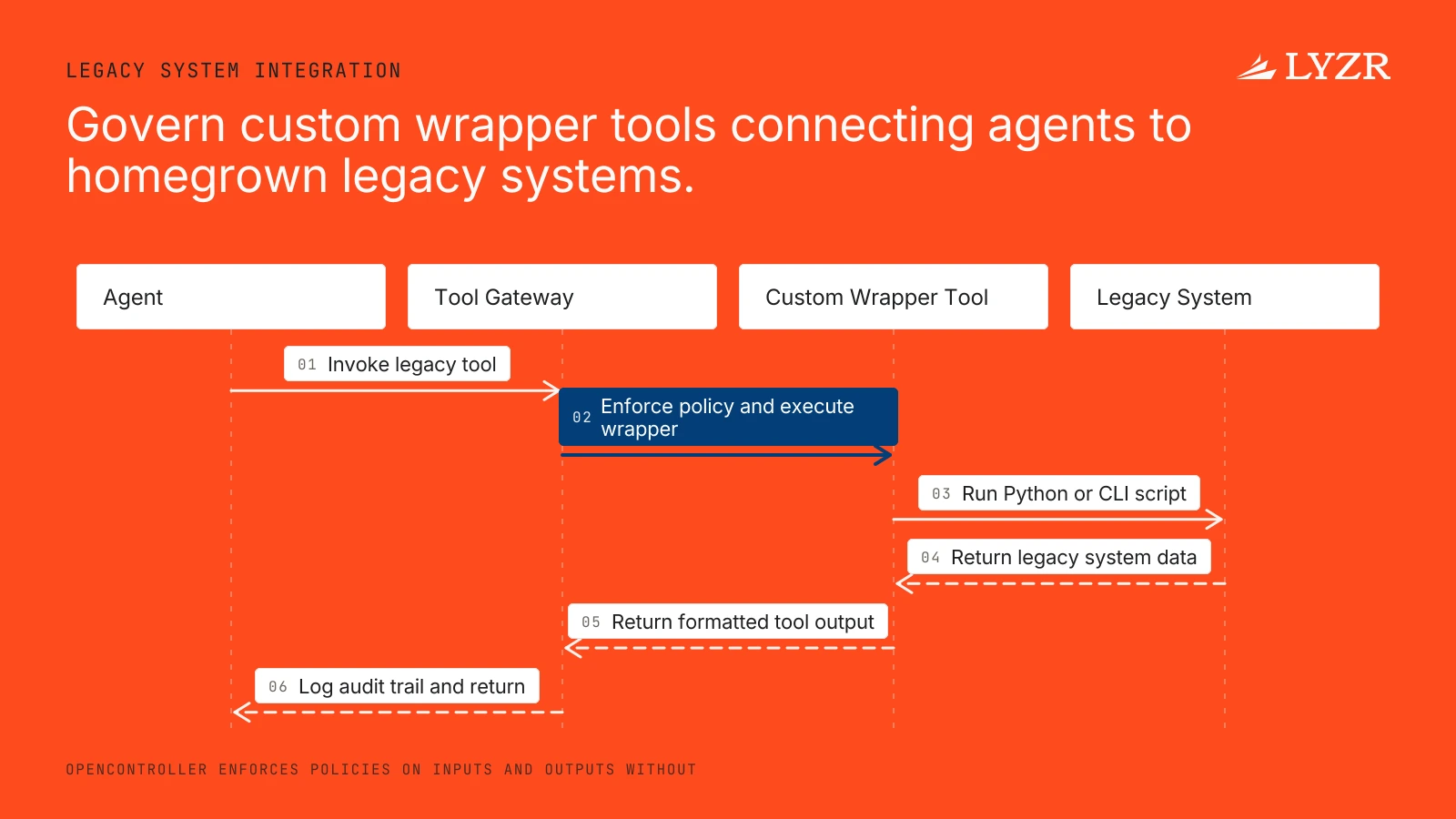
Agents connect via tools you create and OpenController governs.
An agentic application is a reasoning loop that uses tools to interact with the world.
A "tool" is just a function.
It can be a simple script that calls a REST API. Or it can be a more specific adapter for a system that has no API at all.
For a homegrown system, your team would build a small software wrapper that acts as the tool. This wrapper contains the logic needed to communicate with the legacy environment.
This could be:
- A Python function that connects directly to a database.
- A script that uses a proprietary SDK provided by the system's vendor.
- A process that interacts with a command-line interface.
- Even an adapter that performs secure screen-scraping for UI-only applications.
You own this tool. You control its logic.
OpenController doesn't need to know how the tool works internally. It only needs to manage the agent's ability to call it.
The control plane enforces policies on the inputs sent to the tool and the outputs received from it, generating a complete audit trail for every single action.
You Control the Data Staging Layer
Your data sits where you decide it should sit.
Lyzr does not provide a separate operational data store, and this is by design. Your architecture, your control.
The question mentioned curating data before agents use it, and creating a semantic layer. That is precisely the correct and secure workflow.
Lyzr's control plane fits into that workflow as the governance and observability component, not the data-hosting component.
The flow looks like this:
- Source System. Your homegrown, legacy application. The source of truth.
- Staging Environment. This is your operational data store. You run an ETL process to move required data from the source system into a dedicated, agent-accessible environment. This could be a sandboxed database, a cloud data warehouse, or a set of protected file stores.
- Curation & Semantics. In this staging environment, you clean, anonymize, mask, and structure the data. You create the semantic layer and metadata that makes the data intelligible and safe for an agent to use.
- Agent Tool. The tool you build for your agent is pointed only at this curated staging environment. It has no access to the raw production system.
- Governance. OpenController governs the agent's permission to use that tool. It provides the approval gates, policy enforcement, and observability needed to prove compliance and ensure safe operation.
This model keeps a hard line between data preparation and agent execution.
You maintain full data residency and control.
OpenController provides the proof that your agents are only accessing the data you've permitted, in the way you've permitted.
The Point Is Control, Not Custody
OpenController separates the agent's logic from the data's location.
We provide the governance for the former.
You maintain complete sovereignty over the latter.
This architecture ensures you can safely connect AI to your most critical systems, even the ones built decades ago, without compromising on security or control.
If you're building the bridge between your AI strategy and your core infrastructure, let's have a conversation.
Related questions
Want to see how it fits your stack? Talk to us about OpenController by Lyzr.
Got a use case in mind?
8 weeks from use case to agents running in production.
Platform, people and FDEs, all in. Bring your environment. We'll co-build and stay until it's live.
Talk to UsFree resource
101 AI Agents Use Cases
100+ production-ready AI agent use cases across Marketing, Sales, HR, Banking, Insurance, Operations and a lot more
Download now