Your Salesforce agent has no idea what your AWS agent is doing.
This isn't a bug. It's a feature of siloed platforms.
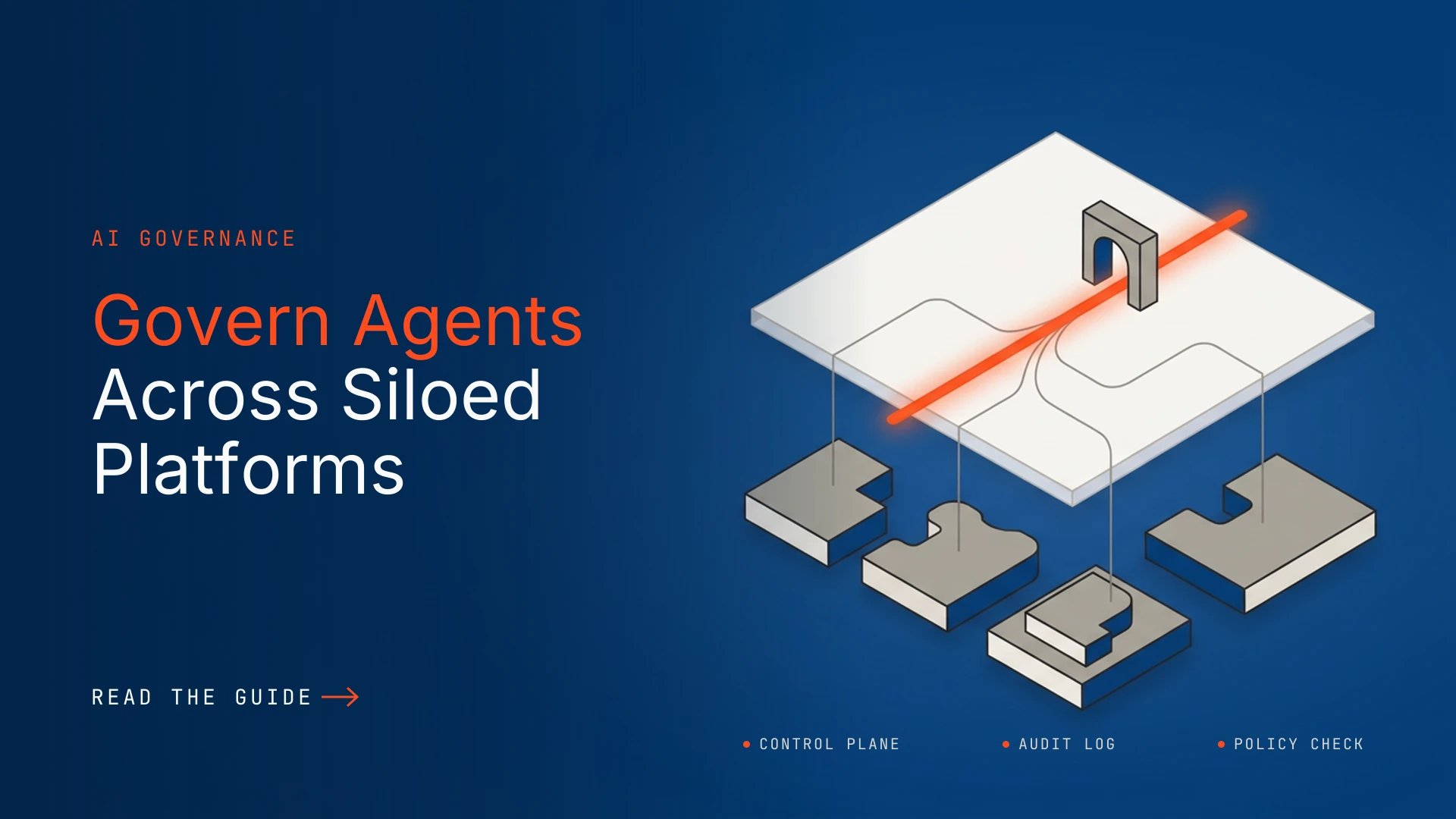
A single control plane governs them by sitting above these platforms, not inside them. It treats each environment, whether Salesforce, ServiceNow, AWS, or Google, as a resource to be managed.
This is accomplished by OpenController by Lyzr, a neutral control plane that works across agent frameworks.
A control plane is the neutral layer that governs everything beneath it. For AI agents, OpenController is that layer.
How a Neutral Plane Governs Siloed Agents
OpenController doesn't care where your agent lives.

It uses a lightweight SDK or API wrapper to instrument the agent's core functions.
Think of it as an interceptor.
- An agent in ServiceNow is invoked to create a ticket.
- The OpenController SDK wraps that invocation, logging the input and context.
- The agent decides to call a tool, perhaps another agent running on AWS to check cloud resource status.
- The SDK intercepts this tool call, checks it against governance policies, and logs the request.
- The AWS agent responds, and that response is also logged.
- The final output is passed through a policy check before being delivered.
All these events, from different clouds and SaaS platforms, are streamed to a single place.
They are standardized into a common format.
This gives you one set of policies, one audit log, and one observability view for every agent you run.
What This Unlocks for Platform Teams
When you govern from a neutral layer, you stop building bespoke controls for every new AI platform.

You get a single, unified governance posture.
Centralized Policy Enforcement.
Define one rule, like "require human approval before an agent deletes a production resource," and OpenController enforces it everywhere. This is how you build a compliant agent fleet that can safely handle sensitive data.
True End-to-End Observability.
If a user request triggers a chain reaction across three different platforms, you get one trace that shows the entire journey. You can finally debug and attribute costs for complex, multi-agent workflows.
Vendor and Framework Independence.
When Google or AWS releases a new agent-building service, you don't have to worry about a new governance blind spot.
You simply connect the new agents to OpenController. Your governance model is no longer tied to your infrastructure provider.
Frequently asked questions
Do we have to rebuild our existing agents to use this?
No. OpenController accepts agents built on any framework; nothing needs to be rebuilt. Integration happens via a lightweight SDK that wraps your existing agent logic, not by forcing a rewrite.
How does this affect agent performance or latency?
The overhead is minimal. The SDK is designed for high-throughput production workloads, and the calls to the control plane are asynchronous.
The added latency is typically measured in milliseconds.
Does this work with proprietary agent builders like Salesforce Einstein Copilot Builder?
Yes. The integration point is the agent's invocation and its tool-use capabilities.
As long as the agent can make an external API call (which our SDK provides), it can be governed by OpenController.
The One Takeaway
You cannot achieve unified governance from inside a silo. To control agents spread across Salesforce, AWS, and Google, you need a control plane that is independent of all of them.
If you're building a strategy for multi-cloud, multi-platform agentic AI, let's talk.
Want to see how it fits your stack? Talk to us about OpenController by Lyzr.
Got a use case in mind?
8 weeks from use case to agents running in production.
Platform, people and FDEs, all in. Bring your environment. We'll co-build and stay until it's live.
Talk to UsFree resource
101 AI Agents Use Cases
100+ production-ready AI agent use cases across Marketing, Sales, HR, Banking, Insurance, Operations and a lot more
Download now