Getting a unified view of agent activity is the real challenge, not building the agents themselves.
Your Microsoft Copilot agent has its own analytics, but it lives in a silo.
OpenController by Lyzr, the control plane for enterprise AI agents, observes it from the outside.
It treats your Copilot agent as another endpoint to govern, unifying its analytics with every other agent in your stack, regardless of how they were built.
Every production agent stack needs a control plane. OpenController is a framework-agnostic, cloud-agnostic one, built for enterprise governance.
How It Works: Observability Without Intrusion
OpenController doesn't need to be inside your Microsoft environment.
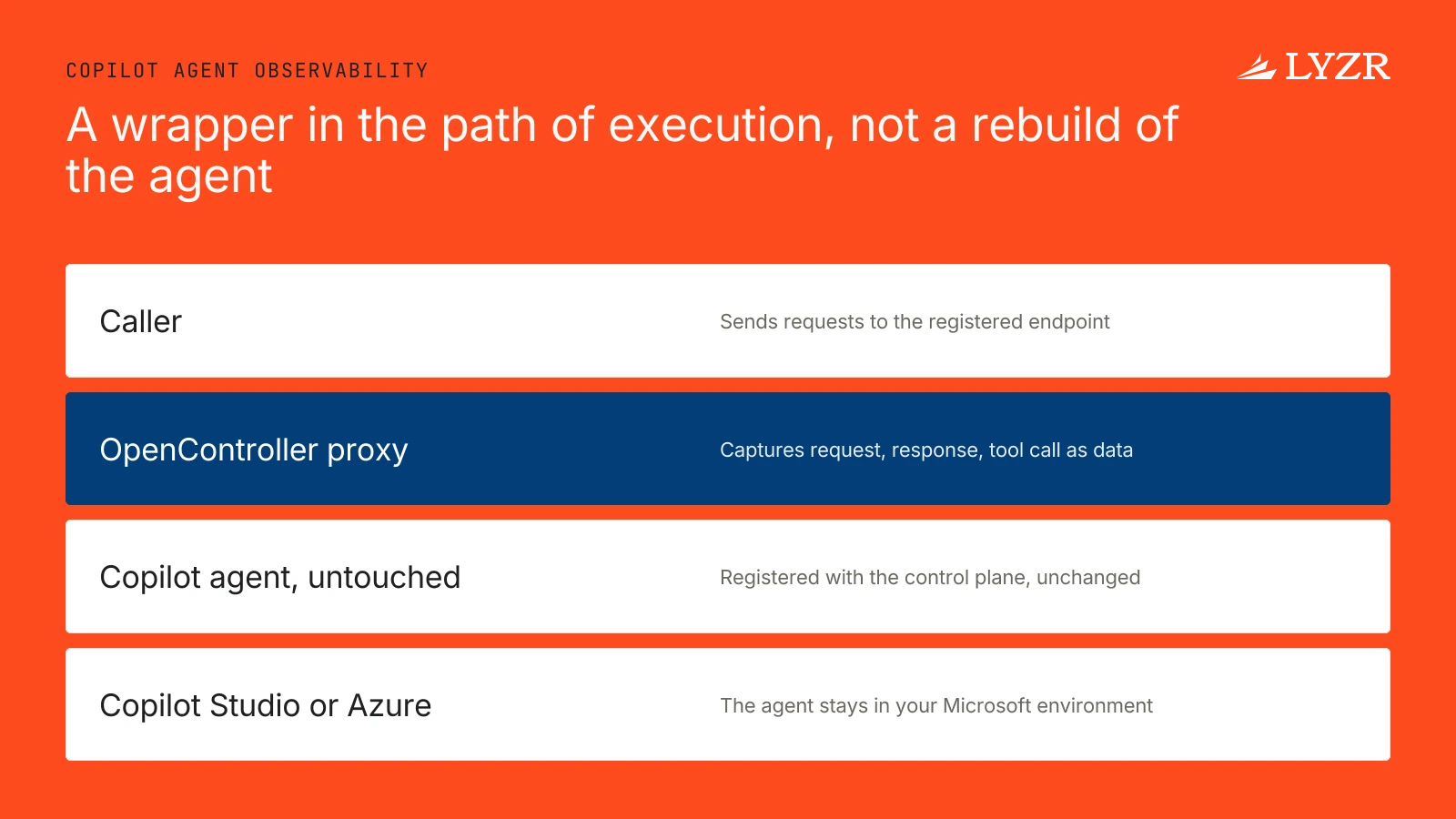
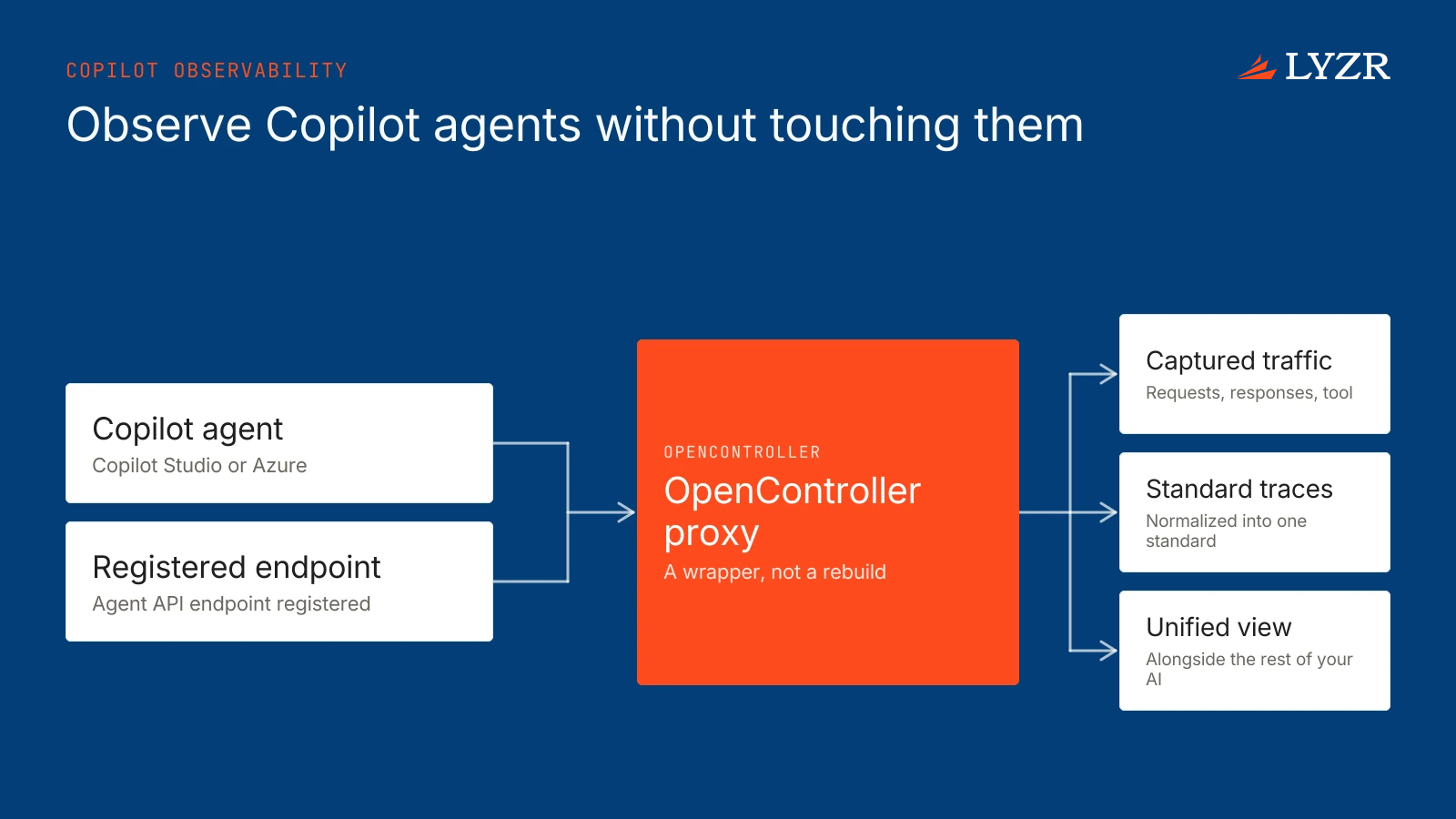
It works by proxying the agent's API endpoint.
You register your deployed Copilot agent with the control plane. All traffic to and from that agent is then routed through OpenController.
This is a wrapper, not a rebuild.
Because it sits in the path of execution, Lyzr's control plane captures every request, response, and tool call as structured data.
It sees the full context of every interaction.
The agent itself remains untouched in Copilot Studio or your Azure environment.
What You See: A Single Source of Truth
The native analytics inside Azure are deep, but specific to that platform.
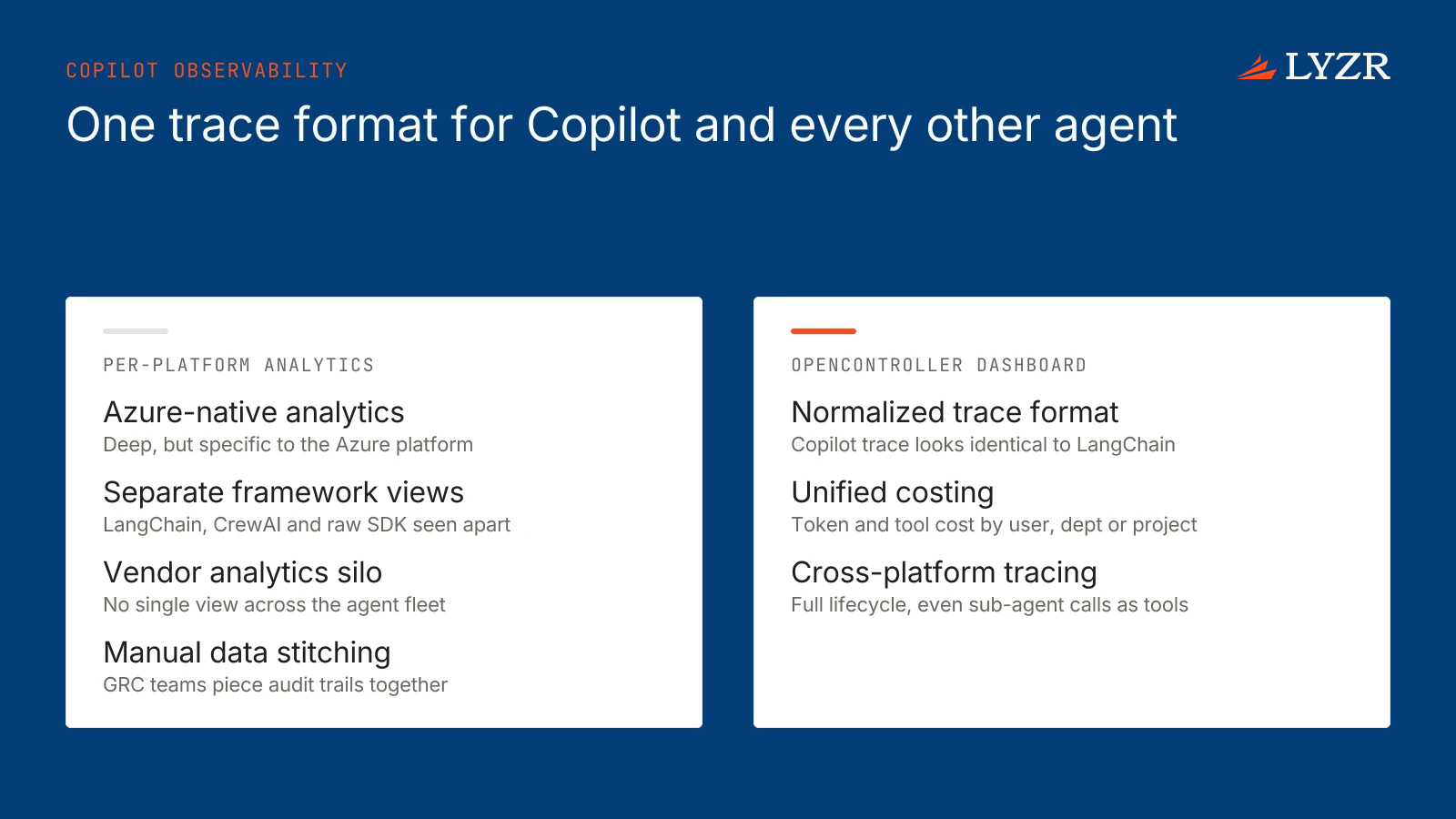
OpenController normalizes the data it captures from your Copilot agent.
It translates the agent’s activity into a standard format.
This means a trace from a Copilot agent looks identical to a trace from an agent built with LangChain, CrewAI, or a raw SDK in the OpenController dashboard.
This gives your platform and security teams one consistent view for:
- Unified Costing. Attribute token and tool costs back to a specific user, department, or project, no matter which agent they used.
- Cross-Platform Tracing. See the entire lifecycle of a request, even when your Copilot agent calls other sub-agents as tools.
- Consistent Policy Enforcement. Apply the same PII/PHI redaction, content moderation, and approval gates across your entire fleet of agents, including those from Microsoft.
- Standardized Auditing. Generate a single, coherent audit trail that proves compliance for all agent activity, satisfying GRC teams without manual data stitching. You can see how this applies to HIPAA, GDPR, and SOC 2.
You escape the vendor analytics silo and gain true fleet-wide governance.
Frequently Asked Questions
Do I have to rebuild my Copilot agent to use OpenController?
No. OpenController works with your agent's existing API endpoint. Your agent runs exactly as it does today, with no code changes required.
Does this replace the analytics in Microsoft Purview or Copilot Studio?
It complements them. The Microsoft tools give you deep, platform-specific diagnostics.
OpenController provides the high-level, cross-platform governance and observability layer that sees your entire AI agent fleet.
How is this different from using Azure API Management?
An API gateway sees raw HTTP traffic. OpenController understands the semantic structure of agent interactions.
It parses prompts, tool calls, and responses to provide agent-specific cost attribution, policy enforcement, and end-to-end tracing that a generic gateway cannot.
Unify Your View
The goal is not to replace your Microsoft tools.
It's to unify their observability with the rest of your AI stack.
See how a neutral control plane provides a single source of truth for agent governance. Let's talk.
Want to see how it fits your stack? Talk to us about OpenController by Lyzr.
Got a use case in mind?
8 weeks from use case to agents running in production.
Platform, people and FDEs, all in. Bring your environment. We'll co-build and stay until it's live.
Talk to UsFree resource
101 AI Agents Use Cases
100+ production-ready AI agent use cases across Marketing, Sales, HR, Banking, Insurance, Operations and a lot more
Download now