Choosing your agent infrastructure is a long-term bet on an ecosystem.
Microsoft Foundry and similar platforms are opinionated, full-stack environments for building agents. OpenController by Lyzr is different.
It is a neutral control plane that works across agent frameworks, designed to govern agents, not build them.
This separation of concerns is the key differentiator.
Every production agent stack needs a control plane. OpenController by Lyzr is a framework-agnostic, cloud-agnostic one, built for enterprise governance.
It means you can own your agent strategy, not rent it from your cloud provider.
Neutral Governance vs. Integrated Stacks
Platforms like Microsoft Foundry or Ark AI are designed to provide a cohesive, end-to-end experience for building, deploying, and evaluating agents within a single ecosystem.
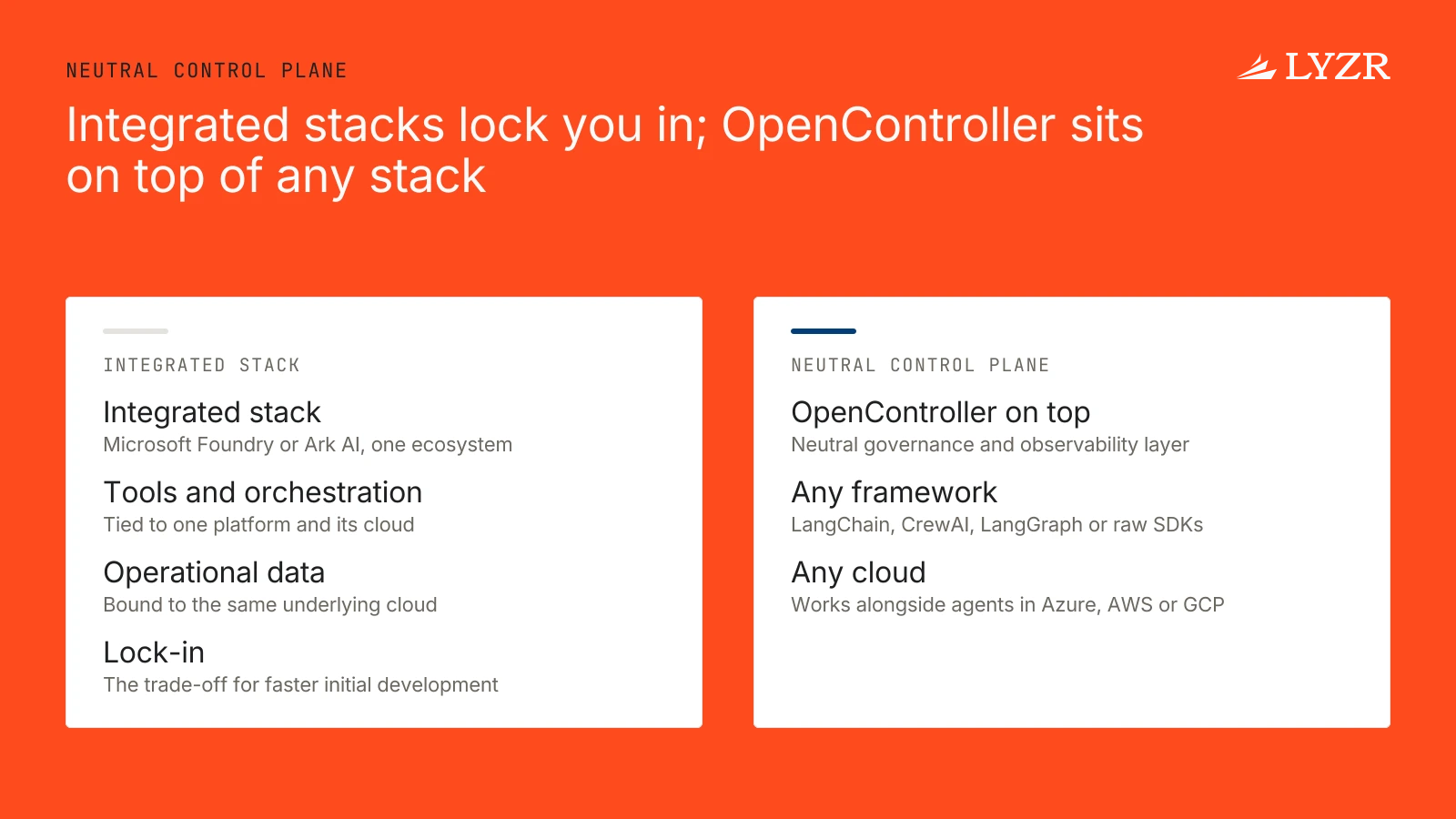
This integration accelerates initial development.
The trade-off is lock-in. Your tools, your orchestration logic, and your operational data become deeply tied to that specific platform and its underlying cloud.
OpenController by Lyzr takes the opposite approach. It is purpose-built to be the neutral governance and observability layer that sits on top of any agent stack, on any cloud.
You don't have to rebuild agents to use it.
It accepts agents built with LangChain, CrewAI, LangGraph, or raw SDKs. It works alongside agents running in Azure, AWS, or GCP.
This preserves your freedom to use the best tools for the job while standardizing how you control and observe them.
A Direct Comparison
| Capability | Microsoft Foundry / Ark AI | OpenController by Lyzr |
|---|---|---|
| Primary Focus | Full-stack: Build, deploy, run, evaluate | Decoupled: Govern, observe, secure |
| Frameworks | Optimized for platform-native tools | Agnostic: Works with any framework |
| Cloud Strategy | Integrated with a specific cloud (e.g., Azure) | Agnostic: Runs across any cloud |
| Architectural Goal | Vertical integration and development speed | Horizontal control and strategic portability |
| Lock-in | High. Couples building with governance | Low. Decouples governance from the build stack |
| Core Value | A faster way to build agents in one ecosystem | A consistent way to control all agents, everywhere |
What This Means for Your Platform Strategy
For platform and infrastructure teams, this distinction is critical.
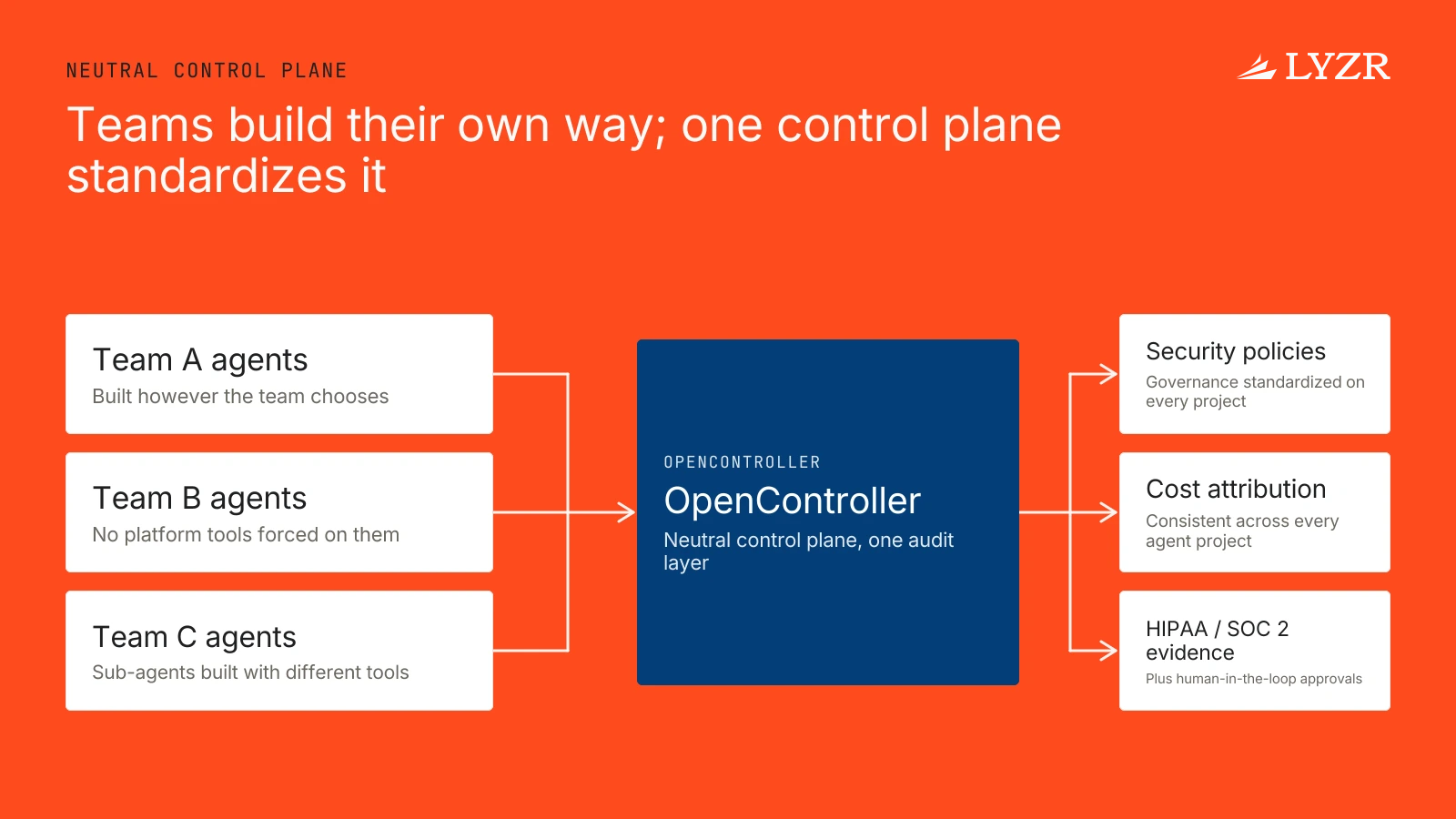
An integrated stack forces a choice on your development teams. To get the platform's benefits, they must use the platform's tools.
A neutral control plane provides optionality.
You can standardize governance, security policies, and cost attribution across every agent project, no matter how individual teams choose to build.
Security and compliance teams get a single, consistent audit layer. You can enforce human-in-the-loop approvals and generate the evidence needed to prove compliance with standards like HIPAA or SOC 2.
Observability becomes uniform. You get one way to see an end-to-end trace, even if an agent calls multiple sub-agents built with different tools.
The Takeaway
Foundry and other full-stack platforms answer the question of how to build agents within their ecosystem.
OpenController answers the question of how you control them in production, safely and at scale, without ceding that control to your build tools or cloud provider.
If you are building an agent strategy that needs to span multiple teams, frameworks, or clouds, let's talk.
Want to see how it fits your stack? Talk to us about OpenController by Lyzr.
Got a use case in mind?
8 weeks from use case to agents running in production.
Platform, people and FDEs, all in. Bring your environment. We'll co-build and stay until it's live.
Talk to UsFree resource
101 AI Agents Use Cases
100+ production-ready AI agent use cases across Marketing, Sales, HR, Banking, Insurance, Operations and a lot more
Download now