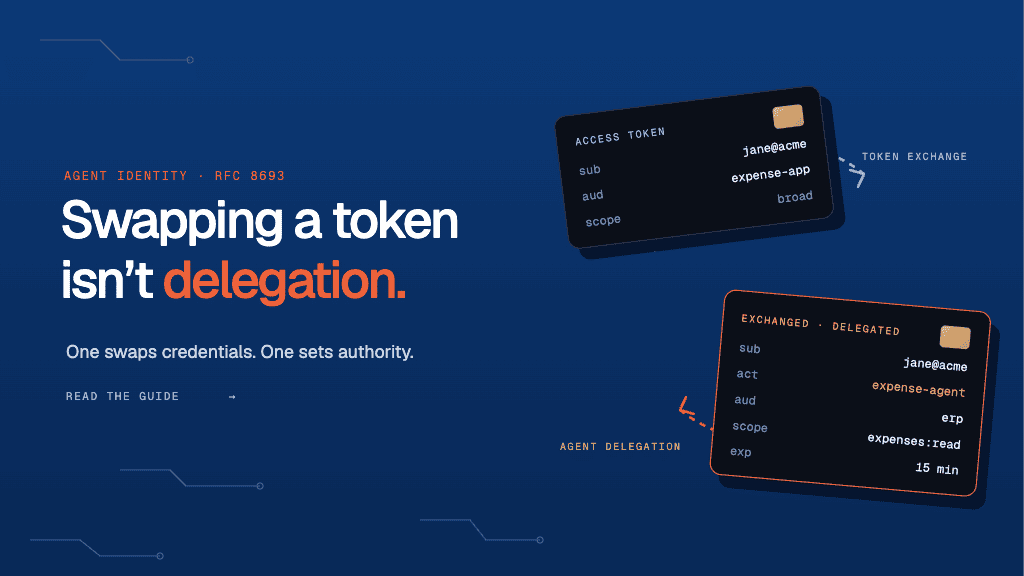
Consider an enterprise AI agent assigned to process an employee’s expense reports. To complete the task, it needs to retrieve expense records from an internal application, verify transactions against a finance system, and update approved claims in an ERP.
The employee already has access to these systems. But should the agent receive the employee’s credentials? Should it use its own service account? Or should it receive a temporary set of permissions that allows it to perform only the actions required for this particular task?
Each option creates a different security outcome.
Giving an agent broad access through a shared service account can expose data and operations beyond its actual responsibilities. Passing an employee’s access token directly between systems can create problems with audience restrictions, permissions, and trust boundaries. And granting an agent unrestricted authority to act on someone’s behalf makes it difficult to establish who approved an action and who actually performed it.
This is where two concepts enter the discussion: OAuth Token Exchange and Agent Delegation.
Both address how one system obtains authority to access another system. However, they operate at different levels of the identity and authorization architecture.
OAuth Token Exchange provides a standardized mechanism for exchanging security tokens. Agent Delegation is a broader architectural approach to assigning an AI agent limited authority to perform actions on behalf of a user, another agent, or an enterprise.
Understanding the distinction is important because enterprise AI systems increasingly involve multiple agents, applications, APIs, and identity providers. Securing the initial login is no longer enough. Enterprises also need to govern what happens after an agent receives permission to act.
1. Why traditional identity and access management becomes complicated with AI agents
Traditional enterprise applications generally have a relatively clear relationship between a user, an application, and the resources that application can access.
An employee logs in, receives an access token, and uses an application. The application checks the token and determines whether the requested operation is permitted.
AI agents introduce another participant into this relationship.
An agent can receive a task from a user, interpret the request, select the necessary systems, call APIs, invoke other agents, and continue executing actions without requiring the user to approve every individual step.
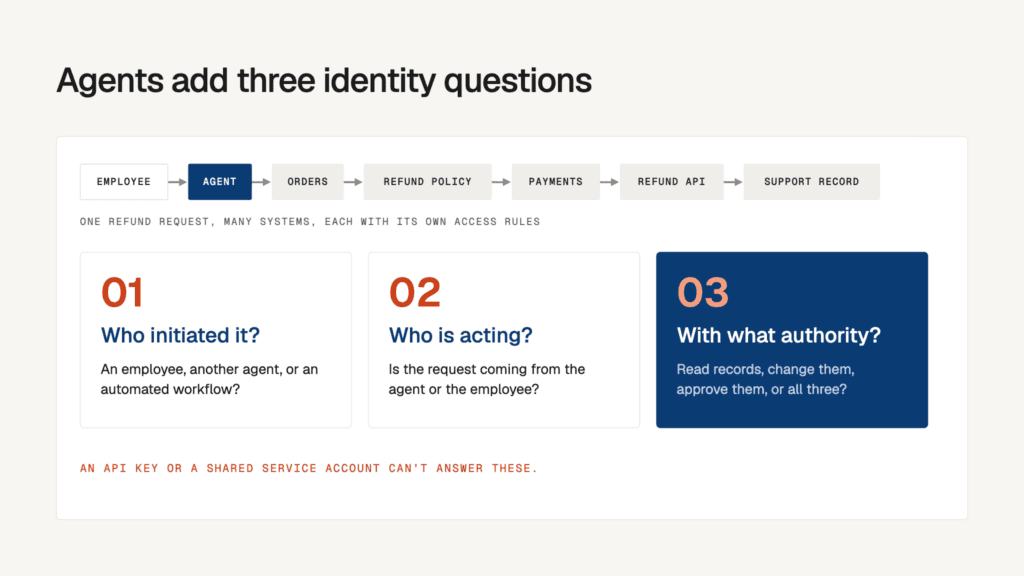
For example, consider an agent handling a customer refund:
- A customer support employee asks the agent to process a refund.
- The agent retrieves the customer’s order history.
- It checks the refund policy.
- It verifies the transaction with the payment system.
- It initiates a refund through an internal API.
- It updates the customer support record.
The agent interacts with multiple systems, each potentially having its own authentication and authorization requirements.
This creates three identity questions:
- Who initiated the task? Was it an employee, another agent, or an automated workflow?
- Who is performing the action? Is the request coming from the agent’s identity or the employee’s identity?
- What authority does the agent have? Can it read records, modify them, approve transactions, or perform all three?
These questions cannot be answered reliably by simply giving every agent an API key or a permanent service account.
Enterprises need to distinguish between the identity of the original requester, the identity of the agent performing the task, and the permissions granted for that task.
That distinction brings us to OAuth Token Exchange.
2. What is OAuth Token Exchange?
OAuth 2.0 Token Exchange is a standardized mechanism defined in RFC 8693. It allows a client to present an existing security token to an authorization server and request a different token.
The new token can have a different audience, scope, or token type, depending on the authorization server’s policies.
The central idea is simple: an application should not necessarily reuse the same access token when communicating with every downstream service.
Instead, it can exchange its existing token for one intended for the specific resource it needs to access.
How OAuth Token Exchange works
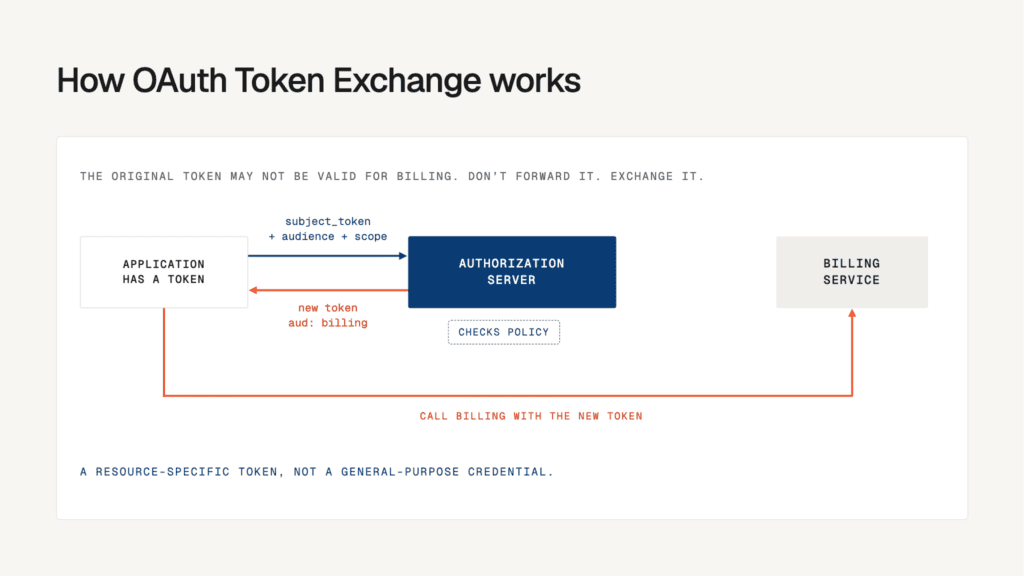
Suppose an employee uses an enterprise application that has permission to access an internal customer database. The application now needs to call a separate billing service on the employee’s behalf.
The original access token may not be valid for the billing service. Rather than forwarding it, the application requests a new token from the authorization server.
The flow looks like this:
- The application receives an existing access token.
- It sends a token exchange request to the authorization server.
- The request identifies the existing token as the subject_token.
- It specifies the intended audience and, where applicable, the requested scope.
- The authorization server validates the request against its policies.
- If authorized, it issues a new token for the target service.
- The application uses the new token to access that service.
The exchanged token is designed for the target resource rather than being a general-purpose credential.
The two important concepts: Impersonation and delegation
RFC 8693 makes an important distinction between impersonation and delegation.
These are different authorization semantics, and enterprises should understand both before designing agent identity flows.
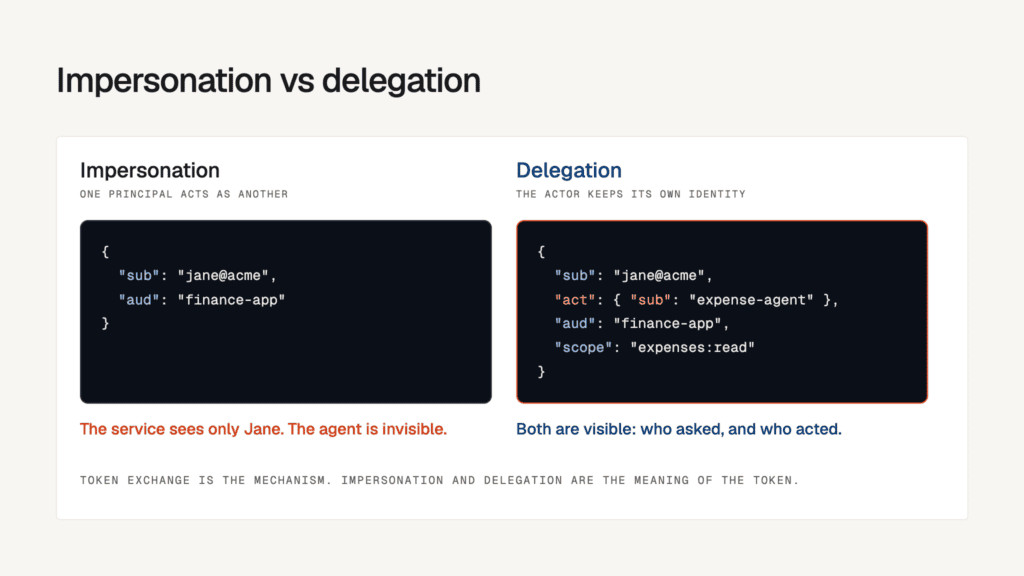
Impersonation
In an impersonation flow, one principal acts as another principal within a defined authorization context.
For example, an application might receive a token that identifies the employee as the subject. The downstream service sees the employee’s identity rather than the application’s separate identity.
This can simplify access to legacy systems, but it can also make it harder to distinguish the application performing the action from the employee whose identity it is using.
Delegation
In a delegation flow, the acting application retains its own identity while representing another principal.
The resulting token can carry information about both the original subject and the acting party.
For example:
- Subject: Employee requesting the operation.
- Actor: AI agent performing the operation.
- Resource: Internal finance application.
- Scope: Permission to retrieve specific expense records.
RFC 8693 supports this distinction through the subject_token and optional actor_token parameters. A JWT representing delegated authority can also use the act claim to identify the current actor.
This is particularly relevant to AI agents because enterprises need to know both whose request initiated an action and which agent actually executed it.
The important distinction: OAuth Token Exchange is the mechanism used to obtain a new security token. Impersonation and delegation describe the authorization semantics associated with that token.
3. What is Agent Delegation?
Agent Delegation is the practice of granting an AI agent authority to perform specific actions on behalf of another principal.
That principal could be:
- An employee initiating a task.
- Another AI agent assigning a subtask.
- An enterprise workflow.
- An application operating under an approved business process.
Unlike a conventional application that performs a fixed set of operations, an AI agent can make decisions about which tools, APIs, and systems it needs to interact with to complete a task.
Consequently, delegation needs to account for more than whether the agent has successfully authenticated.
It needs to establish the boundaries within which the agent can operate.
For example, an employee might authorize an agent to prepare a vendor payment report. The agent should be allowed to retrieve relevant invoices and calculate outstanding amounts. However, that permission should not automatically extend to approving payments, changing vendor bank details, or modifying financial records.
A well-designed delegation model therefore considers:
1. Delegator identity
Who authorized the agent to act? The original employee, another agent, or an enterprise workflow?
2. Agent identity
Which specific agent is executing the task? The system should be able to distinguish the agent from the user who initiated the request.
3. Delegated authority
What actions can the agent perform? Permissions should be defined around the task rather than granted through unrestricted access.
4. Resource boundaries
Which applications, APIs, databases, and records can the agent access?
5. Delegation duration
How long does the authorization remain valid? Can it be revoked when the task is completed or the original authorization changes?
6. Accountability
Can the enterprise trace the original request, the agent’s decisions, the resources accessed, and the actions performed?
This makes Agent Delegation a broader authorization and governance problem, not simply a method for issuing credentials.
How Agent Delegation works in practice
Consider an HR agent that processes employee leave requests.
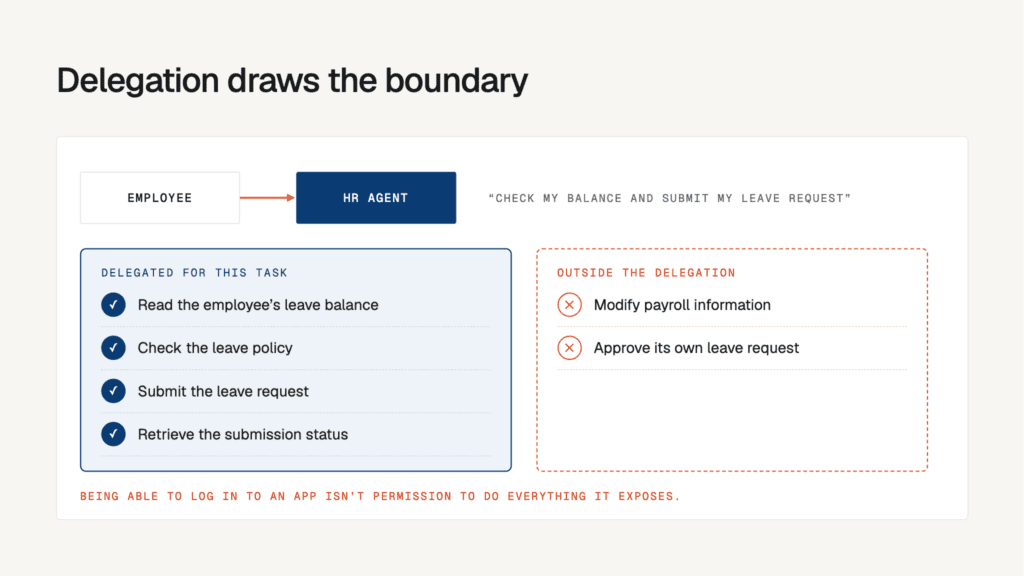
An employee asks the agent to check their leave balance and submit a leave application.
The agent needs permission to:
- Read the employee’s leave balance.
- Check the organization’s leave policy.
- Submit a leave request.
- Retrieve the submission status.
It does not need permission to modify payroll information or approve its own leave request.
A delegation model establishes the relationship between the employee, the agent, the requested task, and the permitted actions.
The agent then operates within those boundaries, using appropriate credentials to communicate with the underlying applications.
The important point is that the agent’s ability to authenticate with an application does not automatically mean it has permission to perform every operation that application exposes.
That separation between authentication and authorization becomes essential as enterprises deploy more autonomous agents.
4. OAuth Token Exchange vs Agent Delegation: What is the actual difference?
The two concepts are closely related, but comparing them as competing authentication protocols would be misleading.
OAuth Token Exchange is a standardized token issuance mechanism. Agent Delegation is a broader approach to defining and managing an agent’s authority.
An enterprise can use OAuth Token Exchange as part of its Agent Delegation architecture.
Here is how they compare.
| Evaluation criteria | OAuth Token Exchange | Agent Delegation |
| Primary purpose | Exchange an existing security token for a new one | Grant an agent authority to act on behalf of a principal |
| Scope | Token issuance and security context | Identity, authority, permissions, and accountability |
| Main participants | Client, authorization server, subject, optional actor, resource server | Delegator, agent, authorization system, resources, and potentially other agents |
| Identity representation | Subject and, where applicable, actor information | Original requester and executing agent identities |
| Permission management | Uses requested scopes and authorization server policy | Requires task-specific permissions and policy enforcement |
| Resource access | Can issue a token for a specific audience | Defines which resources and operations an agent may access |
| Delegation chains | Can represent actor relationships through token claims | Needs to manage authority across multi-agent workflows |
| Revocation | Depends on token and authorization-server implementation | Requires controls over active grants, sessions, and downstream credentials |
| Auditability | Provides token-level identity and authorization context | Requires end-to-end records of delegation and agent actions |
| Best suited for | Secure token exchange across services and trust boundaries | Controlling autonomous and semi-autonomous agent activity |
Which one should enterprises choose?
The answer depends on the problem being solved.
If an application needs a resource-specific token to communicate with a downstream API, OAuth Token Exchange provides a standardized mechanism.
If an enterprise needs to determine what an agent can do, on whose behalf it can act, how long its authority lasts, and how its actions are monitored, it needs an Agent Delegation model.
For many enterprise deployments, these capabilities should work together rather than be treated as alternatives.
OAuth Token Exchange can handle the credential transition, while delegation policies establish the authority that the agent is allowed to exercise.
5. Where the two approaches fit in an enterprise AI architecture
The difference becomes easier to understand when we look at an actual enterprise workflow.
Imagine an AI procurement agent that processes purchase requests.
An employee asks the agent to find an approved supplier, compare quotations, and prepare a purchase order.
The agent needs to access the procurement platform, vendor database, and ERP system.
The enterprise has two separate responsibilities:
- Establishing how the agent authenticates with each system.
- Determining what the agent is authorized to do within those systems.
This is where the two mechanisms work together.
Step 1: Establish the original identity
The employee authenticates through the organization’s identity provider.
The system establishes the employee’s identity and determines whether they are permitted to initiate procurement activities.
Step 2: Establish the agent’s identity
The agent operates under a registered identity that is distinct from the employee’s identity.
This allows the enterprise to distinguish between the person requesting an action and the agent executing it.
Step 3: Define delegated authority
The enterprise authorization layer determines what the agent can do.
For example, it might permit the agent to:
- Search approved suppliers.
- Retrieve vendor information.
- Compare quotations.
- Prepare a purchase order.
However, submitting a high-value purchase order or approving a payment might require additional authorization.
Step 4: Exchange tokens for downstream access
When the agent needs to access the ERP system, it requests a token intended for that specific resource.
OAuth Token Exchange can be used to obtain a new token with the appropriate audience and authorization context, provided the identity provider supports the required flow and policies.
Step 5: Enforce permissions at the resource
The ERP system validates the token and enforces its own authorization rules.
A valid token should not be treated as blanket permission to perform every operation.
Step 6: Record the complete activity
The enterprise records the original requester, agent identity, delegated permissions, token or session context, resource accessed, and action performed.
This creates an accountability trail that can be used for security reviews, investigations, and compliance requirements.
The distinction is important: token exchange helps the agent obtain appropriate credentials, while the enterprise’s delegation and policy architecture determines what the agent can actually do.
6. Evaluation checklist: What should enterprises look for?
Understanding the technical distinction is only the first step. The more important question is whether the identity architecture can support the complexity of production AI agents.
A solution that works for one agent calling one API may not be sufficient when multiple agents interact across departments, applications, and cloud environments.
Enterprises should evaluate their architecture against the following criteria.
| Evaluation area | What to evaluate | What good implementation looks like |
| Identity separation | Can the user and agent be identified independently? | Every action can be attributed to both the initiating principal and executing agent |
| Least-privilege access | Can permissions be restricted to specific tasks? | Agents receive only the permissions required for the assigned operation |
| Audience restriction | Are tokens issued for specific resources? | A token intended for one service cannot be indiscriminately reused elsewhere |
| Delegation boundaries | Can an agent’s authority be limited? | Permissions are constrained by task, resource, and operation |
| Token lifecycle | Are tokens short-lived and appropriately managed? | Expired, compromised, or unnecessary credentials cannot remain usable indefinitely |
| Multi-agent delegation | Can the system track authority across agent-to-agent interactions? | The original delegator and each acting agent remain identifiable |
| Human approval | Can sensitive actions require additional authorization? | High-impact actions are gated by explicit approval policies |
| Revocation | Can access be withdrawn when circumstances change? | Active grants and associated credentials can be invalidated or restricted |
| Auditability | Can actions be reconstructed? | Logs capture identities, permissions, decisions, and resource activity |
| Policy enforcement | Can controls operate across different environments? | Policies are consistently applied across the enterprise’s agent estate |
A useful way to evaluate these capabilities is to move beyond the question, “Does our identity provider support OAuth?”
Instead, ask: Can we prove that every agent has the right authority, for the right task, at the right time, and that every action is attributable?
That is a much stronger test of enterprise readiness.
7. Put your enterprise architecture to the test
Here is a practical exercise for security architects, platform engineers, and enterprise AI teams.
Consider the following scenario:
A finance employee asks an AI agent to review an invoice, verify the vendor’s bank details, and prepare a payment request.
The agent has access to the finance application, vendor database, and ERP system.
Now evaluate the following decisions.
Scenario-based assessment
Question 1: The agent needs to retrieve invoice details from the ERP system.
Which approach addresses the need to obtain a resource-specific access token?
- A. Give the agent the employee’s original access token.
- B. Use OAuth Token Exchange to request a token for the ERP resource.
- C. Give every agent the same permanent administrator credential.
Correct answer: B. OAuth Token Exchange can issue a token for a specific audience, subject to authorization-server policy. Reusing the original token or sharing an administrator credential introduces unnecessary access risk.</text>
Question 2: The agent needs to prepare a payment request but should not approve the payment.
What should the enterprise implement?
- A. Give the agent the same permissions as the finance employee.
- B. Allow the agent to perform every action supported by the ERP API.
- C. Define delegated permissions that allow preparation but restrict approval.
<text>Correct answer: C. Delegated authority should reflect the actual task. Preparing a payment request and approving a payment are separate operations and should have separate authorization requirements.</text>
Question 3: A second agent is assigned to validate the vendor’s bank details.
What should the enterprise be able to establish?
- A. Only whether the second agent successfully authenticated.
- B. Which agent initiated the delegation, which agent performed the validation, and what permissions it received.
- C. Whether both agents share the same service account.
<text>Correct answer: B. Agent-to-agent workflows need traceable identity and delegation relationships. Authentication alone does not establish accountability.</text>
Question 4: The employee’s authorization is withdrawn while the agent is still processing the request.
What should happen?
- A. The agent should continue because it already received its initial token.
- B. The enterprise should have a mechanism to revoke or restrict the active delegated authority and associated credentials.
- C. The agent should retain access until its service account is manually deleted.
Correct answer: B. Revocation needs to account for active grants, sessions, and issued credentials. Token expiry alone may not provide immediate revocation.</text>
The purpose of this exercise is to identify where authentication ends and governance begins. Even if an enterprise has a well-configured OAuth implementation, it may still lack the controls needed to manage an autonomous agent’s complete lifecycle.
That leads to the next challenge: making these controls work across the entire agent ecosystem.
8. Why enterprise agent governance needs to go beyond token management
Token exchange and delegated permissions address important parts of agent security. However, managing credentials is only one layer of the problem.
As enterprises deploy agents across different teams, frameworks, cloud environments, and applications, they need to answer additional questions:
- Which agents are operating across the organization?
- Who owns each agent?
- What applications and data can each agent access?
- Which policies govern its execution?
- Can an agent be stopped or restricted when it violates a policy?
- Can security teams investigate its activity across environments?
These questions become harder when agents are developed independently and connected to different identity providers and application ecosystems.
A centralized identity provider may issue tokens, but it does not automatically provide complete visibility into every agent’s deployment, runtime activity, access patterns, and policy compliance.
This is why enterprises need to connect identity and authorization with broader agent governance.
Where Lyzr OpenController fits
<text weight=”semibold” color=”default”> <Entity value=”Lyzr OpenController” category=”software” disambig=”Enterprise AI agent governance and control plane”/> </text> addresses the operational governance layer of enterprise AI agents.
Rather than treating agent security as an isolated authentication problem, OpenController provides a centralized control layer for discovering, governing, monitoring, and managing agents across environments.
Its role is particularly relevant when enterprises need to:
- Discover agents: Identify agents, models, tools, data, and workflows operating across the enterprise.
- Enforce policies: Apply governance controls to agent execution rather than relying only on documented security policies.
- Control access: Manage permissions and the conditions under which agents can operate.
- Monitor activity: Observe agents, applications, APIs, and infrastructure in production.
- Investigate actions: Connect agent activity with operational and security signals to understand what happened.
This distinction matters. OAuth Token Exchange helps establish the security credentials needed to access downstream resources. Agent Delegation establishes the authority an agent receives. OpenController addresses the wider challenge of governing the agent estate in which these identities, permissions, and actions operate.
Enterprises need all three layers to work together.
Explore Lyzr OpenController to learn more about governing enterprise AI agents across environments.
9. Best practices for implementing secure agent delegation
A sound architecture needs more than a token exchange endpoint and a set of permission rules. Enterprises should establish consistent controls that apply throughout an agent’s execution lifecycle.
Start with separate identities for users and agents
An AI agent should have an identifiable principal of its own. Avoid relying on shared credentials that make it impossible to determine whether an employee or an agent performed an action.
Apply least privilege at the task level
Do not grant an agent access to an entire application simply because it needs one capability within that application.
Define permissions around specific resources and operations. Reading an invoice, modifying a vendor record, and approving a payment should be treated as distinct authorization decisions.
Restrict tokens to their intended audiences
Use resource-specific tokens rather than forwarding credentials across unrelated services. Validate token audience, issuer, expiry, and relevant authorization claims.
Set clear delegation lifetimes
Delegated authority should have a defined duration. Where appropriate, tie its validity to the task, user session, or business process that initiated it.
Maintain delegation provenance
When one agent assigns work to another, preserve the original delegation context. Enterprises should be able to reconstruct the chain of authority rather than seeing only the identity of the last agent in the workflow.
Introduce human approval for high-impact actions
Not every operation needs human intervention. However, financial approvals, sensitive data changes, access modifications, and other high-impact operations should have explicit authorization requirements.
Make revocation part of the architecture
A secure system should have a defined way to withdraw delegated authority, terminate active sessions, and handle previously issued credentials. Do not assume that disabling an agent or waiting for token expiry is sufficient in every situation.
Monitor the entire execution path
Record who initiated the task, which agent executed it, what permissions were used, which resources were accessed, and what actions were performed. Connect these records so that security teams can investigate complete workflows rather than isolated API requests.
Together, these practices create an authorization architecture that can support autonomous execution without sacrificing enterprise accountability.
Conclusion: The question is not just who can authenticate, but who has the authority to act
OAuth Token Exchange and Agent Delegation solve related but different problems.
OAuth Token Exchange provides a standardized way to obtain security tokens for downstream resources, including tokens with delegation semantics. Agent Delegation establishes the broader relationship between a principal, an agent, and the authority granted to that agent.
For enterprises deploying AI agents, treating these as interchangeable concepts creates gaps in identity, access management, and accountability.
A secure implementation needs to establish distinct user and agent identities, restrict authority to specific tasks, issue appropriately scoped credentials, preserve delegation context, and maintain visibility into every action.
And as agent deployments expand across enterprise environments, these controls must extend beyond individual authentication flows.
The goal is not simply to allow agents to access enterprise systems. It is to ensure that every agent operates with clearly defined authority, under enforceable policies, and with an accountable record of what it does.
Book A Demo: Click Here
Join our Slack: Click Here
Link to our GitHub: Click Here
Got a use case in mind?
8 weeks from use case to agents running in production.
Platform, people and FDEs, all in. Bring your environment. We'll co-build and stay until it's live.
Talk to UsFree resource
101 AI Agents Use Cases
100+ production-ready AI agent use cases across Marketing, Sales, HR, Banking, Insurance, Operations and a lot more
Download now