TL;DR
- B2B sales means one business sells products or services to another business, not to an individual consumer.
- The process still runs through five stages: prospecting, qualification, discovery, proposal, and close.
- In 2026, AI agents execute large parts of each stage instead of just assisting reps.
- Three generations of sales tech now coexist: traditional, AI-augmented, and AI-native agentic.
B2B sales is the process of one company selling products or services to another company, rather than to an individual buyer. That single distinction changes everything downstream: who is involved in the decision, how long it takes, what it costs, and now, how much of the work is done by a person versus an agent.
This guide covers what B2B sales means, how it differs from B2C, the five stages of the process, real examples across industries, the biggest challenges teams face, and the AI-native shift reshaping how sales teams operate in 2026.
What is B2B sales?
B2B sales is short for business-to-business sales: one company selling directly to another company rather than to a private individual. The buyer is an organization, and the purchase decision usually runs through a group rather than one person.
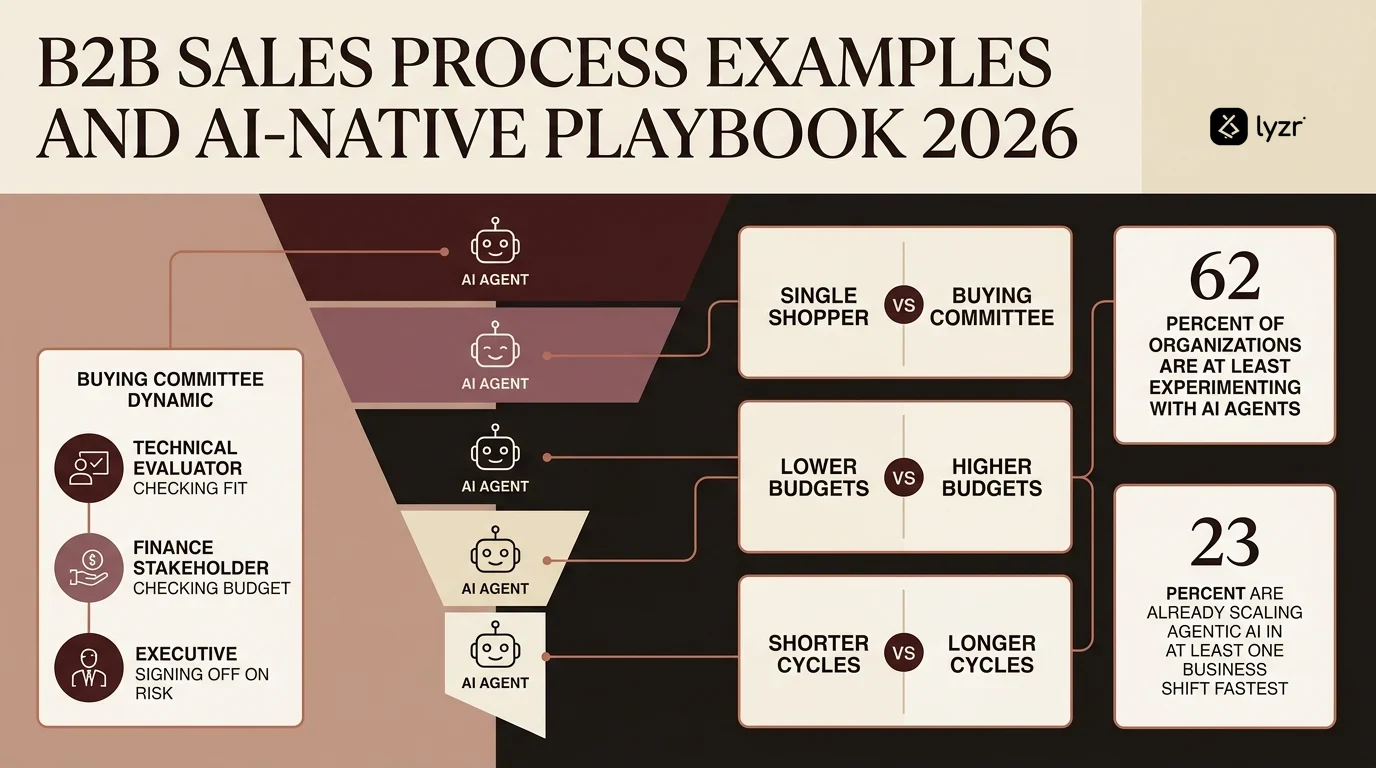
That group dynamic is what makes sales to businesses fundamentally different from selling to consumers. A single deal can involve a finance stakeholder checking budget, a technical evaluator checking fit, and an executive signing off on risk. Budgets run higher. Cycles run longer. The buying committee, not one shopper, decides.
What has changed by 2026 is not the definition. It is the execution. According to McKinsey’s State of AI 2025 survey, 62 percent of organizations are at least experimenting with AI agents, and 23 percent are already scaling agentic AI in at least one business function. Sales is one of the functions absorbing that shift fastest, and the rest of this guide shows exactly where.
B2B sales vs B2C sales: 4 key differences
B2B sales and B2C sales solve different buying problems, and four differences explain most of the gap.
Target audience. B2B buyers evaluate a purchase against business outcomes: cost savings, risk reduction, or revenue growth. B2C buyers make personal decisions, often driven by price, convenience, or brand preference.
Sales cycle length. A B2B deal can take weeks or months and pass through several approvers before a signature. A B2C purchase is usually decided in minutes by one person.
Price point. B2B contracts commonly run from the low thousands into seven figures for enterprise software or equipment. B2C purchases typically sit in the tens to low thousands of dollars.
Content and proof. B2B buyers expect case studies, live demos, and ROI models before they commit budget. B2C buyers respond to reviews, social proof, and a fast checkout.

B2B vs B2C sales at a glance
| Dimension | B2B sales | B2C sales |
|---|---|---|
| Decision maker | Buying committee, multiple stakeholders | Individual consumer |
| Typical cycle | Weeks to months | Minutes to days |
| Typical price point | Low thousands to seven figures | Tens to low thousands of dollars |
| Proof required | Case studies, demos, ROI models | Reviews, social proof |
The B2B sales process: 5 stages with AI applications
The B2B sales process breaks into five stages, and in 2026 nearly every one of them has an AI layer running underneath the human workflow.
Prospecting
This is the search for accounts that match your ideal customer profile (ICP), the description of the company most likely to buy and succeed with your product. The first step in the B2B sales process is often lead generation and prospecting. A sales engagement solution can help teams organize prospect interactions, automate outreach and follow-ups, and keep communication consistent throughout the sales process. Finding prospects that fit that profile has traditionally meant list-building against a database like ZoomInfo, sometimes paired with LinkedIn lead generation agencies for outreach at scale. In 2026, autonomous prospecting agents such as Jazon, Lyzr’s AI SDR, do this work directly: reading intent signals, building lists, and drafting first-touch outreach without a rep opening a spreadsheet.
Qualification
Reps score leads against frameworks like BANT (Budget, Authority, Need, Timeline) or MEDDIC (Metrics, Economic buyer, Decision criteria, Decision process, Identify pain, Champion). Qualification agents from platforms like HubSpot Breeze or Fin for Sales now handle the first round of scoring and route only real fits to a human rep, often verifying contact details along the way with a carrier lookup to confirm a number is live before a rep ever dials it.
Discovery
This is the call where a rep maps the prospect’s actual bottlenecks against what your product solves. Conversation intelligence tools summarize the call and flag next steps, and reps preparing for tougher discovery conversations increasingly train against AI persona-based simulations that model a real buyer’s objections before the call happens.
Proposal and demo
A tailored proposal with a clear ROI case, backed by a demo built around what discovery uncovered. For SaaS teams, product tour software can also give prospects a guided look at the product as they evaluate the solution. Lyzr’s Kathy handles the competitive intelligence a rep needs to position against alternatives, and Dwight scouts and analyzes inbound RFPs so proposals go out faster and better targeted. Reps building those documents from scratch can also use an AI proposal maker to turn discovery notes into a polished, on-brand proposal in minutes.
Negotiation and close
Terms get finalized and contracts get signed. Top teams remove friction here with proper eSignature software and an e-signature workflow so buyers can review and sign without a printer involved, and the moment the call ends, the rep should send a follow-up email while the conversation is still fresh.
See the full range of use cases in the 12 sales agent use cases template.

Examples of B2B sales
B2B sales shows up across nearly every industry, but five categories cover most of what the market looks like. For businesses expanding into new geographies, groundwork like EU company formation often precedes the first sales conversation ever happening.
SaaS solutions. Cloud software sold on subscription, from CRM platforms to the AI sales agents now sold the same way. For ecommerce businesses, SaaS tools can also include a multi channel ecommerce solution that connects online stores with marketplaces and keeps product listings, inventory, pricing, and orders synchronized.
Enterprise software and platforms. Large ERP, database, and security systems sold into procurement-heavy buying processes with long technical evaluations.
Marketing and advertising services. Agencies selling campaigns and content, often layering in tools like Uniqode’s dynamic QR codes to connect offline campaigns to digital tracking, or identifiers like referral codes to track and reward B2B introductions.
Industrial equipment and manufacturing. Machinery, components, and industrial tools sold to manufacturers and contractors, frequently requiring careful MEP coordination so new equipment integrates cleanly on-site. This category also covers specialized local trades, where a provider like putkimies espoo operates within its own regional B2B ecosystem the same way larger vendors do nationally.
Professional and consulting services. Advisory, legal, and IT services sold on expertise rather than a fixed product, alongside the everyday operational purchases that support a sales team, from office supplies and furniture to digital business cards for sales teams that make in-person networking easier to follow up on.
Common challenges in B2B sales
Five challenges show up in almost every B2B sales organization, and AI is now addressing each one directly.
Long sales cycles. Multiple stakeholders and approval layers stretch deals to months. Faster qualification and automated follow-up compress that timeline.
Poor sales and marketing alignment. Leads fall through the cracks between teams. A shared RevOps (revenue operations) data layer gives both teams one view of the pipeline.
Low lead quality. Reps waste hours on leads that were never going to close. Qualification agents filter before a human touches the record.
ROI measurement. Attributing revenue to a specific touchpoint is genuinely hard. Multi-touch attribution and sales analytics narrow the gap.
Data overload. Reps get more signals than they can act on. Sales teams are becoming increasingly data-driven, using insights to spot high-potential leads. This is where the physical side of the job matters too: reps spending long hours at a desk chasing signals stay sharper with basics like ergonomic chairs, while AI-native platforms handle the harder problem of surfacing which signal to act on first.
The AI-native shift in B2B sales
If you haven’t noticed the impact of AI on your sales org yet, you’re behind, because the shift is already three generations deep.
Gen 1: traditional sales tools. A CRM like Salesforce, HubSpot, Zoho, or Microsoft Dynamics for records. Data providers like ZoomInfo and Cognism for contacts. Engagement platforms like Outreach and Salesloft for sequencing. Human-driven, software-supported.
Gen 2: AI-augmented sales. Same tools, with AI layered on top. Salesforce Einstein, HubSpot Breeze, and Gong’s conversation intelligence assist the rep but don’t replace the workflow. The human still owns every step.
Gen 3: AI-native agentic sales. Autonomous agents that run the workflow end to end. Artisan, 11x, Fin for Sales, Salesforce Agentforce SDR, and Jazon fall into this category. They don’t assist a rep’s task list; they own a slice of the pipeline directly. See how Jazon’s approach compares to 11x’s agent lineup in Jazon vs Alice.
A tier-1 professional services firm uses AI SDRs for account intelligence and RFP scouting, a workload that used to sit entirely with junior sales staff. Most enterprise teams in 2026 don’t pick one generation. They run all three: Gen 1 for pipeline records, Gen 2 for rep assistance, Gen 3 for the high-volume, repeatable work that used to eat the most rep hours.
For the full framework on evaluating Gen 3 platforms, see how Jazon compares to the field in AI SDRs vs. human SDRs.
Read the complete framework in the AI sales agents pillar.

Top B2B sales trends in 2026
Four trends define where B2B sales is headed this year, past the generic framing that AI is changing everything.
Agentic outbound at scale. AI SDRs handle the bulk of prospecting and first-touch outreach, leaving reps to focus on complex, late-stage conversations.
Buyer signals over cold volume. Intent data from providers tracking real research activity is replacing cold-list dialing. Outbound now targets accounts already in-market.
Voice AI for inbound qualification. Voice agents field inbound calls around the clock, qualifying leads and booking meetings without a human on the line overnight.
Framework-agnostic orchestration. Enterprises run agents built on different SDKs and models side by side, a workload that increasingly sits with Lyzr’s AI and automation teams offering. A governing Control Plane coordinates and audits them across the stack, which matters more as agent count grows.
Frequently asked questions
What is B2B sales?
B2B sales is the process of selling products or services directly to other businesses rather than individual consumers. Transactions involve higher budgets, longer decision cycles, and multiple stakeholders, including finance and executive leadership.
What does B2B stand for in sales?
B2B stands for business-to-business. It means one business is selling to another business, distinct from B2C (business-to-consumer), where a business sells directly to an individual for personal use.
What is the difference between B2B and B2C sales?
B2B sales involves higher prices, longer cycles, and multiple decision-makers. B2C sales involves lower prices, shorter cycles, and typically one buyer. B2B relies on case studies and demos; B2C relies on reviews and social proof.
What are the stages of the B2B sales process?
The five stages are prospecting (finding target accounts), qualification (checking BANT or MEDDIC fit), discovery (mapping needs), proposal and demo (presenting a tailored solution), and negotiation and close (finalizing terms).
What are examples of B2B sales?
Examples include SaaS software, enterprise platforms like ERP and security systems, marketing and advertising services, industrial equipment, professional and consulting services, and the growing category of AI sales agents sold directly to sales teams.
How is AI changing B2B sales in 2026?
AI is augmenting traditional CRM and engagement tools while enabling autonomous agents that run sales work end to end. AI SDRs handle prospecting, voice AI handles inbound qualification, and conversation intelligence supports discovery and closing.
What is an AI sales agent?
An AI sales agent is an autonomous system that executes sales tasks, including prospecting, lead qualification, meeting booking, and CRM updates, without step-by-step human direction. It differs from a copilot, which assists a rep rather than replacing the task.
What are the top B2B sales trends in 2026?
The top trends are agentic outbound at scale, buyer intent signals replacing cold-list volume, voice AI handling 24/7 inbound qualification, and framework-agnostic orchestration of multiple AI agent platforms under one governing layer.
What are the main challenges of B2B sales?
The main challenges are long sales cycles, weak sales and marketing alignment, low lead quality, difficult ROI measurement, and data overload. AI-native tools address each by automating qualification and prioritizing signals for reps.
What sales tools should a B2B sales team use in 2026?
A modern stack pairs a CRM (Salesforce, HubSpot) with sales data tools (ZoomInfo, Cognism), engagement platforms (Outreach, Salesloft), conversation intelligence (Gong), and AI sales agents (Jazon, Artisan, Fin for Sales) for autonomous execution.
Where to go from here
The definition of B2B sales hasn’t changed. What runs underneath it has.
If you’re still mapping the AI sales agent category, the AI sales agents pillar linked above covers the full evaluation framework. If you’re evaluating an autonomous outbound agent specifically, look at Jazon directly. If you need a function-specific fit across your team, browse sales agents. If you lead a revenue or sales org more broadly, see how Lyzr supports revenue and sales teams. If you’re building the internal case for your CRO or VP of Sales, the sales playbook lays out the argument in business terms. The 12 sales agent use cases template linked earlier is a good reference if you need concrete starting points.
Ready to see it in action? Walk through where an AI-native layer would sit in your current pipeline.
Book A Demo: Click Here
Join our Slack: Click Here
Link to our GitHub: Click Here
Got a use case in mind?
8 weeks from use case to agents running in production.
Platform, people and FDEs, all in. Bring your environment. We'll co-build and stay until it's live.
Talk to UsFree resource
101 AI Agents Use Cases
100+ production-ready AI agent use cases across Marketing, Sales, HR, Banking, Insurance, Operations and a lot more
Download now