No, there is no single, static "bill of materials" for the permissions OpenController requires.
The necessary roles and permissions are determined by the specific actions your AI agents need to perform on each integrated platform.
This is a deliberate security design, not an oversight. It enforces the principle of least privilege for your entire agent ecosystem.
OpenController by Lyzr, as a control plane for AI agents, governs what agents can do, but it does not hold the permissions itself.
Every production agent stack needs a control plane. OpenController is a framework-agnostic, cloud-agnostic one, built for enterprise governance.
TL;DR
Permissions are not for OpenController, but for the individual agents it governs.
The roles are defined by the agent's specific tasks in the target system.
You grant permissions to a service account or identity that the agent uses, and OpenController enforces policies on top of that access.
Why Permissions Are Task-Specific, Not Platform-Static
A central control plane holding administrative credentials for every connected system would be a critical security vulnerability.
OpenController is designed to avoid this.
It does not have permissions in your target systems. It enforces policies on the agents that do.
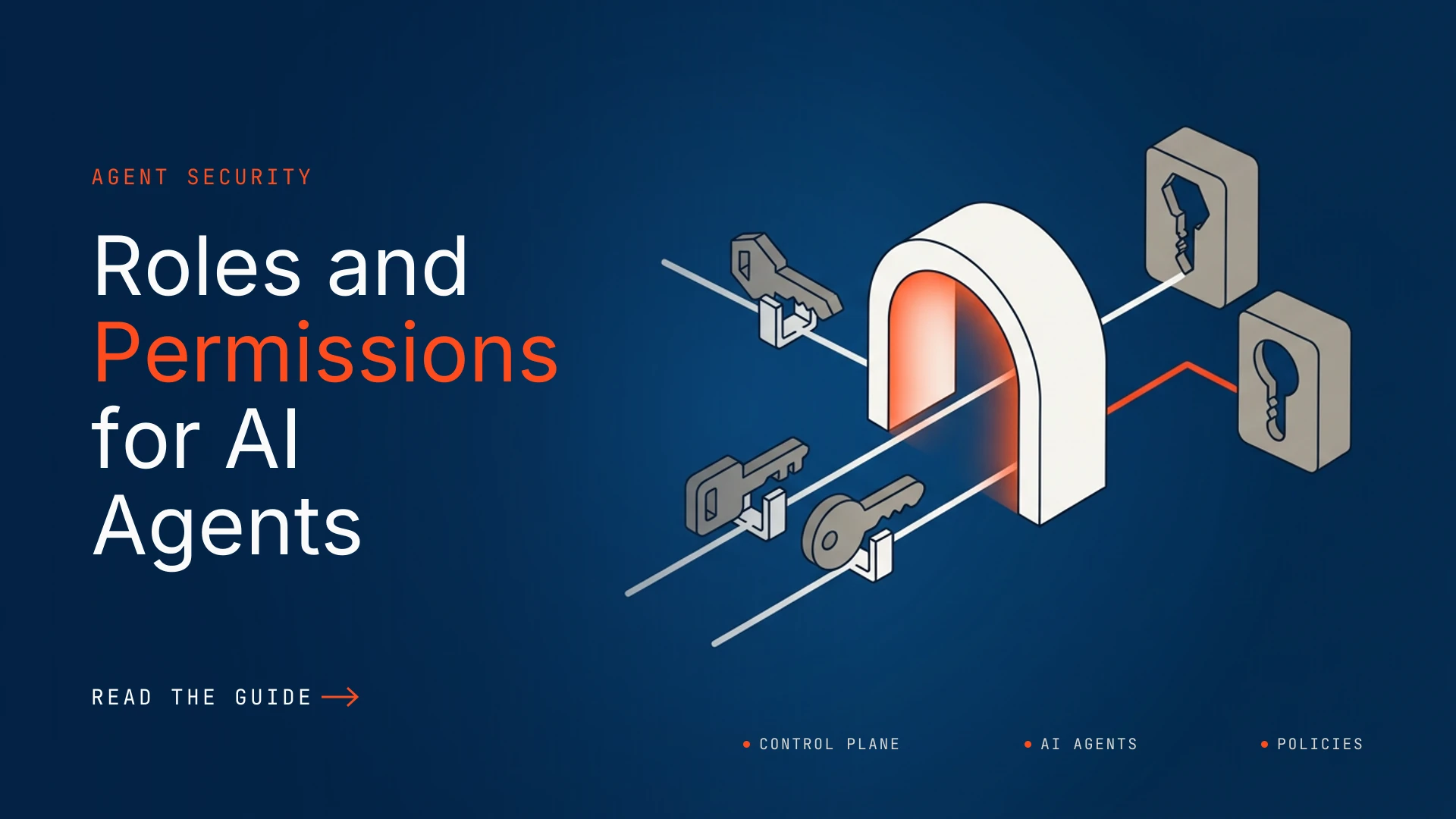
Think of OpenController as the security operations center for your agents.
The SOC guard checks an employee's badge and confirms they are authorized to enter a specific lab.
The guard doesn't hold the keys to every piece of equipment in that lab; the employee does.
In this model, OpenController is the guard. The agent is the employee.
The permissions in NetSuite or ServiceNow are the keys.
This separation of duties is fundamental. It ensures that the control plane manages governance and observability, while access rights remain narrowly scoped and managed within the native platform or your identity provider.
How It Works: An Example with NetSuite
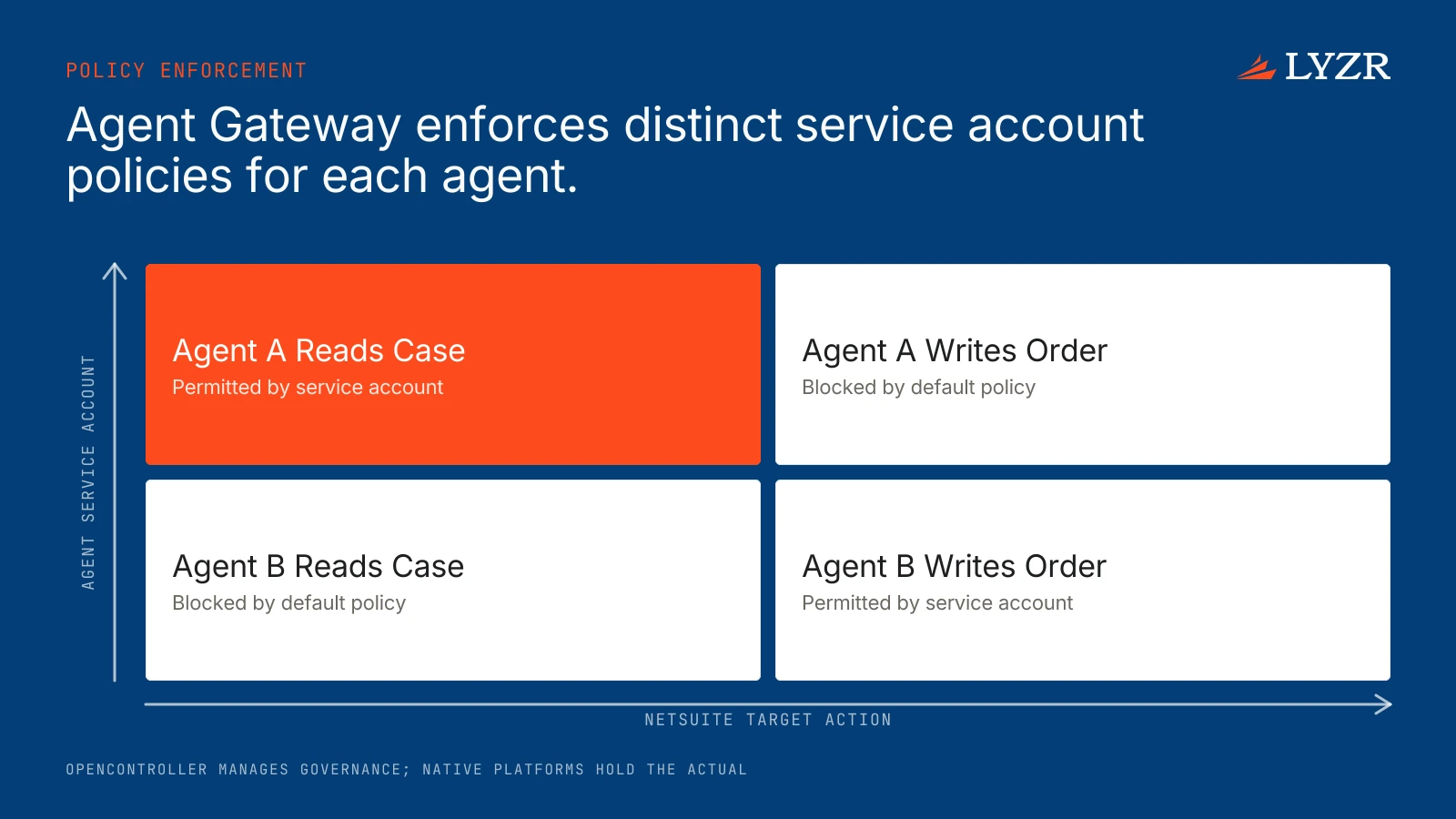
Imagine you have two distinct agents interacting with NetSuite.
Agent A: Its job is to read customer support tickets and summarize them.
This agent would use a service account in NetSuite with read-only access to the Case object.
Agent B: Its job is to create a sales order when a specific trigger occurs.
This agent needs a different service account with write access to the SalesOrder object and perhaps read access to the Customer object.
OpenController’s role is not to access NetSuite directly. Its role is to:
- Enforce a policy that only the customer service team can invoke Agent A.
- Apply a rule that Agent B can't be used to access high-value financial data.
- Create an immutable audit log of every time Agent A or B is run, by whom, and what the outcome was.
- Delegate authorization to your existing identity provider, ensuring agent access aligns with user permissions.
The permissions "bill of materials" is therefore a dynamic list you create, specific to each agent you build. OpenController gives you the framework to govern those agents, no matter what permissions they hold.
Frequently Asked Questions
So OpenController needs no permissions at all?
It needs permissions within your cloud environment (AWS, Azure, GCP) to be deployed and operate.
For discovering and managing agents, it may require specific read permissions on your agent registries or server infrastructure.
But it does not require user or admin permissions inside your business applications like Salesforce, SAP, or NetSuite.
How does OpenController know what permissions an agent has?
It doesn't need to. OpenController's policies operate on the agent's identity and metadata, not its downstream credentials.
You can write a policy based on the agent's name, its function, or the user group calling it.
If the agent then attempts an action it lacks permissions for, the target system will deny it, and OpenController will log the failure.
Does this mean we manage credentials in two places?
No. Your agents' credentials should be managed through a dedicated secrets manager like HashiCorp Vault, AWS Secrets Manager, or Azure Key Vault. OpenController integrates with these systems to ensure agents retrieve their credentials securely at runtime, separating governance from secret management.
Your Governance Model, Not a Static List
The absence of a universal permissions list is a core feature of OpenController's security architecture.
It forces a deliberate, secure-by-design approach where each agent is granted the absolute minimum access required. This contains the blast radius of any single agent and gives security teams granular control and a clear audit trail.
See how this model provides the governance your AI strategy requires. Let's talk.
Related questions
- Can Lyzr’s Opencontroller platform call a custom ACI tool & keep the tool’s secret encrypted?
- What are the limitations and required permissions for provisioning an Opencontroller sandbox environment?
Want to see how it fits your stack? Talk to us about OpenController by Lyzr.
Got a use case in mind?
8 weeks from use case to agents running in production.
Platform, people and FDEs, all in. Bring your environment. We'll co-build and stay until it's live.
Talk to UsFree resource
101 AI Agents Use Cases
100+ production-ready AI agent use cases across Marketing, Sales, HR, Banking, Insurance, Operations and a lot more
Download now