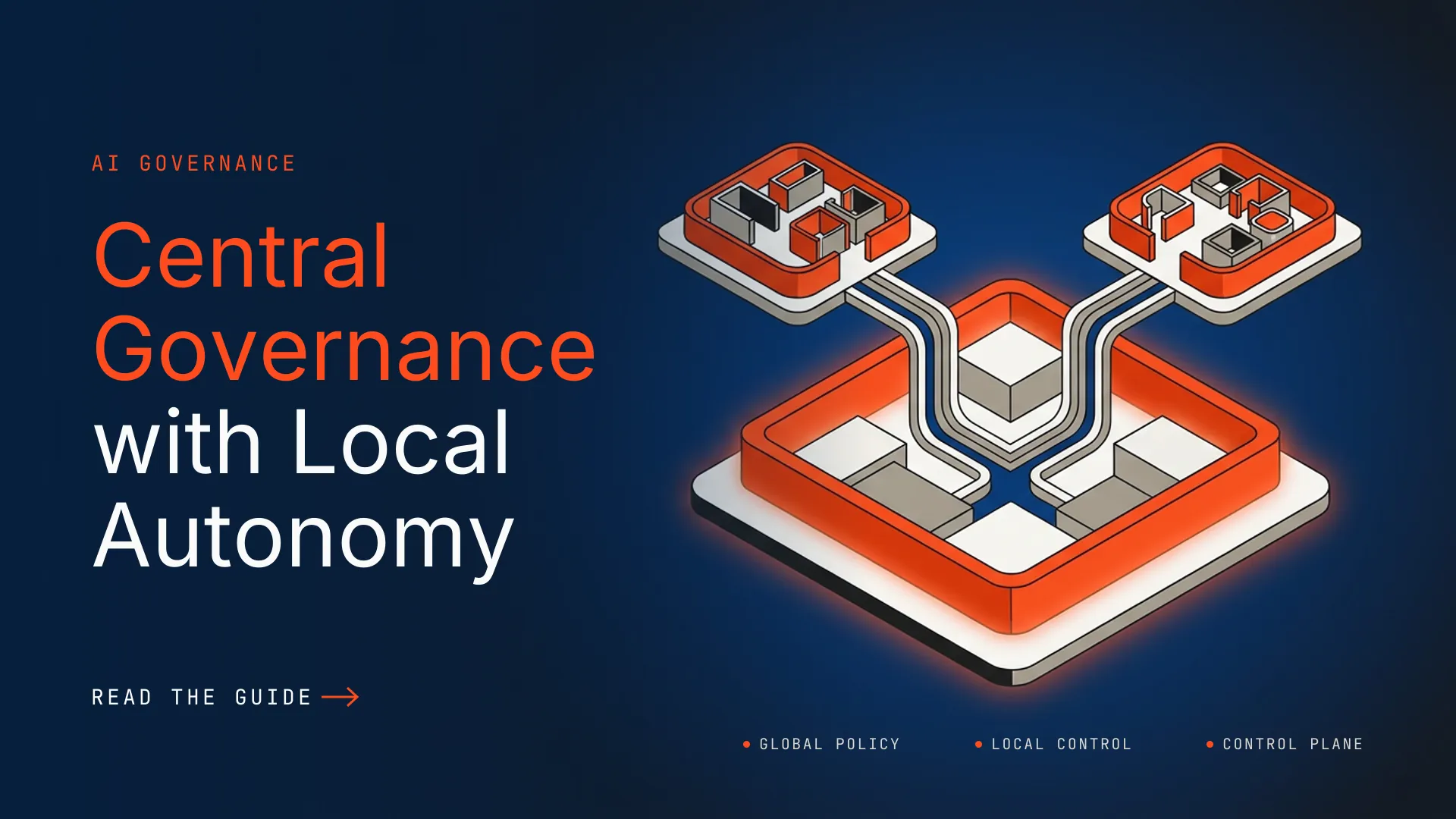
Yes. This exact model of central governance with local autonomy is a core design principle of OpenController.
Global policies are set by a central team, while individual lines of business can apply their own, more specific policies on top.
This allows you to maintain universal guardrails without becoming a bottleneck.
It's made possible by OpenController by Lyzr, the governance layer for production AI agents. A control plane is the neutral layer that governs everything beneath it.
For AI agents, OpenController by Lyzr is that layer, providing the structure for both central and distributed control.
How Central Governance Works
Your central platform or security team defines the non-negotiable rules for the entire organization.
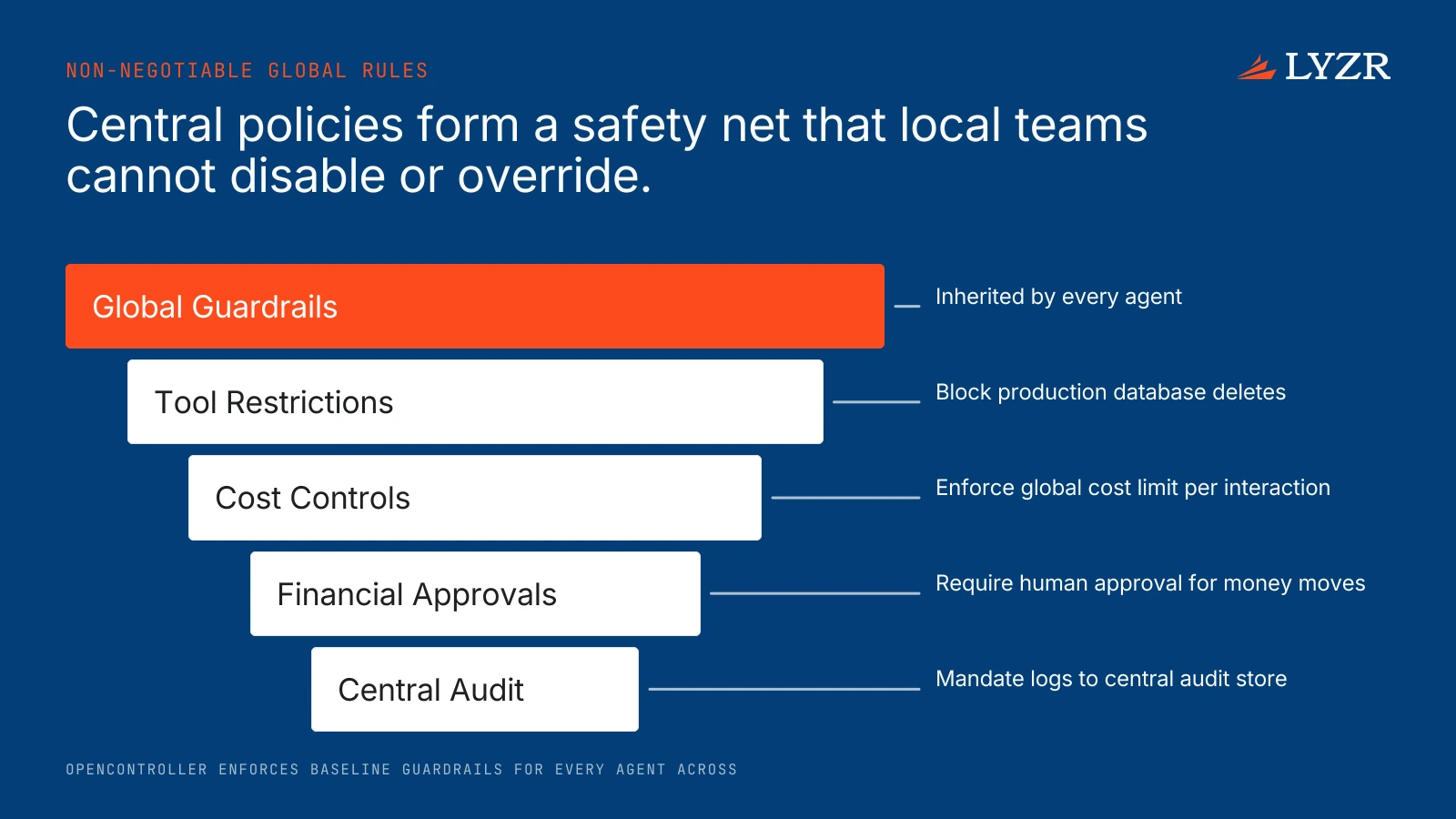
These are the baseline guardrails that apply to every agent, everywhere. No exceptions.
Think of them as global security and compliance mandates.
For example, a central policy might:
- Block all agents from using a specific high-risk tool, like a production database delete function.
- Enforce a global cost limit per agent interaction to prevent runaway spend.
- Mandate that every agent transaction is logged to a central audit store.
- Require human approval for any agent action that moves more than a certain amount of money.
These policies are inherited by every agent. They form a safety net that local teams cannot disable or override.
This ensures your fundamental enterprise requirements for security, cost control, and compliance are always met.
How Local Control is Enabled
While central policies provide the floor for safety, local policies allow each line of business to add the walls and ceiling.
OpenController allows teams to define their own policies that apply only to their agents.
Crucially, these local policies can only be more restrictive than the global ones, never less.
This is the key to enabling autonomy without creating risk.
Let's look at an example.
- Global Policy: A central policy allows agents to access the company's internal knowledge base API. This is a broad "allow" rule.
- Marketing LOB Policy: The Marketing team creates a policy for their agents that restricts access to only the "Case Studies" and "Product Docs" sections of that knowledge base.
- HR LOB Policy: The HR team, however, has no use for this API. They create a policy that blocks their agents from accessing the knowledge base API entirely.
In this scenario, everyone operates within the safe boundaries set by the central team.
The Marketing team gets the specific access it needs to build useful agents.
The HR team can lock down tools they don't use, reducing their agents' potential attack surface.
And the central team didn't have to manage three different, context-specific rules. They only had to set one simple, global one.
This is How Enterprise AI Scales Safely
This balance is not a compromise. It's a requirement for scaling AI.
A purely centralized model makes the platform team a permanent bottleneck, slowing down innovation.
A purely decentralized model creates a shadow AI problem, with unmanaged risk and duplicated effort in every business unit.
OpenController's hierarchical policy model avoids both extremes.
You get central visibility and control over the most critical risks.
You give your business units the freedom to build, test, and deploy agents quickly and safely, with policies that reflect their specific context and needs.
This is how you enable speed while maintaining control.
See how it works for yourself. Let's talk.
Want to see how it fits your stack? Talk to us about OpenController by Lyzr.
Got a use case in mind?
8 weeks from use case to agents running in production.
Platform, people and FDEs, all in. Bring your environment. We'll co-build and stay until it's live.
Talk to UsFree resource
101 AI Agents Use Cases
100+ production-ready AI agent use cases across Marketing, Sales, HR, Banking, Insurance, Operations and a lot more
Download now