AI agents can do more than answer questions. They can retrieve company data, call APIs, update records, and trigger actions across business systems. Each connection creates an important security question: Which agent is acting, whose authority is it using, and what is it allowed to do?
Traditional identity and access management (IAM) provides a foundation, but agent-based systems introduce additional complexity. An agent may act on behalf of an employee, call several tools in one task, or operate without a person supervising every action. Teams need a way to identify agents, limit their permissions, manage credentials, and trace their activity to a responsible owner.
The best tool depends on where that risk sits. Some platforms extend enterprise identity to AI agents, while others focus on workload credentials, runtime authorization, or agent governance.
This guide compares seven tools to help you identify the right fit for your environment.
Quick Comparison: Best AI Agent Identity and Trust Management Tools
| Tool | Best for | Key capabilities | Consider before choosing |
| Microsoft Entra Agent ID | Microsoft-centric enterprises | Agent identities, lifecycle governance, access protection | Licensing and integration requirements |
| Okta for AI Agents | Existing Okta customers | Agent identity management, access governance, centralized control | Availability of specific features and integrations |
| Auth0 | Developer-led agentic applications | Authentication and authorization building blocks | Delegated access and token management |
| Aembit | Secure workload-to-resource access | Workload identity, credential isolation, policy-based access | Deployment and resource compatibility |
| P0 Security | Runtime access control | Context-aware authorization and temporary permissions | Enforcement coverage across connected systems |
| Oasis Security | Non-human identity governance | Identity discovery, risk assessment, lifecycle governance | Coverage and remediation capabilities |
| Zenity | Enterprise agent security | Agent discovery, activity monitoring, runtime governance | Supported agent environments and enforcement options |
These tools address overlapping but distinct requirements. Microsoft Entra Agent ID and Okta are natural starting points for organizations extending an existing identity program. Auth0 suits developer-led applications, while Aembit focuses on workload access. P0 Security emphasizes runtime authorization, Oasis Security focuses on non-human identity governance, and Zenity addresses broader agent security.

Product capabilities and packaging can change. Verify current availability, integrations, and licensing with each vendor before making a decision.
What Does AI Agent Identity and Trust Management Actually Cover?

Before comparing individual platforms, separate the four requirements involved in managing agent trust.
| Requirement | Question to answer | Why it matters |
| Identity | Can every agent be uniquely identified and assigned an owner? | Anonymous or shared identities make accountability difficult. |
| Authentication | How does an agent prove its identity? | Exposed or reusable credentials can create unauthorized access. |
| Authorization | Which data, APIs, and actions can the agent access? | An authenticated agent should not automatically receive broad permissions. |
| Governance and auditing | Can the team review activity, revoke access, and investigate incidents? | Trust must be maintained throughout an agent’s lifecycle. |
A platform may handle identity creation without enforcing every action an agent takes. Similarly, a monitoring tool may detect risky behavior without managing the credentials that enabled it.
That distinction matters when evaluating vendors. Look for controls that enforce your security policies, not just dashboards that report potential risks.

The Best Tools for AI Agent Identity and Trust Management
1. Microsoft Entra Agent ID: Best for Microsoft-Centric Enterprises

Microsoft Entra Agent ID provides identity capabilities designed specifically for AI agents. It supports agent identity creation, ownership management, lifecycle governance, and access protection using Microsoft Entra capabilities. It also provides integration options for agents built on Microsoft and third-party platforms.
Why consider it?
Organizations already using Microsoft Entra ID can evaluate agent identities within their existing identity and security architecture instead of building an entirely separate identity process.
Best fit: Enterprises that use Microsoft services and need centralized agent identity management, governance, and access protection.
What to verify: Confirm the licensing requirements and how the platform governs agents accessing third-party applications. Creating an identity does not automatically secure every downstream action.
Explore the Microsoft Entra Agent ID documentation.
2. Okta for AI Agents: Best for Organizations Using Okta
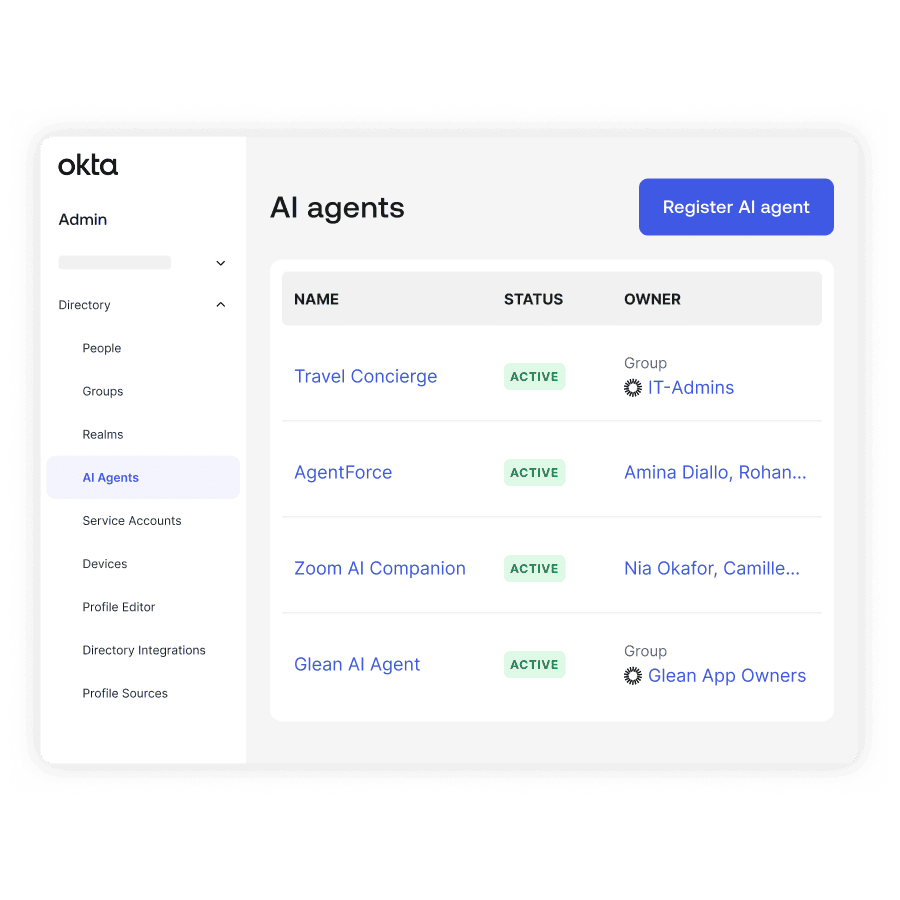
Okta for AI Agents extends identity security and governance to AI agents. Okta announced general availability on April 30, 2026, and its documented capabilities include managing agent identities and governing access.
Why consider it?
Teams already using Okta can evaluate how agent identities fit into their existing identity policies, access reviews, and security operations.
Best fit: Organizations that want to extend an established Okta identity program to AI agents.
What to verify: Test how agent authentication, resource permissions, lifecycle reviews, and audit trails work with your actual agent frameworks and connected applications. Confirm which features are generally available and which remain planned or in development.
Explore Okta for AI Agents.
3. Auth0: Best for Developer-Led Agentic Applications
Auth0 provides authentication and authorization capabilities that developers can incorporate into applications. For agentic applications, an important design question is whether the agent acts independently, on behalf of a signed-in user, or through a separate service identity.
Why consider it?

Developers building customer-facing products or internal agent applications can evaluate Auth0’s identity building blocks as part of their authentication and authorization architecture.
Best fit: Engineering teams building agentic applications that need user authentication and controlled access to connected services.
What to verify: Pay particular attention to delegated authorization, token handling, user consent, and the permissions available to each tool or API. Authenticating a user should not automatically authorize every action an agent might attempt.
Explore Auth0 for current product capabilities and documentation.
4. Aembit: Best for Secure Workload Access and Credential Management

Aembit focuses on identity and access management for workloads, including AI agents. Its approach supports policy-based access to resources and helps reduce reliance on static credentials. Its AI agent integrations can also combine the user’s identity with the agent’s workload identity when evaluating access.
Why consider it?
An agent may need to access a database, API, or internal service to complete a task. Aembit is relevant when you need to control how that access is granted without exposing backend credentials directly to the agent.
Best fit: Teams securing machine-to-machine communication and agent access to sensitive resources.
What to verify: Confirm compatibility with your workloads, deployment model, and target systems. You may still need another platform for broader agent discovery and lifecycle governance.
Explore Aembit.
5. P0 Security: Best for Runtime Authorization

P0 Security focuses on access control across the chain of actions an agent performs. Its Runtime Access platform for AI evaluates requests using identity and contextual information, with support for policy enforcement and temporary, task-specific access in supported systems.
Why consider it?
An agent may have legitimate access to a system but still attempt an action that falls outside the user’s permissions or the task’s intended scope. Runtime authorization helps address this gap.
Best fit: Security teams that need fine-grained control over what agents can do across sensitive tools, data, and infrastructure.
What to verify: Ask the vendor to demonstrate enforcement in your target systems. Confirm whether unauthorized actions are blocked before execution and whether the full chain of delegated identities is captured in audit records.
Explore P0 Security.
6. Oasis Security: Best for Non-Human Identity Governance
Oasis Security focuses on non-human identity security, including discovery, risk assessment, ownership identification, and lifecycle governance across hybrid environments. Its current product positioning also includes agentic access management.
Why consider it?
AI agents exist alongside service accounts, bots, scripts, and other machine identities. Managing only the agents your team knows about can leave unmanaged identities and excessive permissions undiscovered.
Best fit: Organizations that need visibility and governance across a large population of non-human identities.
What to verify: Establish how the platform discovers agent-related identities, prioritizes risk, supports remediation, and enforces access policies. Confirm which controls are native and which require integrations.
Explore Oasis Security.
7. Zenity: Best for Broader Enterprise Agent Security

Identity is only one part of agent trust. Teams also need to understand which agents are running, what applications and data they can reach, and whether their actions violate policy.
Zenity focuses on enterprise agent security and governance, making it worth evaluating when your requirements extend beyond identity provisioning alone.
Why consider it?
A business may have agents operating across multiple applications and development environments. Security teams need visibility into those deployments and a way to assess and manage associated risks.
Best fit: Enterprises looking for agent discovery and broader security governance across supported environments.
What to verify: Check which agent platforms are covered, whether controls can prevent risky actions or only generate alerts, and how the product integrates with your existing identity systems.
Explore Zenity.
How to Choose the Right Tool for Your Environment

The easiest way to narrow your shortlist is to start with the security gap you need to close.
| Your main requirement | Tools to evaluate first | What your proof of concept should demonstrate |
| Govern agent identities in a Microsoft environment | Microsoft Entra Agent ID | Identity creation, ownership, access control, and auditability |
| Extend your existing identity program | Okta | Agent access governance within your current identity architecture |
| Build an agent that acts on behalf of a user | Auth0 | Authentication and appropriately scoped delegated access |
| Protect credentials used to access APIs and services | Aembit | Secure resource access without exposing static credentials |
| Control sensitive actions at runtime | P0 Security | Unauthorized requests denied before execution |
| Discover and govern non-human identities | Oasis Security | Identity discovery, ownership, risk assessment, and remediation |
| Manage broader enterprise agent security | Zenity | Visibility into agents and applicable runtime security controls |
You may not need a single platform to cover every requirement. The important thing is to identify which product enforces each control and how the components work together.
A Quick Assessment Before You Book a Demo
Use this checklist with your security, engineering, and platform teams to identify gaps in your current setup.
- Does every production agent have a unique identity and a named owner?
- Can access be limited to the specific tools, data, and actions required for a task?
- Are credentials securely managed rather than embedded in prompts, source code, or static configuration?
- Can we trace an action to the agent and, where relevant, the user who initiated it?
- Can we revoke access quickly when an agent or integration is no longer trusted?
- Can our controls block unauthorized actions rather than simply alert us afterward?
If several answers are no or not sure, use those gaps to define your proof of concept.
Choose one real agent and one sensitive workflow. Test identity, authorization, logging, and revocation from start to finish. This gives you a more useful evaluation than a generic feature demonstration.
What to Test During a Proof of Concept

Ask each shortlisted vendor to demonstrate the same scenario: an employee asks an agent to retrieve a customer record and update it in a business system. The agent should access only the records and actions that the employee is authorized to use.
Evaluate whether the tool can:
- Identify the agent and show who owns it.
- Authenticate the agent without exposing reusable credentials.
- Enforce least-privilege permissions when the agent calls a tool or API.
- Record the initiating user, agent identity, requested action, and outcome.
- Deny unauthorized requests and allow administrators to revoke access.
Also compare integration effort, supported environments, deployment requirements, pricing, and behavior when an identity or policy service becomes unavailable.
These practical checks help you distinguish a promising demonstration from a solution your team can operate reliably.
Final Thoughts
The best tool for AI agent identity and trust management is the one that closes your most important security gap.
Microsoft Entra Agent ID and Okta are sensible starting points for organizations extending an existing identity program. Auth0 is worth evaluating for developer-led agentic applications, Aembit for secure workload access, P0 Security for runtime authorization, Oasis Security for non-human identity governance, and Zenity for broader enterprise agent security.
Some organizations will need multiple layers. What matters is that every production agent has a known identity and owner, access is limited and enforceable, credentials are managed securely, and sensitive actions leave an auditable trail.
Before committing to a platform, test one real agent workflow from authentication through authorization, logging, and revocation. That will tell you far more about its fit than a feature checklist alone.
FAQs
1. What is AI agent identity management?
AI agent identity management assigns identities to AI agents and governs their ownership, authentication, permissions, lifecycle, and access to business resources.
2. Why do AI agents need separate identities?
Separate identities help organizations distinguish agents, limit their permissions, investigate activity, and revoke access without disrupting unrelated services. They also make it easier to connect actions to the responsible owner or initiating user.
3. Are AI agent identity tools the same as AI guardrails?
No. Identity tools establish who or what is making a request and what it can access. AI guardrails generally focus on model inputs, outputs, or behavior. Secure deployments may need both, along with enforcement at the API or tool layer.
4. Can one platform manage every aspect of agent trust?
Not necessarily. Some platforms focus on identity and lifecycle management, others on credentials or authorization, and others on discovery and runtime governance. Evaluate which controls are enforced directly and which require integrations.
5. What is the most important feature to look for?
Start with enforceable least-privilege authorization. Each agent should receive only the access required for its task, and the system should be able to deny unauthorized actions, log activity, and revoke access when necessary.
Book A Demo: Click Here
Join our Slack: Click Here
Link to our GitHub: Click Here
Got a use case in mind?
8 weeks from use case to agents running in production.
Platform, people and FDEs, all in. Bring your environment. We'll co-build and stay until it's live.
Talk to UsFree resource
101 AI Agents Use Cases
100+ production-ready AI agent use cases across Marketing, Sales, HR, Banking, Insurance, Operations and a lot more
Download now