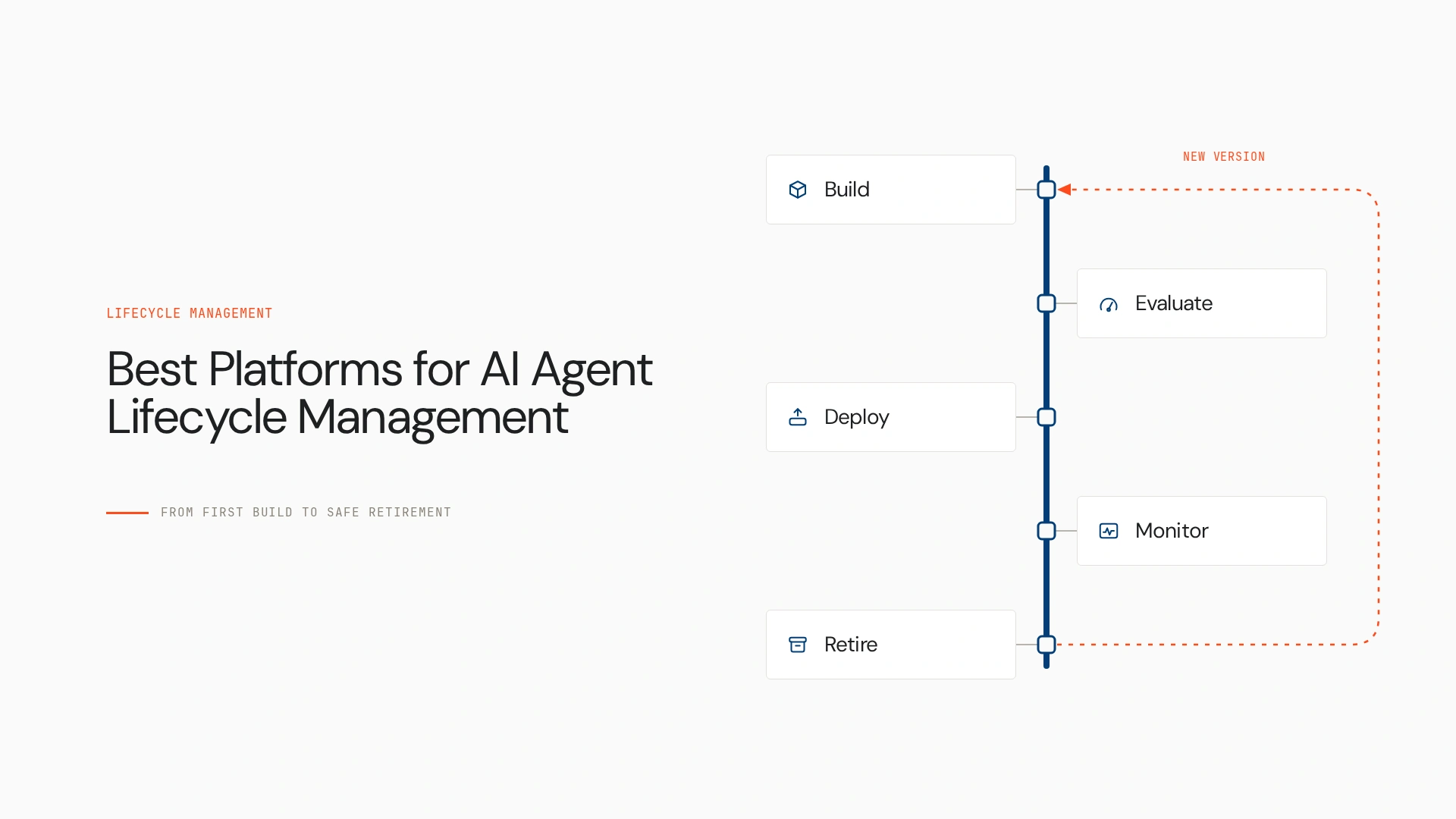
Managing AI agents in production involves more than keeping them running. Teams need to track versions, evaluate performance, manage permissions, investigate failures, and oversee changes throughout an agent’s lifecycle.
This gets more complicated when agents are developed by different teams, use different frameworks, and run across multiple cloud environments. A development framework may help build and test agents, while a monitoring tool tracks their behavior in production. Neither necessarily gives enterprises a unified view of all their agents.
The best AI agent lifecycle management platforms cover different parts of this process. Some focus on development and deployment, others on observability and governance, while control planes help enterprises manage agents across their existing infrastructure.
TL;DR: Which AI Agent Management Platform Should You Choose?
- Lyzr Opencontroller: Best for governing agents across different frameworks, models, and environments.
- IBM watsonx Orchestrate: Best for enterprise agent operations, including centralized visibility and governance.
- xpander.ai: Best for teams looking for agent development and operational governance capabilities in one platform.
- Fiddler AI: Best for AI observability, evaluation, and monitoring.
- TrueFoundry: Best for engineering teams managing AI infrastructure and deployments.
- Google Vertex AI: Best for organizations building agents within Google Cloud.
- Microsoft Copilot Studio: Best for creating and managing business agents within the Microsoft ecosystem.
- LangGraph and LangSmith: Best for code-first agent development, tracing, and evaluation.
- Rubrik Agent Cloud: Worth evaluating for organizations focused on agent security and recovery, based on its current documented capabilities.
The best choice depends on how much of the lifecycle you need to manage, which tools you already use, and whether you need centralized governance across multiple agent environments.
What Is AI Agent Lifecycle Management?
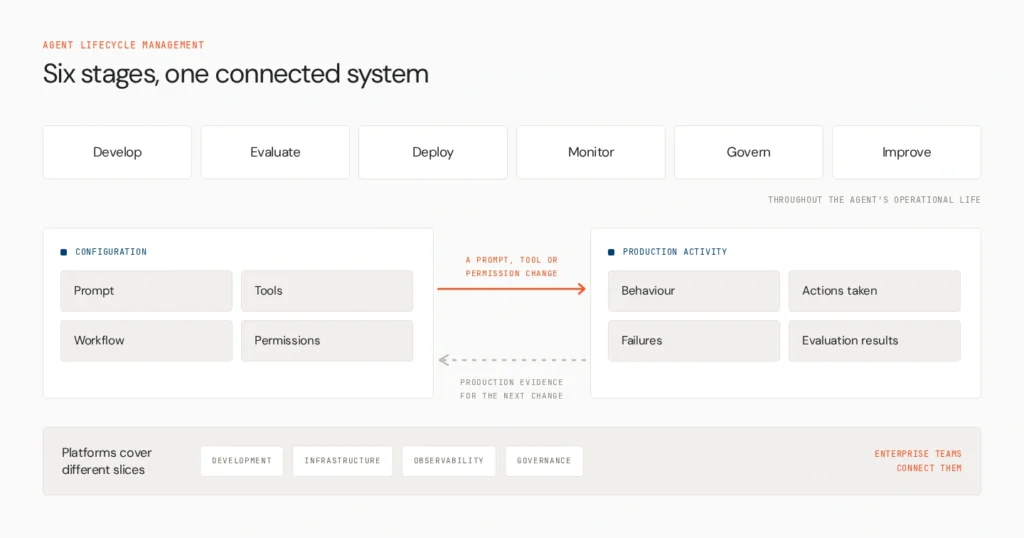
AI agent lifecycle management covers the processes used to develop, evaluate, deploy, monitor, govern, and improve agents throughout their operational life.
The lifecycle begins when developers configure an agent, connect its tools, and define its workflow. Before release, teams need to test its behavior against quality, reliability, and safety requirements. After deployment, they must monitor production activity, manage permissions, investigate failures, and evaluate whether changes improve performance.
These stages are connected. A prompt or tool change can affect an agent’s behavior, while a change in permissions can alter the actions it is allowed to perform. Teams therefore need visibility into both the agent’s configuration and its production activity.
Some platforms cover several stages, while others specialize in development, infrastructure, observability, or governance. Enterprise teams often need to connect these capabilities to manage agents consistently at scale.
The Best AI Agent Lifecycle Management Platforms Compared
| Platform | Primary role | Best for | Main consideration |
|---|---|---|---|
| Lyzr Opencontroller | AI control plane | Cross-platform agent governance | Complements development and runtime tools |
| IBM watsonx Orchestrate | Agent operations and control plane | Enterprise-wide agent management | Assess ecosystem and integration requirements |
| xpander.ai | Agent platform and governance | Governed agent development and operations | Verify fit with existing stack |
| Fiddler AI | Observability and evaluation | Monitoring agent behavior and quality | Does not replace every lifecycle component |
| TrueFoundry | AI infrastructure and deployment | Engineering-led operations | Assess governance coverage |
| Google Vertex AI | Cloud AI and agent platform | Google Cloud environments | Cloud ecosystem fit matters |
| Microsoft Copilot Studio | Business agent platform | Microsoft-centric organizations | Best suited to its ecosystem |
| LangGraph and LangSmith | Development, tracing, and evaluation | Code-first teams | Additional operational tools may be needed |
| Rubrik Agent Cloud | Agent security and protection | Security and recovery requirements | Verify the specific lifecycle capabilities required |
The following platforms address different parts of the lifecycle. Compare their documented capabilities rather than assuming each one offers a complete, interchangeable solution.
1. Lyzr Opencontroller: Best for Enterprise Agent Lifecycle Governance

Best for: Enterprises managing agents across multiple frameworks, models, teams, and environments.
Lyzr Opencontroller provides a unified control plane for discovering, evaluating, monitoring, and governing agents across an organization’s AI estate. Its purpose is to give teams a consistent operational layer even when agents are built and deployed using different technologies.
Its lifecycle-related capabilities include:
- Agent discovery: Identify agents, models, tools, data, and workflows across the environment.
- Pre-production controls: Evaluate and validate agents before they reach production.
- Runtime oversight: Monitor agents, applications, APIs, and infrastructure.
- Governance: Apply controls and maintain visibility into agent activity across environments.
The distinction matters when different teams use different development frameworks or cloud platforms. Each team can retain its existing development workflow while the organization establishes a common layer for managing its agents.
Opencontroller is particularly relevant when enterprises need to understand which agents exist, how they operate, what policies apply, and how production behavior can be investigated. It is not a replacement for the development framework or runtime used to execute an agent.
Organizations running a single, low-complexity agent may not need a separate control plane. The value becomes clearer as the number of agents, environments, teams, and governance requirements grows.
Explore Lyzr Opencontroller to understand how a control plane fits into an existing agent architecture.
2. IBM watsonx Orchestrate: Best for Centralized Enterprise Agent Operations

Best for: Enterprises that need centralized agent visibility, operational management, and governance.
IBM watsonx Orchestrate has expanded beyond agent development and orchestration to include an agentic control plane. IBM describes capabilities for managing agents centrally, with operational visibility, governance controls, a shared catalog, and support for agents built using external platforms. Its AI Gateway can discover and import agents from supported third-party environments.
This makes watsonx Orchestrate relevant to organizations that need to manage agents across teams and integrate agent operations into existing enterprise workflows.
Its strengths include centralized management and a growing focus on cross-platform agent operations. However, buyers should assess supported integrations, deployment requirements, and how the platform fits with their existing infrastructure.
Trade-off: Organizations should compare the scope of IBM’s control-plane capabilities with their existing stack and determine whether they need additional tools for particular governance or operational requirements.
3. xpander.ai: Best for Governed Agent Development and Operations
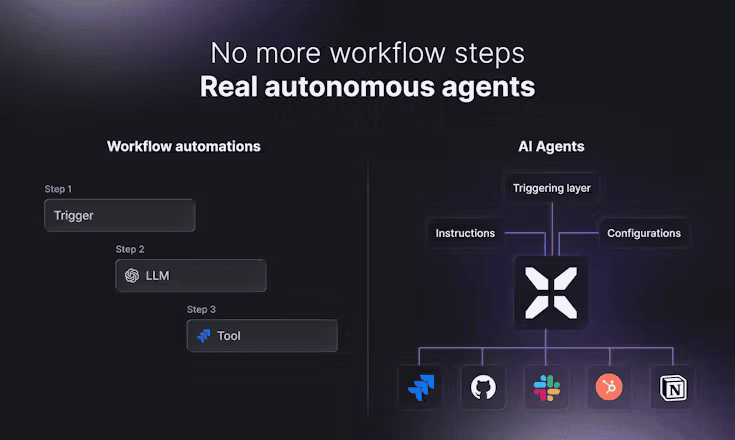
Best for: Teams looking to combine agent development with operational controls.
xpander.ai offers capabilities for agent governance, identity, permissions, spending limits, observability, and human approvals. Its governance offering is designed to help teams control what agents can access, which actions require approval, and how agent activity is tracked.
These capabilities address several challenges that appear as agents move from development into production. Teams need to manage credentials, limit access, monitor execution, and introduce approval steps for sensitive actions.
xpander.ai is worth evaluating when an organization wants a governed operational environment while retaining flexibility in its agent development approach.
Trade-off: Buyers should confirm support for their existing frameworks, identity providers, deployment environments, and required integrations. They should also distinguish the platform’s documented capabilities from features that require third-party services.
4. Fiddler AI: Best for Agent Observability and Evaluation
Best for: Teams that need to understand and evaluate AI behavior in production.
Fiddler AI focuses on AI observability and monitoring, with capabilities for evaluating system behavior and identifying performance or quality issues. These capabilities can help teams investigate unexpected outputs, track relevant signals, and assess whether AI applications continue to meet their requirements.
For agentic systems, observability becomes especially important because an incorrect result may stem from a sequence of tool calls, retrieval steps, or intermediate decisions rather than a single model response.
Fiddler is relevant to the monitoring and evaluation stages of the lifecycle. Teams should assess its current agent-specific capabilities and integrations against their needs.
Trade-off: Observability is one part of lifecycle management. Organizations may still need separate tools for agent development, deployment, identity management, release approvals, and cross-platform governance.
5. TrueFoundry: Best for AI Infrastructure and Deployment

Best for: Engineering teams managing AI applications and deployments at scale.
TrueFoundry focuses on AI infrastructure and deployment workflows, helping engineering teams manage the infrastructure used to run AI applications. For organizations moving agents into production, deployment consistency, resource management, and integration with existing infrastructure can be important parts of the lifecycle.
Its relevance depends on the team’s operational requirements and the specific capabilities available in the current product. Buyers should examine how it handles agent deployment, version management, observability, and integrations with their chosen frameworks.
Trade-off: Infrastructure management does not automatically provide complete agent lifecycle governance. Teams should assess whether they also need dedicated capabilities for agent identity, pre-release evaluation, policy enforcement, and cross-environment oversight.
6. Google Vertex AI: Best for Google Cloud Environments
Best for: Organizations building and operating agents within Google Cloud.
Google’s Vertex AI ecosystem provides tools for developing and managing AI applications, including agent development through Google’s Agent Development Kit and related managed services. The platform is relevant to teams that want to build agents while using Google Cloud’s infrastructure and AI services.
Its main appeal is the ability to work within an existing cloud environment rather than assemble every component independently. Teams should evaluate which lifecycle capabilities are provided by the development framework, which are available through managed services, and which require additional integrations.
Trade-off: Organizations operating across multiple clouds or agent frameworks should assess how they will maintain consistent visibility, policies, and operational processes beyond Google Cloud.
7. Microsoft Copilot Studio: Best for Microsoft-Centric Business Agents

Best for: Organizations building business agents around Microsoft applications and workflows.
Microsoft Copilot Studio allows teams to create and manage agents that connect with business data, applications, and workflows across the Microsoft ecosystem. It is especially relevant to organizations using Microsoft 365, Power Platform, and related services.
For business teams, its visual development approach can make it easier to create agents that support internal processes or customer interactions. Buyers should assess the available testing, deployment, security, and monitoring capabilities against their specific requirements.
Trade-off: Copilot Studio is primarily suited to its ecosystem. Enterprises managing agents across several independent frameworks and cloud environments should evaluate how their broader agent inventory, governance, and runtime oversight will be handled.
8. LangGraph and LangSmith: Best for Code-First Development and Evaluation

Best for: Engineering teams that need control over agent workflows, tracing, and evaluation.
LangGraph helps developers build stateful agent applications with explicit workflow logic, while LangSmith supports tracing, evaluation, and debugging. Used together, they can support development and important parts of the operational lifecycle.
For example, a team can define how an agent moves through a workflow, inspect its execution traces, and evaluate whether a change improves its results. This is useful when debugging complex workflows where failures can occur across multiple steps or tool calls.
Trade-off: LangGraph and LangSmith serve different but complementary roles. Teams still need to plan deployment, permissions, production governance, and oversight across agents that may be built with other frameworks.
9. Rubrik Agent Cloud: Consider It for Agent Security and Recovery

Best for: Organizations evaluating security and protection requirements for AI agents.
Agent security becomes a lifecycle concern when agents can access sensitive data or perform consequential actions. Organizations need to understand what agents can do, investigate suspicious activity, and determine how to contain or recover from incidents.
Rubrik Agent Cloud is worth evaluating in this context, but buyers should verify its current product capabilities against their specific requirements. In particular, confirm what action visibility, protection, recovery, and rollback mechanisms are supported before treating it as a complete lifecycle management platform.
Trade-off: Security and recovery capabilities address important operational risks, but they do not necessarily cover agent development, evaluation, deployment, or lifecycle governance end to end.
How to Choose the Right AI Agent Lifecycle Management Platform
Start by mapping the lifecycle capabilities your organization needs. A platform may be strong at development or observability without covering every requirement for production operations.
- For development and orchestration: Choose a framework that fits your workflow complexity, engineering skills, and integration requirements.
- For managed infrastructure: Evaluate cloud and enterprise platforms that align with your deployment environment.
- For production monitoring: Look for tracing, evaluation, and diagnostic capabilities that help teams investigate failures and assess agent behavior.
- For security and governance: Assess identity, permissions, policy enforcement, auditability, and human approval requirements.
- For cross-platform lifecycle management: Consider whether a control plane can provide consistent visibility and governance across agents built by different teams and deployed in different environments.
Also examine how changes move into production. Can your team evaluate a new version before release? Can it identify which version is running? Can it investigate what happened during a particular execution? Can it apply consistent controls across the agent estate?
The answers will help you decide whether your existing tools cover the lifecycle or whether you need a broader management layer.
For a practical guide to preparing agents for production, explore Lyzr’s How to Take Agents to Production playbook.
Manage the Agent Lifecycle Beyond Development
As organizations deploy more agents, managing each one through a separate set of tools can make it harder to maintain consistent visibility, permissions, and governance.
Lyzr Opencontroller provides a control-plane approach for governing agents across frameworks, models, and environments. It complements the technologies used to build and run agents, helping enterprises establish a more consistent approach to evaluation, runtime oversight, and lifecycle governance.
Explore Opencontroller to see how it fits into your existing agent stack, or book a demo to discuss your production architecture.
Frequently Asked Questions
The best AI agent management platforms depend on your requirements. Lyzr Opencontroller and IBM watsonx Orchestrate address centralized agent operations and governance, while Fiddler AI focuses on observability and evaluation. LangGraph and LangSmith suit engineering teams building and debugging code-first agent applications.
There is no single best AI agent platform for every organization. The right choice depends on whether you need development tools, managed deployment, production observability, or lifecycle-wide governance across multiple agents and environments.
For personal life management, the best platform depends on whether you need help with scheduling, task organization, reminders, or personal productivity. These tools serve a different purpose from enterprise AI agent lifecycle management platforms.
For enterprise agent lifecycle management, five options to evaluate are Lyzr Opencontroller, IBM watsonx Orchestrate, xpander.ai, Fiddler AI, and LangGraph with LangSmith. They address different needs, so the right shortlist should reflect the lifecycle stages your organization needs to manage.
AI agent lifecycle management covers the processes used to develop, evaluate, deploy, monitor, govern, and improve AI agents. It helps teams manage changes and production behavior throughout an agent’s operational life.
Agent observability helps teams understand what an agent did and how it performed. Agent governance establishes and enforces the rules around how agents are identified, authorized, deployed, and operated. Enterprises often need both.
An enterprise should evaluate an AI control plane when agents are spread across multiple teams, frameworks, or environments and existing tools do not provide sufficient shared visibility and governance. The need depends on the complexity of the agent estate and the organization’s operational requirements.
Book A Demo: Click Here
Join our Slack: Click Here
Link to our GitHub: Click Here