Building an AI agent is relatively straightforward. Getting multiple agents to work together reliably in production is harder.
Once agents start calling tools, accessing business data, handing off tasks, and triggering actions across systems, teams need to manage execution, state, failures, permissions, and visibility. The platform you choose determines how much of this infrastructure you can configure yourself and how much is managed for you.
The best AI agent orchestration platforms serve different needs. Some give developers fine-grained control over workflows. Others provide managed infrastructure or visual automation. Enterprise teams running agents across multiple frameworks may also need a separate control layer to govern them after deployment.
Here are nine platforms to consider, along with what each does best and where it fits in a production AI architecture.
TL;DR: Which AI Agent Orchestration Platform Is Best?
- Lyzr Opencontroller: Best for enterprises that need a unified control plane to govern agents across frameworks, models, and environments.
- LangGraph: Best for developers building complex, stateful agent workflows with explicit execution paths.
- CrewAI: Best for coordinating teams of specialized agents around roles and tasks.
- OpenAI Agents SDK: Best for developers building tool-using agents with handoffs between specialized agents.
- Microsoft Agent Framework: Best for developers who want flexible agent and workflow building blocks with Microsoft ecosystem integrations.
- Amazon Bedrock AgentCore: Best for deploying and operating agents within AWS infrastructure.
- Google Vertex AI Agent Builder: Best for building and managing agents within Google Cloud.
- n8n: Best for connecting AI steps with existing business applications through visual workflows.
- Salesforce Agentforce: Best for organizations building agents around Salesforce data, processes, and customer workflows.
The right choice depends on whether you primarily need to coordinate agent execution, simplify deployment, automate business processes, or govern agents across an enterprise.
What Is an AI Agent Orchestration Platform?
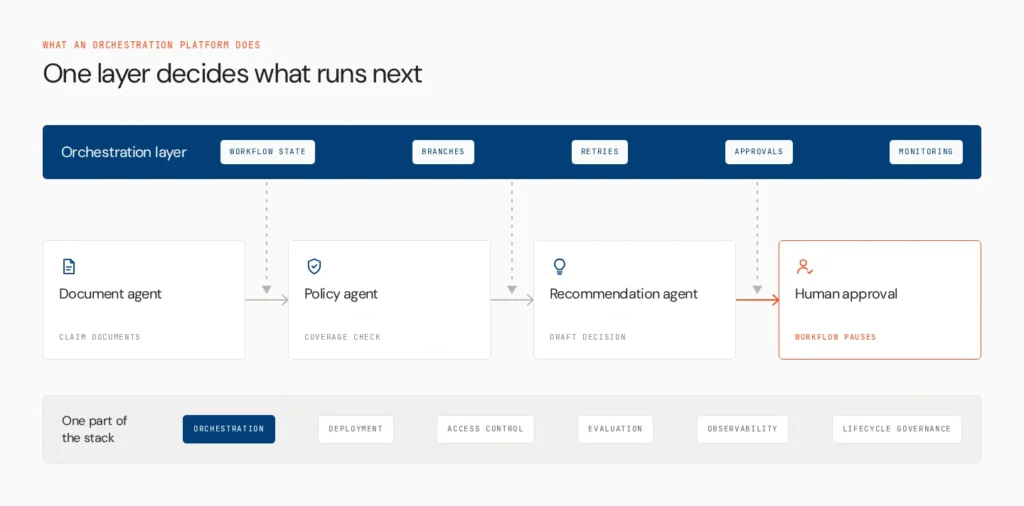
An AI agent orchestration platform coordinates how agents execute tasks, use tools, share information, and hand work to other agents. Depending on the platform, it may manage workflow state, conditional branches, retries, human approvals, and execution monitoring.
Consider an insurance claims workflow. One agent gathers documents, another checks policy details, and a third prepares a recommendation. An orchestration layer determines which step runs next, what information passes between agents, and when the workflow should pause for human approval.
However, orchestration is only one part of running agents in production. Teams may also need deployment infrastructure, access controls, evaluation, observability, and lifecycle governance. Some platforms combine several of these capabilities, while others focus on a narrower part of the stack.
The Best AI Agent Orchestration Platforms Compared
| Platform | Primary category | Best for | Key consideration |
|---|---|---|---|
| Lyzr Opencontroller | AI control plane | Enterprise agent governance | Complements execution frameworks |
| LangGraph | Developer framework | Stateful workflows | Requires engineering expertise |
| CrewAI | Multi-agent framework | Role-based agent collaboration | Requires production architecture planning |
| OpenAI Agents SDK | Developer SDK | Tool use and agent handoffs | Assess model and infrastructure requirements |
| Microsoft Agent Framework | Developer framework | Structured workflows and agent applications | Requires implementation and hosting decisions |
| Amazon Bedrock AgentCore | Managed agent platform | AWS-based production agents | AWS ecosystem fit matters |
| Google Vertex AI Agent Builder | Managed agent platform | Google Cloud agent development | Google Cloud integration is a key consideration |
| n8n | Workflow automation | Visual business process automation | Complex agent systems may need additional components |
| Salesforce Agentforce | Enterprise agent platform | Salesforce-centered workflows | Best value depends on Salesforce adoption |
The platforms below are grouped by their primary role. Their features overlap, so evaluate the capabilities of the specific product or service you plan to use rather than assuming every offering in a category works the same way.
1. Lyzr Opencontroller: Best for Enterprise AI Agent Governance

Best for: Enterprises managing agents across multiple frameworks, models, clouds, and environments.
Lyzr Opencontroller provides a unified AI agent control plane for organizations that need visibility and governance across their agent estate. It is designed to connect the operational stages of agent development, evaluation, deployment, runtime monitoring, and continuous improvement.
Its role differs from that of a conventional orchestration framework. A framework defines how an agent workflow executes. A control plane helps organizations manage the agents themselves across their broader infrastructure.
Key capabilities include:
- Agent discovery: Build visibility into agents, models, tools, and workflows across the AI estate.
- Pre-production governance: Evaluate and validate agents before they reach production.
- Runtime visibility: Monitor agents, applications, APIs, and infrastructure.
- Lifecycle oversight: Connect production signals to decisions about governance and improvement.
The distinction becomes important when teams build agents with different frameworks or deploy them across several environments. Instead of managing every agent as an isolated application, they can establish a more consistent operational approach.
Opencontroller is most relevant when agent ownership, permissions, deployment decisions, runtime behavior, and governance need to be managed across teams. A small project with one simple workflow may only need its existing framework and monitoring tools.
2. LangGraph: Best for Stateful Agent Workflows

Best for: Engineering teams building complex workflows with branching logic, persistent state, and human intervention.
LangGraph is a developer framework for building stateful agent applications around graph-based execution. Developers define workflow steps and transitions, giving them control over how an application progresses through decisions, tool calls, and repeated execution.
This approach suits workflows that need to pause, resume, branch based on intermediate results, or involve human approval. It is useful when an application requires predictable execution paths alongside model-driven decisions.
LangGraph gives developers substantial flexibility, but teams still need to design and operate the surrounding application infrastructure. LangSmith can complement it with tracing, evaluation, and debugging capabilities.
Trade-off: LangGraph is a strong fit for engineering-led development, but it requires technical expertise and does not, by itself, eliminate the need to plan enterprise-wide governance across separately deployed agents.
3. CrewAI: Best for Role-Based Multi-Agent Collaboration

Best for: Teams building workflows around specialized agents that collaborate on a shared goal.
CrewAI organizes agent work around roles, tasks, and collaboration. A team might use one agent to research a topic, another to analyze the findings, and a third to produce a report. Each agent can have its own instructions and tools.
CrewAI also offers Flows for structured execution, including conditional logic and state management. Teams can combine these with Crews when a workflow needs both defined steps and agent-driven problem-solving.
This makes CrewAI useful for research, content production, and other multi-step processes where tasks can be divided among specialized agents.
Trade-off: Defining agent roles is only part of production readiness. Teams still need to determine how the system will be deployed, evaluated, monitored, secured, and maintained as the number of agents grows.
4. OpenAI Agents SDK: Best for Tool Use and Agent Handoffs

Best for: Developers building agents that use tools and delegate work to specialized agents.
The OpenAI Agents SDK provides building blocks for creating agents with instructions, tools, guardrails, and handoffs. Developers can use a manager-style pattern in which one agent calls specialists as tools, or a handoff pattern in which control passes to another agent.
For example, a customer support application could route a billing question to a billing specialist and a refund request to a refund specialist. The developer defines the available agents and handoffs, while the application determines how those components work together.
The SDK is a practical option for teams that want to build agent applications in code rather than adopt a full visual workflow platform.
Trade-off: Teams must assess their model-provider requirements, application architecture, deployment environment, and operational needs. A development SDK does not automatically provide a unified governance layer for every agent operating across an enterprise.
5. Microsoft Agent Framework: Best for Flexible Enterprise Workflows

Best for: Engineering teams that want structured agent workflows and integrations across enterprise systems.
Microsoft Agent Framework provides tools for building agents, managing conversations and state, and composing workflows with explicit execution paths. It supports Python and .NET, with integrations across multiple model providers and agent services.
Its workflow capabilities are useful when a task requires several agents and functions to execute in a defined order. The framework also supports human-in-the-loop patterns, checkpoints, and resuming workflows, which matter for longer-running processes.
Organizations can evaluate it alongside their existing Microsoft infrastructure and hosting choices.
Trade-off: Teams need to distinguish the capabilities of the open-source framework from those of Microsoft’s managed cloud services. They must also plan how to deploy, monitor, secure, and govern their applications in the context of their wider architecture.
6. Amazon Bedrock AgentCore: Best for Production Agents on AWS

Best for: Teams that want managed agent infrastructure within AWS.
Amazon Bedrock AgentCore provides services for building, deploying, and operating AI agents. Its components support agent runtime, tool connectivity, memory, identity, and production monitoring, and it can work with multiple frameworks and foundation models.
A key advantage is that teams can use familiar agent development approaches while relying on managed AWS infrastructure for selected operational needs. AgentCore Runtime, for example, can host agent code built with frameworks such as LangGraph and CrewAI.
This makes AgentCore worth evaluating when AWS is already central to an organization’s architecture.
Trade-off: Teams should assess the services they actually need, their AWS dependencies, and how they will manage agents deployed outside that ecosystem. They should also distinguish AgentCore’s runtime and operational services from the workflow logic defined in their chosen framework.
7. Google Vertex AI Agent Builder: Best for Google Cloud Workloads

Best for: Organizations building agents with Google Cloud services and data infrastructure.
Google Vertex AI Agent Builder provides tools for developing, scaling, and managing AI agents in production. Google’s Agent Development Kit (ADK) supports the development of multi-agent systems, while the wider platform provides managed services for the agent lifecycle.
The platform is worth considering when teams already use Google Cloud and want to connect agents to their existing data and AI infrastructure. Developers should evaluate which components are handled by the ADK, which are provided by Vertex AI, and which require additional services.
Trade-off: Organizations operating across multiple clouds or using a varied collection of frameworks should assess how their chosen setup will work beyond Google Cloud. They should also verify the specific deployment, monitoring, and governance capabilities required for their workloads.
8. n8n: Best for Visual Workflow Automation
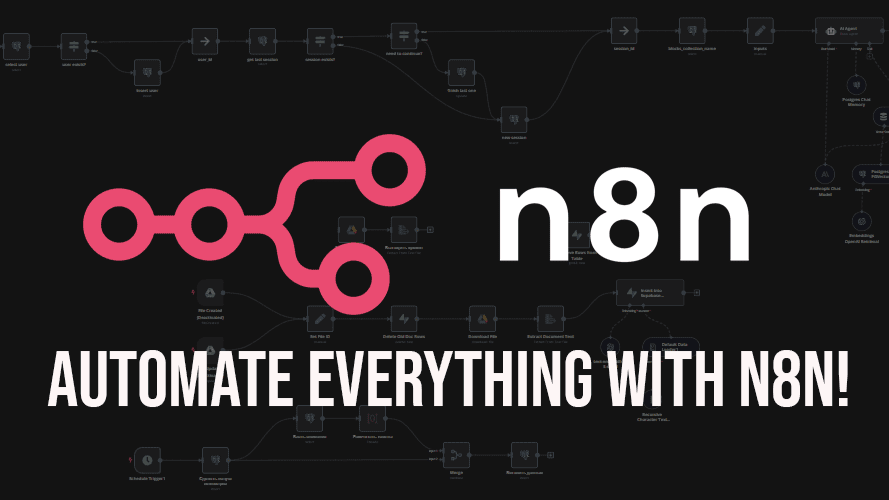
Best for: Operations teams and developers connecting AI tasks to existing applications and APIs.
n8n is a visual workflow automation platform that lets teams connect services, APIs, and AI steps through configurable workflows. It is useful when a business process already involves several systems and the team wants to introduce AI into selected steps.
For example, a workflow could receive a customer request, retrieve information from a CRM, use an AI agent to classify the request, and route it to the right team. The visual workflow makes the connections and sequence easier to inspect.
Trade-off: A visual workflow builder may be sufficient for a straightforward automation, but complex multi-agent applications can require additional engineering, testing, and operational components. Teams should assess their requirements for persistent state, complex handoffs, access control, and lifecycle governance before choosing it as their primary platform.
9. Salesforce Agentforce: Best for Salesforce-Centered Workflows

Best for: Organizations that want agents grounded in Salesforce data and business processes.
Salesforce Agentforce enables teams to build, test, deploy, and manage AI agents within the Salesforce ecosystem. Its tools connect agents with Salesforce data, Flows, Apex, MuleSoft APIs, and other business assets. It also provides testing, observability, and guardrails for agent applications.
This makes Agentforce a strong candidate for customer service, sales, and other workflows that depend heavily on Salesforce records and business logic. Teams can build agents around existing processes instead of recreating every integration from scratch.
Trade-off: Its fit depends on how central Salesforce is to the organization’s operations. Enterprises running agents across a wider mix of platforms should assess how Agentforce fits alongside their other frameworks and governance tools.
How to Choose the Right AI Agent Orchestration Platform
Start with the problem your team needs to solve. A platform that works well for a small workflow may not be the right choice for a large agent estate.
- Choose a developer framework when you need fine-grained control over state, branching, tool calls, and agent handoffs.
- Choose a managed cloud platform when deployment, infrastructure, and integration with an existing cloud environment are your main priorities.
- Choose a visual automation platform when you want to connect AI steps to business applications without building every workflow component from scratch.
- Assess a control plane when agents operate across multiple frameworks, teams, and environments, and you need consistent discovery, evaluation, runtime visibility, and governance.
Also consider what happens after deployment. How will you investigate failures? Who can approve a new agent version? How are permissions managed? Can you evaluate changes before release and trace production behavior afterward?
These questions help determine whether your existing orchestration stack is enough or whether you need a broader operational layer.
Choosing an orchestration platform is only one part of production readiness. For a practical guide to moving agents from development into production, explore Lyzr’s How to Take Agents to Production playbook.
The Next Step: Govern Agents Beyond the Workflow
Orchestration helps agents complete tasks. Production operations also require teams to understand which agents are running, what they can access, how they were evaluated, and how their behavior is monitored over time.
For enterprises managing agents across different frameworks, models, and environments, Lyzr Opencontroller provides a control-plane approach to agent discovery, evaluation, runtime visibility, and governance.
Explore OpenController to see how it fits alongside your existing agent stack, or book a demo to discuss your production architecture.
Frequently Asked Questions
The best AI orchestration platform depends on your workflow and infrastructure. LangGraph suits stateful, code-first workflows, CrewAI supports role-based agent collaboration, and managed cloud platforms simplify deployment within their ecosystems. Enterprises managing agents across several frameworks should also evaluate their lifecycle governance requirements.
Popular options include LangGraph, CrewAI, OpenAI Agents SDK, Microsoft Agent Framework, Amazon Bedrock AgentCore, Google Vertex AI Agent Builder, n8n, and Salesforce Agentforce. They differ in execution control, deployment, integrations, and operational capabilities, so compare them against your specific requirements.
There is no single best platform for every agent application. Developer frameworks offer control over execution, managed platforms simplify infrastructure, and enterprise agent platforms provide capabilities tied to particular ecosystems. The right choice depends on your technical requirements, existing stack, and production responsibilities.
An AI agent orchestration platform coordinates agent execution, tool use, workflow state, and handoffs between agents. Depending on the product, it may also provide deployment, monitoring, and governance capabilities.
Options include frameworks such as LangGraph, CrewAI, and Microsoft Agent Framework, subject to their current licensing terms and the licenses of associated components. Check each project’s official repository and license before adopting it commercially.
An AI agent framework provides development components for building agents and defining their behavior. An orchestration platform coordinates the execution of workflows and agents. Some products combine both roles, while others focus on a narrower part of the architecture.
Yes, provided the agents have compatible interfaces and the necessary integrations or communication protocols. Teams must also handle identity, data access, error handling, and consistent monitoring when agents operate across different frameworks.
Agent orchestration coordinates how tasks and agents execute. Agent governance addresses how agents are identified, evaluated, authorized, deployed, monitored, and managed throughout their lifecycle. A production architecture may need both.
An enterprise should evaluate a control plane when agents are distributed across teams, frameworks, clouds, or environments and existing tools do not provide the required shared visibility and governance. The need depends on the complexity of the agent estate and the organization’s operational and compliance requirements.
Book A Demo: Click Here
Join our Slack: Click Here
Link to our GitHub: Click Here