A regulatory update can look small when it first arrives.
A few numbers change in a rule. A new effective date appears. A paragraph gets revised. On paper, the work may seem limited to updating a policy document.
In a bank, that same change can travel much further.
It can affect business rules, operational procedures, customer disclosures, testing scenarios, training material, and the evidence a compliance team needs to show how the change was handled.
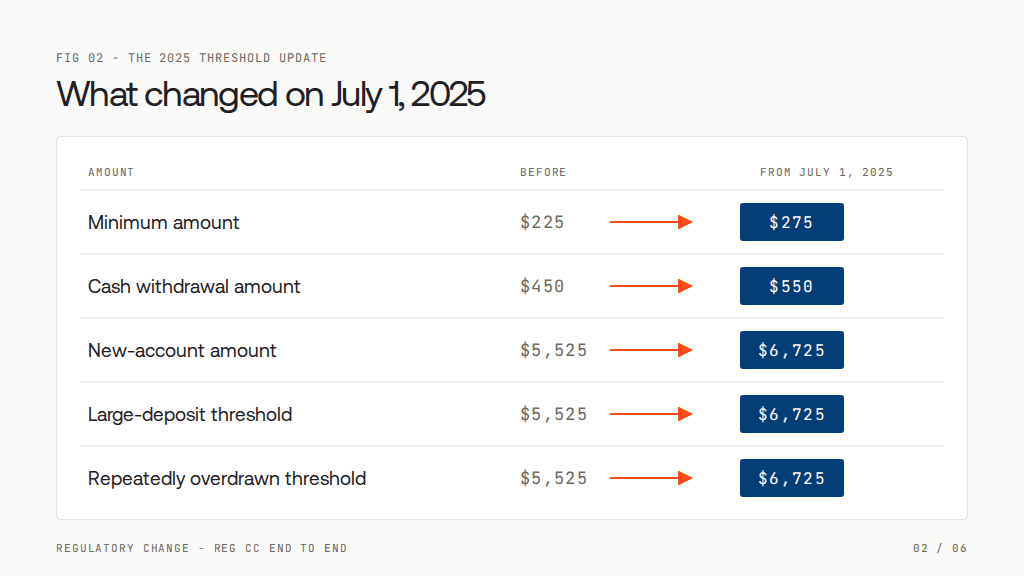
Regulation CC is a good example. The rule governs the availability of funds and collection of checks. On July 1, 2025, inflation-adjusted dollar thresholds took effect for five years. The update changed several amounts, including the minimum amount, cash withdrawal amount, new-account amount, large-deposit threshold, and repeatedly overdrawn threshold. The new-account, large-deposit, and repeatedly overdrawn thresholds moved to $6,725, while the minimum amount became $275 and the cash withdrawal amount became $550.
The interesting question is not simply, “What changed in Reg CC?”
It is:
What happens after the change is published, when a bank has to turn that regulatory language into something its people, policies, systems, and controls can actually use?
That is where an AI agent can become useful.
Start With the Change, Not With the Workflow
Before an agent can act on a regulatory update, it needs to establish what the update actually says.
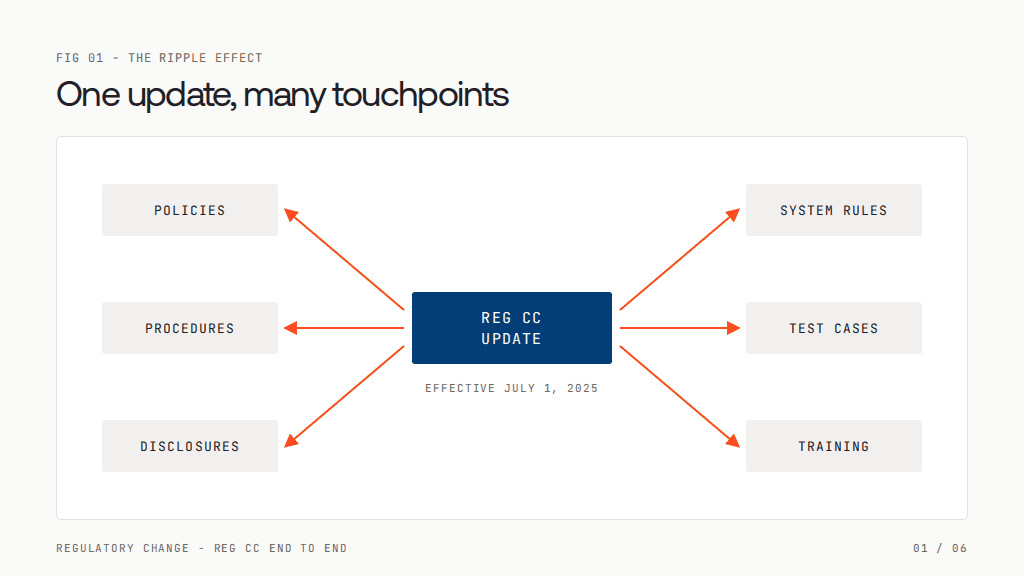
For the 2025 Reg CC adjustment, the source rule explains that the Federal Reserve and CFPB adjusted specified dollar amounts for inflation. The adjustment was based on a 21.8% increase in the relevant Consumer Price Index between July 2018 and July 2023, and the new thresholds became effective July 1, 2025.
A useful regulatory agent should not treat a headline, summary, or internal message as the rule itself. It should trace the change back to authoritative source material and identify the exact provisions affected.
What the agent extracts
| Regulatory detail | Example from the 2025 Reg CC update |
| Regulation | Regulation CC, 12 CFR Part 229 |
| Change type | Inflation-based threshold adjustment |
| Effective date | July 1, 2025 |
| Review period | Five years |
| Minimum amount | $275 |
| Cash withdrawal amount | $550 |
| New-account amount | $6,725 |
| Large-deposit threshold | $6,725 |
| Repeatedly overdrawn threshold | $6,725 |
| Source authorities | Federal Reserve and CFPB |
This first step matters because the rest of the work depends on getting the regulatory fact pattern right.
Once the agent has established the change, the next question becomes much more practical: where does this change show up inside the institution?
Step 1: The Agent Turns Regulatory Text Into a Change Record
Regulatory language is written for legal precision. Operational teams need something different.
They need to know:
- What changed?
- Which section changed?
- When does it take effect?
- What was the old value?
- What is the new value?
- Which internal processes depend on that value?
- Who needs to review or approve the change?
The agent can turn the source material into a structured change record instead of leaving the regulatory update as a document for someone to interpret manually.
For the Reg CC example, that could look like this:
The point is not that the agent has changed anything yet.
It has created a reliable representation of the change that other steps can work from.
That gives the institution a common starting point for impact analysis.
Step 2: The Agent Maps the Change to Internal Policies and Controls
This is where a regulatory update stops being a reading exercise.
A bank may have policies, procedures, operational manuals, system configurations, customer notices, training material, and testing scripts that reference the affected thresholds.
Finding those references manually can be slow, particularly when the same regulatory concept appears across different repositories.
An agent can search approved internal sources and connect the external rule to those internal artifacts.
From one regulatory change to multiple internal touchpoints
| Internal artifact | What the agent looks for | Example impact |
| Funds availability policy | Old dollar thresholds | Replace outdated values |
| Deposit operations procedure | Hold decision logic | Confirm exception handling |
| Customer notices | Threshold references | Update disclosure language |
| Teller procedures | Cash withdrawal rules | Validate operational instructions |
| New-account procedures | New-account threshold | Check applicable controls |
| QA test cases | Boundary values | Add new test values |
| Training material | Examples using old values | Refresh examples |
| Compliance monitoring | Regulatory threshold checks | Update monitoring criteria |
This is one of the most important parts of the process.
The agent is not simply searching for the words “$5,525.” It needs to understand why the value appears and whether the surrounding process is actually affected.
That distinction helps separate a document that mentions the rule from a control that depends on the rule.
Step 3: The Agent Separates Direct Impact From Possible Impact
Not every reference should automatically become a change request.
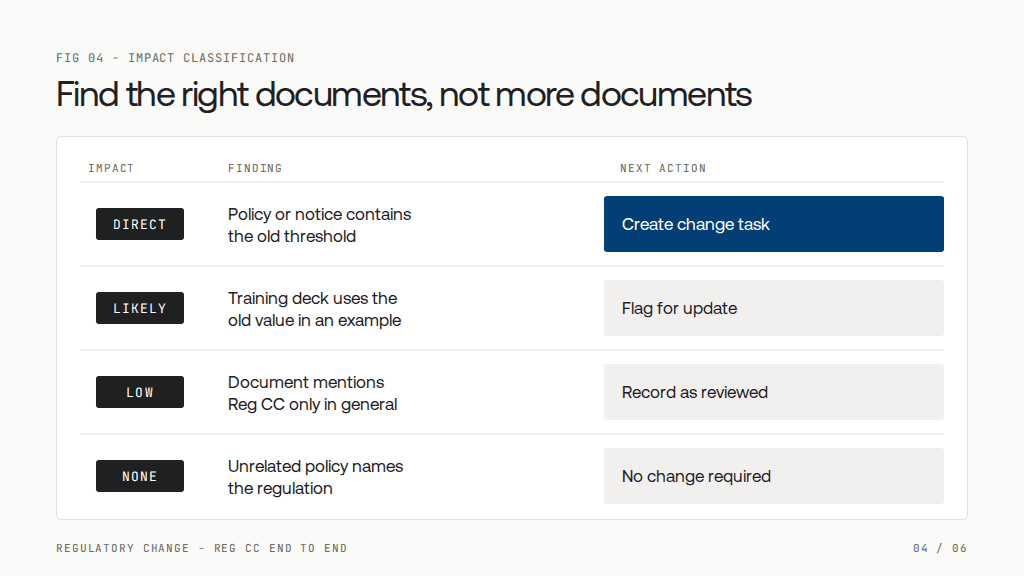
Suppose an internal document contains the old $5,525 threshold. That is a strong signal that the document needs review.
But another document might mention Regulation CC only as background. Updating it may add noise rather than value.
So the agent can classify findings before creating work.
| Finding | Agent assessment | Next action |
| Policy contains old threshold used in a calculation | Direct impact | Create change task |
| Procedure explains an affected hold process | Direct impact | Create review task |
| Customer notice contains old threshold | Direct impact | Route for disclosure review |
| Training deck uses old threshold in an example | Likely impact | Flag for update |
| Document only references Regulation CC generally | Low impact | Record as reviewed |
| Unrelated policy contains the regulation name | No impact | No change required |
This classification is important because regulatory change management is not just about finding more documents.
It is about finding the right documents.
Once the agent has separated the impact, it can move from discovery to controlled execution.
Step 4: The Agent Builds the Change Plan
Now the change starts to look like a project rather than a regulatory memo.
Instead of handing a compliance analyst a long list of search results, the agent can organize the work by dependency, owner, priority, and approval requirement.
A simplified change plan could look like this:
| Work item | Dependency | Suggested owner | Approval needed? | Status |
| Update funds availability policy | Confirm final interpretation | Compliance | Yes | Review |
| Review hold procedures | Policy interpretation | Operations | Yes | Review |
| Update customer disclosure | Final approved wording | Compliance/Legal | Yes | Draft |
| Review system thresholds | Approved business rule | Technology | Yes | Validation |
| Update QA scenarios | Final rule values | QA/Compliance | No/controlled | Ready |
| Refresh training material | Approved procedures | Training | Yes | Pending |
| Capture evidence | Completion of above | Compliance | No | Planned |
The agent is coordinating the work, but that does not mean it should make every decision itself.
For a regulated change, the better model is agent-led, human-approved execution.
The agent can identify, compare, draft, route, and test. Designated people remain responsible for interpretation and approval where institutional controls require it.
Step 5: The Agent Checks the Change Before Anything Goes Live
Changing a threshold is not enough.
The institution needs to know that the new value works wherever it is supposed to work and that the old value is no longer driving the affected process.
This is where the agent can turn the regulatory requirement into test scenarios.
For example, if a threshold changes from $5,525 to $6,725, boundary testing becomes useful.
Example test matrix
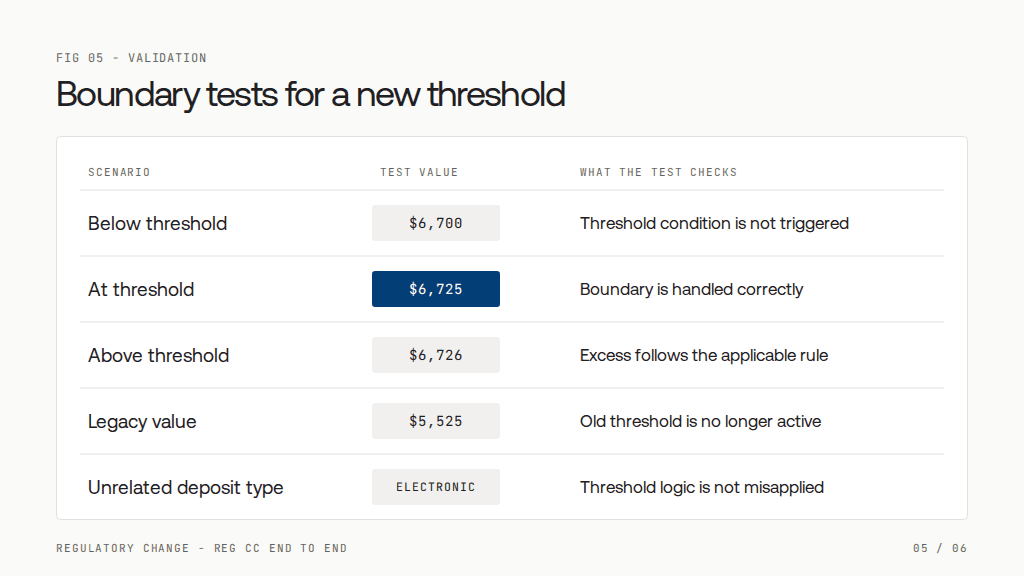
The exact implementation and expected result would depend on the bank’s approved interpretation, policies, and system design.
That is why an agent should generate and organize test cases rather than quietly deciding the legal meaning of every scenario.
The goal is traceability:
regulatory requirement → internal rule → implementation → test → result
Step 6: The Agent Routes Exceptions Instead of Hiding Them
Real regulatory work rarely ends with every item marked “complete.”
An internal policy may conflict with another procedure. A system may still contain the old value. A document may have an unclear owner. A test may fail.
A useful agent should make those exceptions visible.
For example:
| Exception | What the agent can do | Human decision |
| Two policies show different thresholds | Flag the conflict | Decide which approved policy governs |
| System value differs from policy | Create escalation | Determine remediation |
| Source interpretation is unclear | Surface supporting source text | Compliance/legal interpretation |
| Disclosure wording is inconsistent | Identify affected versions | Approve final language |
| Test result does not match expected outcome | Record failure and evidence | Decide remediation and retest |
This is a critical difference between automation and uncontrolled automation.
A mature regulatory agent should know when not to proceed.
If the evidence is incomplete or the interpretation is uncertain, the safest next action may be escalation.
Step 7: The Agent Creates the Audit Trail as It Works
By this point, the agent has moved through several stages:
- Identified the regulatory change.
- Extracted the affected provisions.
- Mapped the provisions to internal artifacts.
- Classified the impact.
- Created a change plan.
- Generated or coordinated validation.
- Escalated exceptions.
The final piece is proving that all of this happened in a controlled way.
Instead of creating audit evidence at the end from memory, the agent can maintain an evidence trail throughout the workflow.
A simple evidence chain
| Stage | Evidence captured |
| Source identification | Regulatory publication and effective date |
| Interpretation | Extracted provision and change summary |
| Impact analysis | Affected policies, procedures, systems, and documents |
| Change execution | Approved revisions and task history |
| Validation | Test cases, results, and exceptions |
| Approval | Reviewer and approval record |
| Completion | Final status and implementation evidence |
This creates a much clearer answer to a question an auditor or compliance reviewer may eventually ask:
How did you determine what this rule change affected, who approved the changes, and how did you verify that the update was implemented correctly?
The answer is no longer scattered across email threads, spreadsheets, tickets, and folders.
It is connected to the original regulatory change.
What Changes When an Agent Handles the Process?
The value is not simply that an agent can search documents faster.
The larger change is that the work can become connected.
A traditional process may look like this:
| Traditional approach | Agent-assisted approach |
| Analyst reads the update | Agent extracts and structures the change |
| Search across repositories manually | Agent maps affected internal artifacts |
| Spreadsheet tracks findings | Agent maintains connected change tasks |
| Teams work from separate lists | Agent routes work based on dependencies |
| Testing is created separately | Agent connects requirements to test scenarios |
| Exceptions surface late | Agent flags conflicts during analysis |
| Evidence is assembled afterward | Evidence is captured throughout the workflow |
That does not remove the need for compliance professionals, legal reviewers, operations teams, technology teams, or auditors.
It changes where they spend their time.
Instead of spending as much time finding, copying, reconciling, and tracking information, teams can spend more time reviewing the decisions that actually require judgment.
The Bigger Lesson: A Rule Change Is a Chain of Decisions
Reg CC makes the point clearly.
A threshold adjustment may begin as a small regulatory update, but its operational meaning depends on everything connected to that threshold.
That is why an AI agent handling regulatory change should not be thought of as a document summarizer.
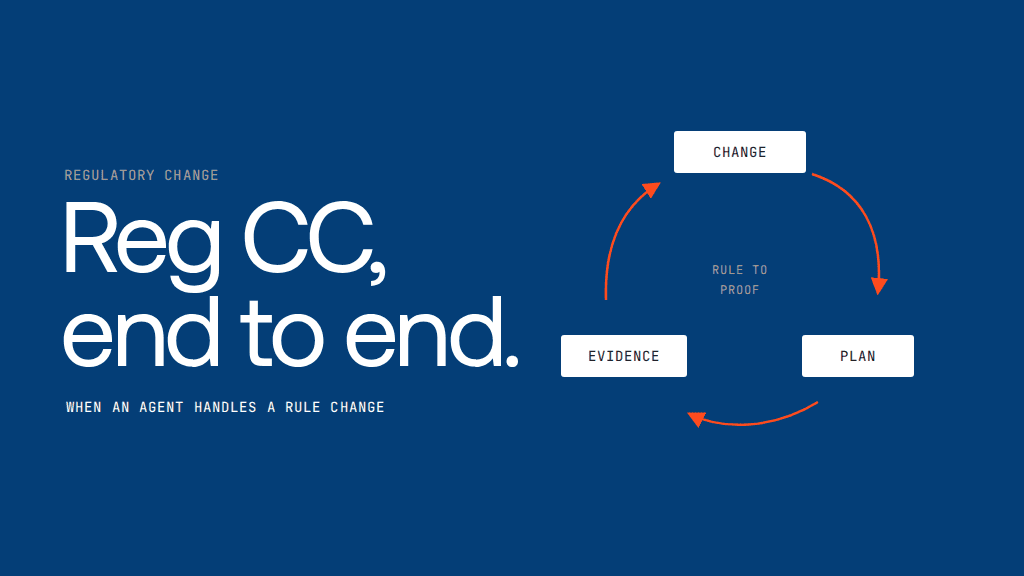
Its job is closer to maintaining a chain of evidence:
What changed → why it changed → where it applies → what must change → who approves it → how it was tested → what evidence proves completion
That chain is what turns regulatory text into operational change.
And the same model can extend beyond Reg CC. Whether the update involves a dollar threshold, a disclosure requirement, a reporting rule, or a procedural obligation, the underlying challenge remains similar.
The regulation is only the starting point.
The real work is carrying that change all the way through the organization without losing context along the way.
FAQs
1. What is Regulation CC?
Regulation CC, or 12 CFR Part 229, implements provisions of the Expedited Funds Availability Act and the Check Clearing for the 21st Century Act. It covers funds availability requirements, exceptions, disclosures, and certain check collection and return requirements.
2. What changed in Regulation CC on July 1, 2025?
The Federal Reserve and CFPB implemented inflation-based adjustments to specified dollar thresholds. The changes included a $275 minimum amount, a $550 cash withdrawal amount, and $6,725 thresholds for new accounts, large deposits, and repeatedly overdrawn accounts.
3. Can an AI agent interpret a regulation on its own?
An agent can extract provisions, compare versions, identify potential impacts, and organize supporting evidence. However, regulated institutions should define appropriate human review and approval points, particularly when legal or compliance interpretation is required.
4. What can an agent do after identifying a Reg CC change?
It can map the change to internal policies and procedures, identify affected systems and disclosures, create change tasks, generate test scenarios, flag exceptions, route approvals, and maintain implementation evidence.
5. Does agentic regulatory change management replace compliance teams?
No. The strongest use case is to reduce manual research and coordination while keeping people responsible for interpretation, approval, exceptions, and governance.
6. Why is audit evidence important in regulatory change management?
A completed change is easier to defend when the institution can show the source requirement, impact analysis, approvals, implementation steps, testing results, exceptions, and final evidence as one connected record.
Book A Demo: Click Here
Join our Slack: Click Here
Link to our GitHub: Click Here
Got a use case in mind?
8 weeks from use case to agents running in production.
Platform, people and FDEs, all in. Bring your environment. We'll co-build and stay until it's live.
Talk to UsFree resource
101 AI Agents Use Cases
100+ production-ready AI agent use cases across Marketing, Sales, HR, Banking, Insurance, Operations and a lot more
Download now