TL;DR
- Agent interoperability is the ability for AI agents built on different frameworks, models, and vendors to discover, communicate, and delegate work to each other without custom, point-to-point integration.
- Two protocols now dominate production architectures: Anthropic’s Model Context Protocol (MCP) for agent-to-tool connectivity, and Google’s Agent2Agent Protocol (A2A) for agent-to-agent coordination, both now governed under the Linux Foundation.
- IBM’s Agent Communication Protocol (ACP) has folded into A2A, consolidating what was a fragmented protocol landscape into a two-layer stack.
- Governance has not kept pace with adoption. Most enterprises still lack visibility into what their agents are actually doing across system boundaries.
- Architects need to decide between orchestration and choreography, build shared context layers, and treat agent identity and audit trails as first-class design concerns, not afterthoughts.
You’ve probably already built the first agent. Maybe two.
One drafts support replies. Another pulls numbers out of a reporting tool. They work. They also have no idea the other one exists.
That’s not a bug in your implementation. It’s the default state of enterprise AI right now. Every framework, every vendor, every LLM provider ships its own way of calling tools and passing context, which means the moment you try to connect agent A to agent B, you’re writing glue code you’ll have to maintain forever.
According to a Cyberspace Administration of China initiative presented at WAIC 2026, “OpenAI’s agents, Google’s agents, Microsoft’s agents, and the various Chinese agents all use their own formats and their own interfaces, and largely don’t speak the same language.” If you’ve tried to make one agent call another vendor’s agent, you already know what that means in practice: “it either fails entirely or requires writing substantial amounts of glue code.”
This is the architecture problem of the decade for anyone building agentic systems, and it finally has real answers. Not perfect ones. But real ones, with production traction, standards bodies, and enough field experience to separate what works from what’s still theory.
The Silo Problem Isn’t Theoretical Anymore
Point-solution agents feel like progress right up until you try to scale past three or four of them.
Each one carries its own memory model, its own auth pattern, its own way of describing what it can do. None of that is visible to the next agent you build. So instead of composing capability, you’re duplicating it. Your support agent and your billing agent both query customer history independently, in slightly different ways, and eventually produce slightly different answers to the same question.
The consequence shows up as a security and governance problem before it shows up as an efficiency problem. A 2026 research note from the Cloud Security Alliance found that among 235 large-enterprise security leaders, results point to a widening gap between how much access agents have and how much of that access is actually governed.
Read that last number again. Sixteen percent. That’s not a rounding error, that’s most of the industry operating agent fleets it can’t fully see or control.
The stack fragmentation underneath these silos is a separate, related problem. Teams that lock into one vendor’s agent framework often find themselves rebuilding the same integration work every time they add a new capability. Framework-agnostic platforms exist specifically to break that dependency before it compounds.
What Agent Interoperability Actually Means
Agent interoperability is the ability for agents built independently, on different stacks, by different teams or vendors, to discover each other’s capabilities and work together without a custom integration for every single pairing.
One widely cited technical definition puts it plainly: “AI agent interoperability is the ability for agents, tools and platforms from different vendors to work together through shared standards, instead of one-off custom integrations.” That single sentence is doing a lot of work. It’s the difference between an ecosystem and a pile of point integrations that break every time someone updates an API.
Interoperability operates on two distinct planes, and conflating them is the single most common architectural mistake teams make right now.
Agent-to-tool. This is how an individual agent reaches out to a database, an API, a document store, a CRM. “The Model Context Protocol, introduced by Anthropic in late 2024, standardizes how AI agents access tools, data sources, and prompts through a client-server architecture, defining three primitive types: Tools, Resources, and Prompts.” If you’ve shipped any agent that calls a function, you’re already touching this layer whether you’ve named it or not.
Agent-to-agent. This is how one agent hands work to another, entirely separate agent, potentially built on a different framework by a different company. “Google’s Agent-to-Agent (A2A) protocol enables independent AI agents to communicate through standardized message formats, task coordination, and capability discovery mechanisms, allowing agents from different vendors and frameworks to work together seamlessly, like how HTTP enables universal web connectivity.”
Those two planes are complementary, not competing. As the Lyzr Agent Studio documentation puts it, “interoperability means multiple systems can follow the same protocol, reducing the need for system-specific logic, and A2A capabilities let agents communicate with each other, share information, and coordinate tasks.”
MCP and A2A: The Two-Layer Backbone Architects Are Actually Building On
If you’re designing a multi-agent system in 2026, you’re almost certainly building on top of two protocols, not twenty.
The Model Context Protocol and Agent-to-Agent protocol, governed by the Linux Foundation, together form the two-layer backbone of risk-managed, scalable agentic ecosystems. That consolidation didn’t happen by accident. It reflects a genuine industry convergence after a messy 2024-2025 period of competing proposals.
A2A’s growth curve is the clearer signal of the two. “The A2A Protocol surpassed 150 organizations supporting the standard within its first year, with deep integration across Google, Microsoft and AWS platforms, and active production deployments across multiple industries.” MCP’s footprint is arguably larger still: “Anthropic’s Model Context Protocol is now the de facto standard for agent-to-tool connectivity, governed by the Linux Foundation’s Agentic AI Foundation, with over 18,000 community-indexed servers and reportedly tens of millions of monthly SDK downloads.”
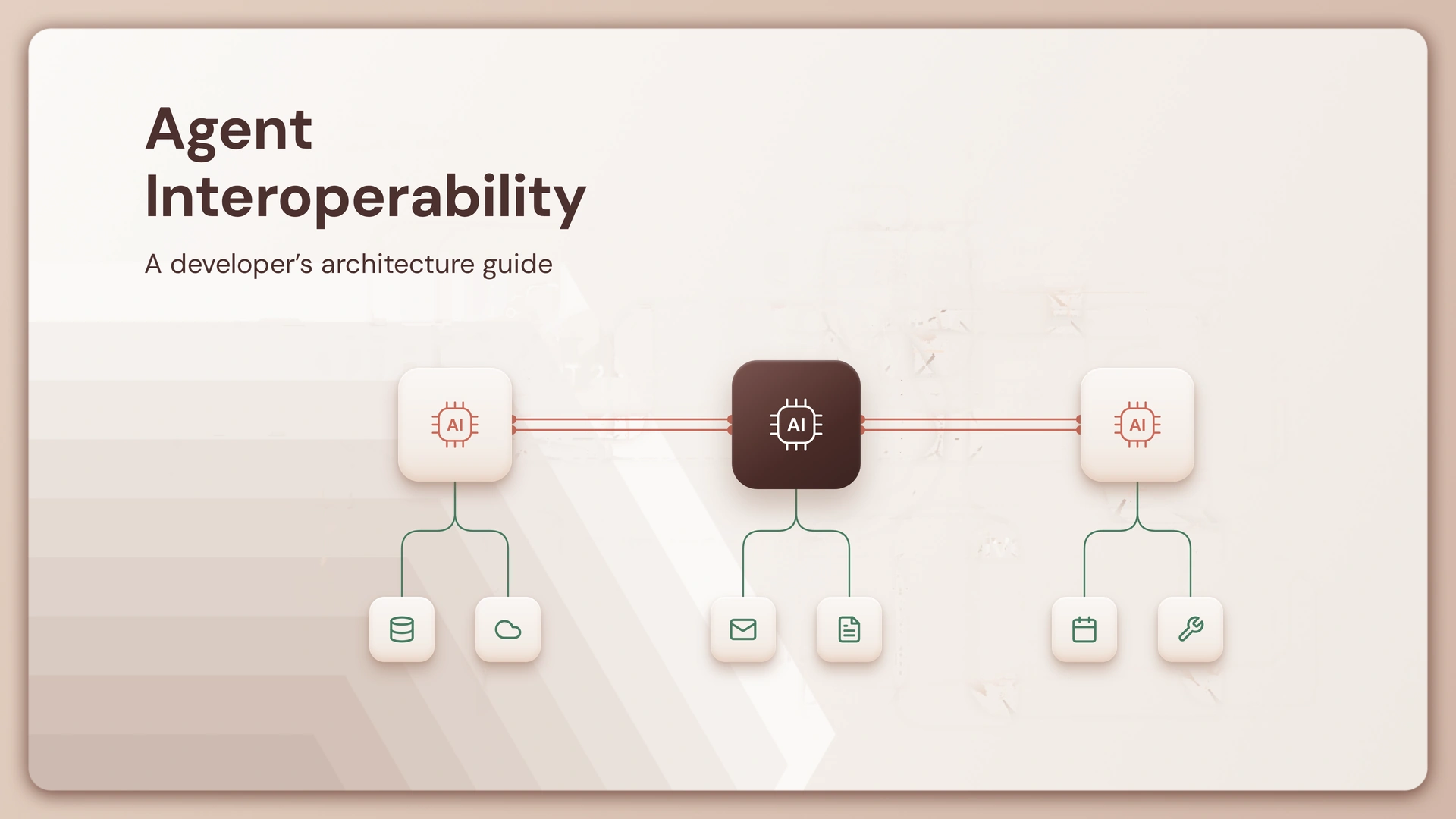
The way to think about the split is architectural, not competitive. “Two key protocol types emerge to facilitate interoperability: one connects agents to tools and resources, the other enables agent-to-agent collaboration, and the A2A and MCP protocols address these distinct but highly complementary needs.” Put an orchestrator agent in front, let it delegate to specialists over A2A, and let each specialist reach into its own tools over MCP. That’s the pattern showing up in production architecture reviews across the industry right now, and it’s exactly how Lyzr Agent Studio structures multi-agent workflows: “agents exchange data directly through the A2A Server URL, no reconfiguration, no translation layers,” while each individual agent handles its own tool calls through MCP.
Salesforce’s contribution deserves a specific mention here, because it solved a real discovery problem. “Salesforce contributed the concept of an Agent Card, a lightweight JSON contract that communicates an agent’s capabilities, identity, compliance tags, and Trust Score, which the Google product team adopted as the keystone for capability discovery and version negotiation.” Every agent in an A2A network now publishes something like a business card that other agents can read before deciding whether to trust it.
MCP vs. A2A at a Glance
| Dimension | Model Context Protocol (MCP) | Agent2Agent Protocol (A2A) |
|---|---|---|
| Primary layer | Agent-to-tool | Agent-to-agent |
| Introduced by | Anthropic, late 2024 | |
| Core primitives | Tools, Resources, Prompts | Agent Cards, task coordination, capability discovery |
| Governance | Linux Foundation Agentic AI Foundation | Linux Foundation, absorbed IBM’s ACP in 2025 |
What Happened to ACP and ANP?
If you researched agent protocols even six months ago, you probably came across three or four competing names: MCP, A2A, ACP, sometimes ANP. That landscape has already simplified.
In August 2025, IBM Research and Google announced that IBM’s Agent Communication Protocol would join forces with Google’s Agent2Agent Protocol under the Linux Foundation’s LF AI & Data umbrella, and ACP development is now winding down, with its assets and expertise contributed directly to A2A. Practically, this means “the unified Agent2Agent protocol now incorporates ACP’s stateful, asynchronous concepts as the standard for agent collaboration.”
ANP, the more decentralized, marketplace-oriented protocol, hasn’t disappeared but occupies a narrower niche. “Rather than competing, these protocols address different layers of agent communication, from tool access with MCP, to enterprise collaboration with A2A, to decentralized marketplaces with ANP.” For the overwhelming majority of enterprise architectures, though, the decision tree has narrowed to one question: MCP for tools, A2A for agents. “The right architecture isn’t either/or. Modern agentic systems layer the two: A2A for high-level orchestration and MCP for low-level tool execution.”
Orchestration or Choreography: The Decision You Can’t Defer
Once your protocol layer is settled, the harder architectural question surfaces: who decides what happens next?
Orchestration puts a central controller in charge. It receives a goal, breaks it into steps, and explicitly invokes each specialist agent in sequence. You get a clear audit trail and a single point of debugging, at the cost of a bottleneck and a single point of failure.
Choreography removes the central controller entirely. Agents subscribe to events and act autonomously when something they care about happens. “In multi-agent architectures, an orchestrator agent might delegate subtasks to specialized agents, one for research, one for code generation, one for customer data retrieval, and A2A provides a standard communication layer for that delegation, enabling agents built on entirely different platforms to share context and coordinate without requiring shared infrastructure.”
Most production systems don’t pick one pattern and stay there. They orchestrate the steps that need auditability and compliance sign-off, and choreograph the steps that need speed and resilience under load. The mistake isn’t choosing wrong. It’s not choosing deliberately, and ending up with a hybrid you didn’t design on purpose.
Agent Orchestration 101: The 2026 Enterprise Guide to Coordinating AI Agents at Scale
The Governance Gap Nobody Wants to Own
Here’s the part that doesn’t make it into most vendor pitch decks: interoperability makes governance harder before it makes it easier.
When connecting an agent to a tool required custom integration work, there was an implicit review process, a developer had to build it, someone had to approve the deployment, and the connection was at least visible. MCP removes that friction. “Any developer who can configure an MCP server can give an agent access to tools and data sources that the security team may never see.” That’s the same shadow IT dynamic that played out with early cloud adoption, just moving faster this time because agents act autonomously.
The data backs this up at the industry level. “Gaps in observability, debuggability, and lifecycle management are widespread, with only 7 to 8% of firms reporting mature agent governance,” even as “87% of IT leaders now prioritize interoperability for agentic orchestration.” That gap between intent and maturity is exactly where incidents happen.
A recent academic gap analysis of the major protocols found something architects should sit with: “MCP, A2A, ACP, ANP, and ERC-8004 together address a coherent set of coordination concerns, identity, capability declaration, discovery, tool access, message passing, and reputation,” but coordination concerns and governance concerns are not the same thing. Knowing which agent said what to whom is not the same as knowing whether it was authorized to.
Regulators are starting to move here, unevenly. “NIST’s Center for AI Standards and Innovation formally launched the AI Agent Standards Initiative on February 17, 2026, establishing the first US government program dedicated explicitly to interoperability and security standards for agentic AI systems.” That’s a signal worth watching, not a solved problem. Build your own audit trail and identity model now, don’t wait for the standard to arrive fully formed.
Enterprises operating across multiple jurisdictions face a compounding version of this problem, since audit and access requirements differ by region even before agent-to-agent delegation enters the picture. What European CISOs Need From an AI Agent Platform walks through what that looks like in practice.
What This Looks Like When It Works
Picture a supply chain disruption. A monitoring agent flags a weather delay on a critical shipment.
Instead of just raising an alert, it triggers a logistics agent to re-route other shipments and recalculate ETAs. In parallel, it notifies a procurement agent, which sources the delayed component from an alternative supplier. A communications agent drafts customer updates with accurate new timelines. None of these agents were necessarily built by the same team, on the same framework, or even by the same vendor. The Agent Card each one publishes is what let the others find it, trust it, and hand it work.
That’s not a demo script. It’s the direct architectural payoff of building for interoperability from day one instead of retrofitting it after your third or fourth siloed agent goes into production. Lyzr’s own November 2025 platform update frames the same shift plainly: “the A2A capability enables multi-agent orchestration, and agents can now work alongside agents built on external platforms, passing tasks, data, and decisions between each other.”
Building for Interoperability, Not Just Automation
If you’re architecting a multi-agent system this year, a few decisions are no longer optional:
Publish an Agent Card for everything you build. Even internal-only agents benefit from declaring capabilities, auth requirements, and version explicitly rather than implicitly through whoever remembers the integration details.
Separate your tool layer from your agent layer deliberately. Use MCP for what an agent reaches into. Use A2A for what an agent hands off to. Don’t let these blur into one bespoke integration pattern per agent pair, or you’ve rebuilt the silo problem with extra steps.
Design the audit trail before you need it. “An agent operating within your governance perimeter may delegate a task to an external agent operating outside it, and there may be no audit record of what was communicated or authorized” unless you build that logging in from the start.
Treat the connector layer as infrastructure, not glue code. Platforms like the Lyzr Agent Control Plane are built around this idea directly: “integrations use standardized connector layers with MCP and A2A protocols, ensuring interoperability, and when a SaaS tool changes its API, the connector layer updates automatically so agent workflows survive even as the enterprise stack evolves.”
Get these four right and you’ve built something that compounds. Get them wrong and every new agent adds maintenance burden instead of capability. Platform teams carrying this responsibility across an entire organization benefit from a dedicated operating model, which is why Lyzr for Platform Teams exists as its own workflow rather than a generic admin console.
Frequently asked questions
What is agent interoperability?
Agent interoperability is the ability of AI agents built on different frameworks, models, or by different vendors to discover each other, exchange information, and coordinate tasks without custom, one-off integration for every pair of systems. “It is the ability of AI agents, developed on different frameworks, by different teams, or operating in varied environments, to interact effectively without custom integrations for every connection, going beyond simple data exchange to include task delegation, context sharing, capability discovery, and coordinated decision-making.”
Why does agent interoperability matter for enterprise AI?
It matters because most business processes span more systems than any single agent can reach on its own. “Most business work does not happen inside one tool, a single request may touch CRM, ERP, helpdesk, billing, compliance, or procurement systems,” and without a shared way for agents to hand off work across those boundaries, automation stalls at the edge of whatever one agent can see.
What is the difference between MCP and A2A?
MCP governs how a single agent connects to its tools and data. A2A governs how separate agents communicate with each other as peers. “The Model Context Protocol defines how an AI agent interacts with and utilizes individual tools and resources, while the Agent2Agent Protocol focuses on enabling different agents to collaborate with one another to achieve a common goal.” They’re designed to be used together, not as alternatives to each other.
Is ACP still a separate protocol from A2A?
No, not anymore. “ACP development is winding down, with its assets and expertise being contributed directly to A2A” following the 2025 agreement between IBM and Google to consolidate under the Linux Foundation.
What are the main security risks in interoperable multi-agent systems?
The biggest risks come from expanded attack surfaces and weak visibility into cross-agent activity. “As agents communicate across platforms and access shared data layers, new attack surfaces open up that enterprise security teams need to get ahead of,” including prompt injection that crosses agent boundaries and ambiguous accountability when an agent operating under one vendor’s controls delegates work to an agent operating under another’s.
How do AI agents communicate with each other across different vendors and frameworks?
Through shared protocols rather than custom integrations, most commonly A2A today. “In A2A, agents advertise their capabilities using a structured metadata format called agent cards, then communicate through signed, structured messages based on a shared schema,” which lets an agent built on one framework discover and safely delegate to an agent built on a completely different stack.
The Real Question Isn’t Which Protocol Wins
The protocol layer is converging fast enough that betting on MCP and A2A together is no longer a risky architectural call, it’s close to the default. What isn’t settled is everything sitting on top of that layer: who’s accountable when a delegated task goes wrong, how you audit a decision that touched four agents from three vendors, and whether your governance program can move at the speed your integration layer just started moving at.
That’s the actual work in front of architects right now. Not whether to adopt agent interoperability, but whether you’re building the identity, audit, and control layer at the same pace you’re building the agents themselves. The teams that treat these as one design problem, not two separate ones handled by different departments, are the ones whose multi-agent systems will still be running cleanly a year from now.
If you’re mapping out where MCP, A2A, and a governed connector layer fit into your own architecture, Lyzr’s Agent Studio and Control Plane are built around exactly this problem, standardized protocol support paired with the identity, audit, and deployment controls that keep an interoperable agent fleet from becoming an ungoverned one.
Book A Demo: Click Here
Join our Slack: Click Here
Link to our GitHub: Click Here