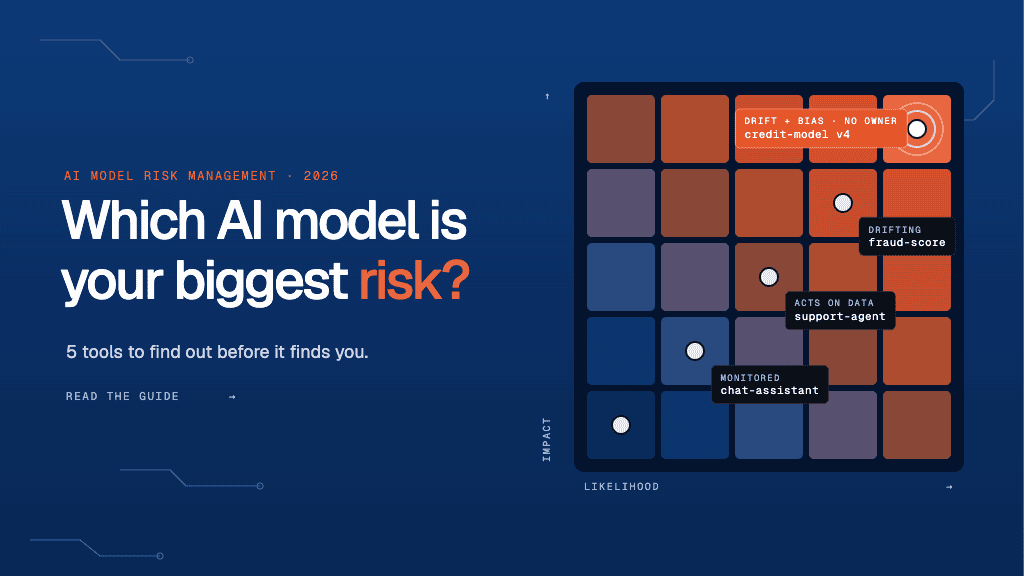
AI models can produce biased outcomes, expose sensitive information, drift from expected performance, or operate without clear ownership. AI model risk management tools help teams identify these issues, document controls, and respond before they become business problems.
However, not every platform solves the same problem. Some focus on governance and compliance, while others specialize in model monitoring or AI agent behavior. This guide compares five tools to help you identify the right fit for your organization’s risk management needs.
What to Look for in an AI Model Risk Management Tool

Before comparing vendors, identify the capabilities your organization needs. A tool that documents compliance approvals may not detect unreliable model outputs in production. Similarly, a monitoring platform may identify performance issues without managing the policies and approvals around them.
Evaluate each platform against these five requirements:
| Feature | What to look for | Why it matters |
| AI model inventory | A centralized view of models, AI agents, owners, and deployment status | Helps identify which systems need oversight |
| Risk assessment and governance | Risk assessments, policy management, approval workflows, and control tracking | Makes risk reviews more consistent and accountable |
| Model evaluation and monitoring | Checks for bias, drift, and unreliable outputs | Helps detect issues during testing and after deployment |
| Security and runtime controls | Sensitive-data protection, policy enforcement, and escalation options | Helps manage risks when AI systems process data or take actions |
| Audit trails and reporting | Traceable decisions, test results, incidents, approvals, and exportable evidence | Supports internal reviews and compliance reporting |
Not every organization needs the same combination of features. If your main concern is model performance, prioritize evaluation and monitoring.
If you manage AI agents that access business data or execute tasks, examine runtime controls and policy enforcement. Organizations with formal governance requirements may need stronger inventory, approval, and audit capabilities.
With these requirements defined, you can compare tools based on how well they address your actual risk gaps rather than simply counting features.
Best AI Model Risk Management Tools: Quick Comparison
| Tool | Best for | Main strengths | Check before choosing |
| Lyzr AI Governance Agents | AI agent oversight | Policy checks, risk monitoring, governance workflows | Confirm required controls and integrations |
| IBM watsonx.governance | Enterprise AI governance | Model tracking, evaluation, monitoring, governance workflows | Check deployment-specific capabilities |
| Credo AI | Governance and regulatory readiness | Risk assessments, policy management, governance workflows | Check fit with internal approvals and reporting |
| ModelOp | Large AI model portfolios | Lifecycle management, governance controls, operational visibility | Review integration and implementation needs |
| Fiddler AI | Model monitoring and explainability | Production monitoring, behavior analysis, explainability | Check which governance processes need separate support |
Capabilities are summarized from vendor materials. Confirm current features, integrations, and availability with each provider. Enterprise pricing should be validated directly with vendors.
5 Best Tools for AI Model Risk Management
1. Lyzr AI Governance Agents: Best for AI Agent Oversight
Lyzr’s AI governance agents focus on monitoring AI systems, applying policies, flagging risks, and maintaining records of agent activity. This is relevant when your concern extends beyond a model’s accuracy to the actions an AI agent takes while completing a task.
Lyzr also offers responsible AI capabilities such as personally identifiable information (PII) redaction, toxicity checks, and prompt-injection protections. Confirm the specific controls and integrations required for your environment during a demo.
Consider Lyzr if: You want to connect governance with AI agent behavior and automate repetitive oversight tasks.
Ask during evaluation: Which policies can be enforced automatically? What happens when a check fails? Can a human review sensitive actions?
2. IBM watsonx.governance: Best for Enterprise Lifecycle Governance
IBM watsonx.governance supports governance for machine learning models and generative AI assets throughout their lifecycle. Its capabilities include model tracking, AI asset evaluation, monitoring, and governance workflows.
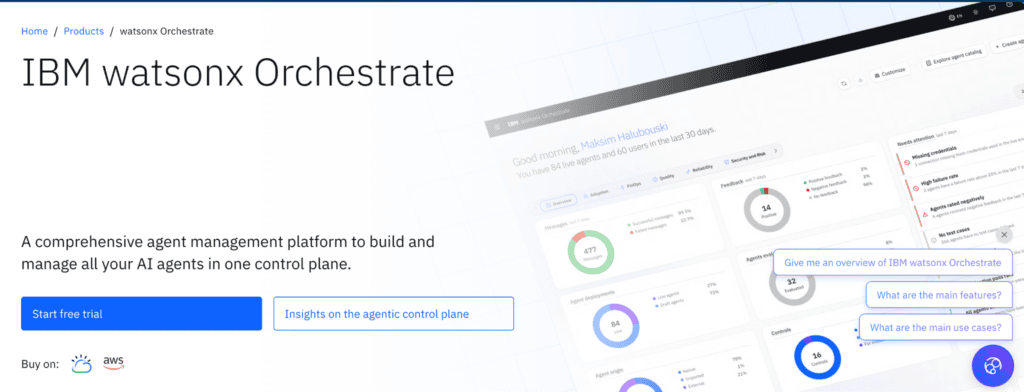
It can suit organizations that need a structured view of AI assets alongside established risk and compliance processes. However, capabilities may differ by deployment environment and integrated services.
Consider it if: You manage a broad model portfolio and need formal oversight connected to enterprise processes.
3. Credo AI: Best for Governance and Regulatory Readiness
Credo AI focuses on AI governance, including inventory, risk assessment, policy management, and governance workflows. It is worth evaluating if you need a repeatable way to document how AI use cases are assessed and governed.

Check how its workflows map to your internal policies, approval roles, and reporting requirements. The platform can help organize evidence, but your team must still define applicable controls and accountability.
Consider it if: Your priority is establishing a formal AI governance program and maintaining visibility into risk assessments and compliance work.
4. ModelOp: Best for Large AI Portfolios

ModelOp focuses on AI lifecycle management and governance across machine learning, generative AI, agentic AI, and third-party AI. This can help enterprises where models are owned by different teams and tracked across multiple systems.
During evaluation, check whether it connects model records, approvals, controls, and lifecycle activity with your existing development and risk systems.
Consider it if: You need consistent governance and operational visibility across multiple models and business units.
5. Fiddler AI: Best for Monitoring and Explainability
Fiddler AI focuses on AI observability, model monitoring, and explainability. These capabilities help teams understand production behavior, identify performance changes, and investigate problematic predictions or outputs.
Monitoring is important, but it may not cover model inventory, formal approvals, regulatory mapping, or audit evidence. Determine whether your organization needs additional governance tools to cover these areas.
Consider it if: Your main gap is understanding and investigating model behavior after deployment.
What to Check Before Choosing a Platform
Once you have shortlisted two or three tools, evaluate how they would work with your existing systems and processes. A long feature list is less useful than seeing how a platform handles a real risk scenario.
| Evaluation question | What to confirm |
| Does it support our AI stack? | Compatible models, agents, providers, frameworks, and integrations |
| Can we define our own policies? | Custom thresholds, approval rules, exceptions, and control ownership |
| What happens when a risk is detected? | Alerts, escalation, remediation tracking, and human review |
| Can we produce audit evidence? | Traceable records, timestamps, reports, and export options |
| How is sensitive data handled? | Data retention, access controls, deployment options, and security requirements |
| What will implementation take? | Setup effort, integration work, ongoing administration, and pricing |
Ask vendors to distinguish between features available out of the box and those that require custom development or additional products. This can affect implementation time and total cost.
A Quick Assessment Before You Book a Demo
Use this checklist to identify your most pressing requirements before speaking with vendors.
- We lack a reliable AI inventory. Prioritize model discovery, ownership, and lifecycle tracking.
- We struggle to document risk assessments and approvals. Prioritize policy management, evidence collection, and governance workflows.
- We are concerned about bias, drift, or unreliable outputs. Prioritize evaluation, monitoring, alerts, and explainability.
- Our AI agents can access data or take actions. Check runtime policy enforcement, sensitive-data controls, escalation paths, and audit logs.
- We need to demonstrate compliance. Check reporting, traceability, evidence export, and control mapping.
If several statements apply, avoid selecting a platform based on a single feature. Ask each shortlisted vendor to demonstrate one end-to-end scenario: identify a risk, assign an owner, apply a control, record the result, and show how the issue is escalated or closed.
This exercise will help you see whether the platform supports your actual risk management process or only one part of it.
Final Thoughts
The best AI model risk management tool is the one that addresses your organization’s specific risks and fits your existing processes.
IBM watsonx.governance, Credo AI, and ModelOp are worth evaluating for structured enterprise governance. Fiddler AI is relevant when monitoring and explainability are the priority. Lyzr is worth exploring when policy checks and oversight for AI agents are central to your requirements.
Shortlist two or three platforms, bring a real use case to each demo, and test the full process from risk detection to evidence and remediation. This will give you a clearer basis for comparing their practical value.
Next step: If AI agent oversight and policy automation are priorities, explore Lyzr’s AI governance agents to assess how they could fit your existing controls.
Frequently Asked Questions
1. What is AI model risk management?
AI model risk management is the process of identifying, assessing, monitoring, and reducing risks associated with AI models throughout their lifecycle. These risks include bias, drift, unreliable outputs, privacy exposure, security weaknesses, and limited explainability.
2. Is AI model risk management the same as AI governance?
They overlap but are not identical. AI governance establishes policies, roles, and oversight processes. Model risk management applies these principles to identifying, assessing, monitoring, and mitigating risks associated with specific models and use cases.
3. What features should AI model risk management software include?
Look for model inventory, risk assessments, policy management, evaluation and monitoring, alerts, audit trails, reporting, and integrations. The right combination depends on whether your main concern is compliance, production monitoring, or AI agent behavior.
4. Can one tool manage every AI risk?
Not necessarily. Some platforms focus on governance workflows, while others specialize in monitoring, security, or runtime controls. Confirm which capabilities are built in, which require integrations, and which still depend on manual processes.
Book A Demo: Click Here
Join our Slack: Click Here
Link to our GitHub: Click Here
Got a use case in mind?
8 weeks from use case to agents running in production.
Platform, people and FDEs, all in. Bring your environment. We'll co-build and stay until it's live.
Talk to UsFree resource
101 AI Agents Use Cases
100+ production-ready AI agent use cases across Marketing, Sales, HR, Banking, Insurance, Operations and a lot more
Download now