Somewhere in your organization right now, an engineering team is hardcoding an OpenAI API key into a production workflow.
It’ll work fine. For a while.
Then a pricing change lands. Or a rate limit gets hit during your busiest week. Or a competitor ships a feature powered by a model that’s simply better at the one task your whole product depends on, and you’re stuck watching from the sidelines because switching means months of rework.
This isn’t a hypothetical.
Lock-in concerns are widespread: 81% of enterprise leaders express concern about dependency on specific AI vendors, with 29% saying they’re very concerned. Among 542 U.S. enterprise executives surveyed, nearly three-quarters (74%) say losing their AI vendor would disrupt day-to-day operations or leave them unable to function.
And the confidence gap is stark. 74% of businesses report they would face significant disruption or are fully reliant on their primary AI vendor, while only 6% could stop using them with no interruption. While 89% of leaders believe they could switch AI vendors within a month, the majority of those who have attempted it (58%) say the process either failed or required far more effort than expected.
That gap between concern and readiness is the story of enterprise AI in 2026. Everyone knows the risk. Almost nobody has architected against it.
This is what LLM agnostic solutions exist to fix. Not as a defensive posture, but as the difference between an AI program that compounds in value and one that quietly becomes someone else’s product roadmap.
What Does LLM Agnostic Actually Mean?
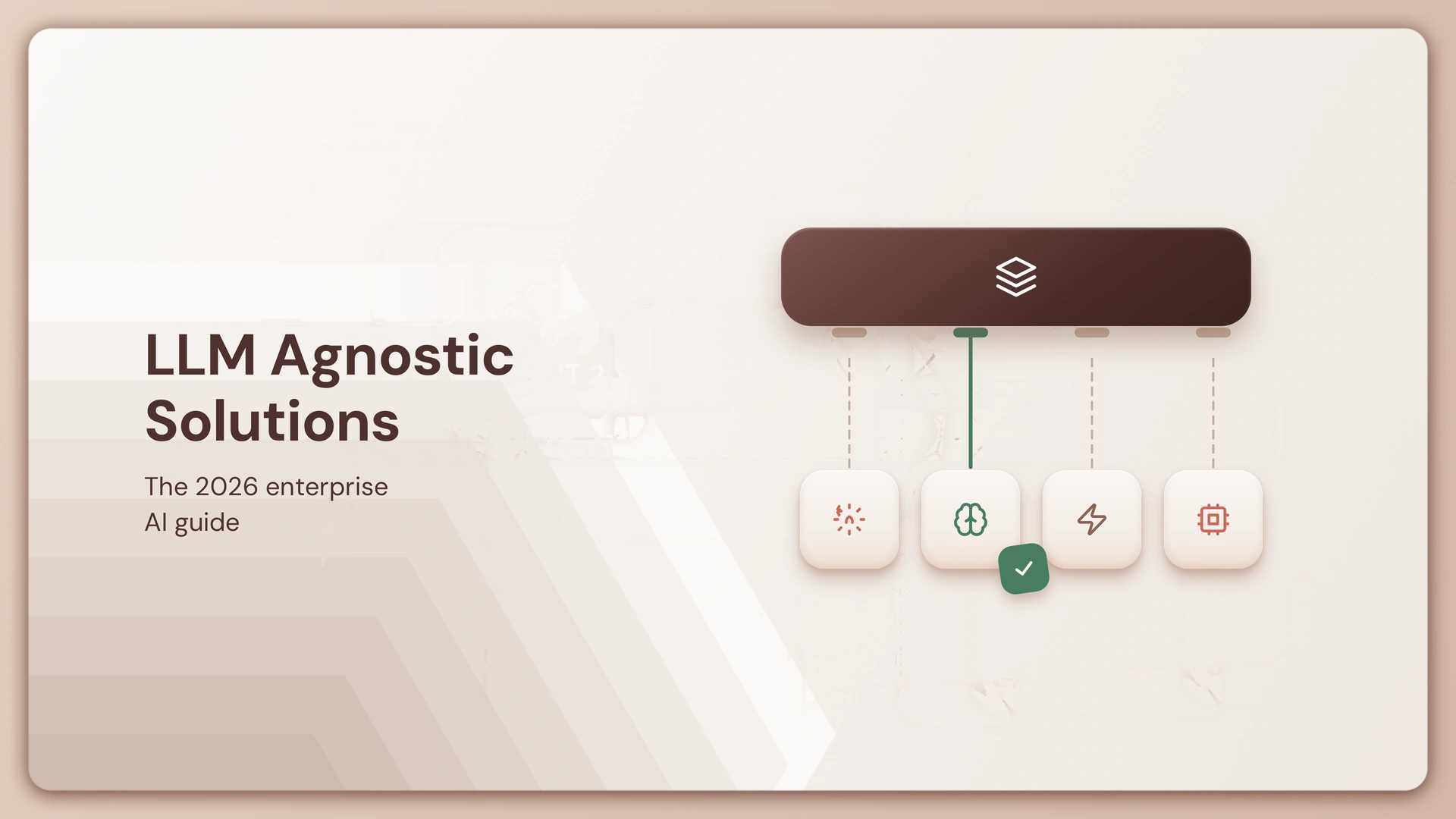
LLM agnostic means your AI system isn’t wired directly to one model or provider.
Instead of building directly on top of OpenAI’s API or Anthropic’s Claude or Google’s Gemini, you build with an abstraction layer that lets you swap models without rebuilding your application.
The application layer, your chatbot, your research assistant, your document processor, never talks to a specific model directly. It makes a generic request. Something else decides which model actually handles it.
Think of it like building a house with standard electrical outlets instead of wiring everything directly to one specific appliance brand. When a better appliance comes along, you just plug it in. You do not have to rewire the walls.
What sits behind that outlet matters. The first priority is building an abstraction layer between your application logic and the LLMs themselves, one that smooths out the differences between models so your system can swap them in and out with minimal disruption.
That’s the mechanism. The reason it matters is less about the technology and more about who holds leverage in your AI program: you, or your vendor.

LLM Agnostic vs. Model Agnostic: There’s a Real Difference
They sound interchangeable. They’re not quite the same guarantee.
An LLM agnostic system can call different models. A truly model agnostic system produces the same quality of answer regardless of which model is doing the work.
Model routing means the platform can call different LLMs at runtime, but the model still generates the response, so swapping models changes responses. Model agnosticism means responses originate from governed knowledge rather than the model itself, so swapping the model underneath shouldn’t change what a customer sees.
This distinction matters most in regulated, customer-facing contexts. A support bot that changes tone or accuracy every time you swap models underneath it hasn’t solved the lock-in problem. It’s just moved it from “which vendor” to “which version of the vendor’s model we happen to be running this week.”
The practical target for most enterprises sits between the two: an orchestration layer that routes intelligently, paired with governed data and guardrails that don’t shift when the model does.
The Cost of Not Doing This
Vendor lock-in in AI isn’t like the CRM or ERP lock-in enterprises have managed for two decades. It’s worse, and in a specific way.
AI vendor lock-in is different in ways that make traditional lock-in management strategies insufficient. The dependency isn’t just functional, it’s cognitive. When your teams build workflows around a specific model’s behavior, its tone, its reasoning patterns, its failure modes, they develop implicit knowledge that doesn’t transfer to a different model.
That’s the part most cost-benefit spreadsheets miss. You’re not just paying an API bill. You’re accumulating institutional muscle memory tuned to one model’s quirks, and that muscle memory is worthless the moment you need to switch.
The switching costs are measurable, too. AI vendor lock-in costs 19-34% in switching costs once you factor in re-prompting, re-testing, and re-certifying workflows against a new model. Separately, vendor lock-in costs enterprises an average of $315K per migration, and that figure only captures the visible engineering cost, not the retrained habits and rebuilt prompt libraries underneath it.
The market itself is moving fast enough to make “we’ll deal with it later” an expensive bet. Claude holds an estimated 54% of the enterprise coding-model market vs OpenAI’s 21%, up from 42% just six months earlier, the widest single-vendor lead of any LLM workload category, a shift that happened well inside a normal enterprise procurement cycle. Whoever’s ahead today isn’t guaranteed to be ahead in eighteen months.
Why the Smartest Enterprises Stopped Picking Favorites
The CIOs furthest ahead on this aren’t asking “which LLM should we standardize on.” They’re asking how to build a system that never has to answer that question twice.
Cost control that actually works
Not every task needs your most expensive model. Using a high-end model for every request is inefficient. A simple task like summarizing an email doesn’t need the same compute power as complex financial modeling. Being LLM agnostic lets a business match the right model to the right task, optimizing for both cost and performance. A model gateway that routes intelligently turns this from a manual decision into infrastructure, which is exactly the kind of governed automation covered in Lyzr’s enterprise guide to workflow automation.
Resilience that survives an outage
If your entire operation depends on one API and that API goes down, so do you. An LLM agnostic architecture gives you the option to fail over to alternative models the moment your primary provider has issues, rather than watching a core product feature go dark for every user simultaneously.
A portfolio, not a single bet
No model wins at everything. An LLM agnostic architecture lets you match models to tasks. Use the heavyweight model where you need its reasoning depth. Use lighter, cheaper models where speed matters more than maximum intelligence.
Governance that doesn’t reset with every model swap
Access controls, audit logging, and compliance frameworks should work consistently regardless of which model handles a query. You shouldn’t have to rebuild your governance and security controls every time you change models, a principle at the core of any serious enterprise AI security platform.
None of this is exotic anymore. The Gartner Market Guide for AI Gateways projects that by 2028, 70% of software engineering teams building multimodel applications will use AI gateways to improve reliability and optimize costs, compared to 25% in 2025. The direction of travel is settled. The only open question is whether you build this capability before or after a vendor forces the issue.
What the Stack Actually Looks Like
Saying “we’re LLM agnostic” and actually being LLM agnostic are different amounts of engineering work.

The application layer
This is what users touch. It makes a generic request, “summarize this,” “extract these fields,” “draft this response,” without caring which model fulfills it.
The orchestration and gateway layer
Before AI gateways, teams called each LLM provider directly, and each team managed its own API keys, set its own budgets, wrote its own retry logic, and maintained its own logging, which created fragmented visibility, unpredictable costs, and no consistent governance across model usage. A proper gateway centralizes routing rules, cost thresholds, and fallback logic in one place instead of scattering them across every team’s codebase.
The model layer
Your actual portfolio, mixing proprietary APIs from OpenAI, Anthropic, and Google with open-source models you might self-host for sensitive workloads.
Comparing a Single-Model Strategy to an LLM Agnostic Strategy
| Dimension | Single-LLM Strategy | LLM Agnostic Strategy |
|---|---|---|
| Cost | Fully exposed to one provider’s pricing changes | Routes simple tasks to cheaper models, saving premium models for complex work |
| Reliability | An outage or rate limit takes your whole feature down | Automatic failover to a backup model, minimal user-facing disruption |
| Performance | Stuck with one model’s strengths and blind spots | Routes each task to the model best suited for it |
| Governance | Rebuilt from scratch with every model change | Access controls and audit logging persist across model swaps |
Building this properly requires more than a router. Best practice includes creating a unified layer that abstracts differences between providers, building routing logic based on performance, cost, and latency, using local or open-source models for regulated data, and implementing observability to track model performance, latency, token usage, and cost over time.
That’s a real engineering lift, which is why most enterprises are choosing to buy this layer rather than build it from scratch, the same way they buy a CDN instead of building content delivery in-house. It’s also the same reason teams that have already solved enterprise prompt management find the transition to a governed multi-model gateway far less painful.
Where Lyzr Fits
This is the layer Lyzr’s Control Plane is built to own. The control plane sits above your LLM choice. Swap GPT-4o for Claude, Gemini for Llama, without touching your agent logic. You own your model decisions.
That freedom extends across frameworks too, not just models. Lyzr is framework agnostic, supporting LangChain, CrewAI, AutoGen, custom stacks, any LLM, and any cloud, with no rewrite required. Agents already running on AWS, Azure, GCP, or a competitor’s stack connect into the same governed environment. No migration. No rewrite. Just connect and govern.
This matters because being LLM agnostic is table stakes for something bigger: building AI agents that plan, use tools, and execute multi-step work rather than just answering questions. A single agent workflow might use a lightweight model to plan its steps, a specialized model to query a database, and a frontier model to synthesize a final report for a human reviewer, all inside one governed workflow, all without three separate integration projects. If you’re mapping out what that looks like operationally, Lyzr’s guide on taking agents to production walks through the practical steps.
The underlying philosophy at Lyzr is that the model is a component, not a foundation. You are paying a toll for every cognitive task your business performs. If your provider changes their terms of service or deprecates a model, your workforce stops. If you build on a single vendor’s foundation, you are building for that vendor, not for yourself.
For teams evaluating what platform-level flexibility should look like against the current field, Lyzr’s breakdown of the top AI agent builder platforms in 2026 is a useful starting point.
“The dependency is not just functional, it is cognitive.” That’s the part of vendor lock-in most cost-benefit spreadsheets never capture, and the part an agnostic architecture is built to remove.
Frequently Asked Questions
What does LLM agnostic mean?
LLM agnostic means building systems that are not tied to a particular LLM or platform. In practice, your application talks to an abstraction layer instead of a specific model’s API, so the underlying model can be swapped, upgraded, or replaced without rewriting the application itself.
What is the difference between LLM agnostic and model agnostic architecture?
LLM agnostic typically refers to the ability to run on any large language model. Model agnostic is used more strictly: responses are meant to stay independent of which model is in use, because they originate from governed knowledge rather than the model itself. One guarantees flexibility. The other guarantees consistency across that flexibility.
Is LangChain LLM agnostic?
Yes, in the sense that it’s designed to work with various LLMs. It’s worth noting that LangChain is a development framework, not a governed enterprise gateway. It gives you the tools to build a model-agnostic pipeline, but the routing logic, failover rules, and governance still need to be designed on top of it.
Why is being LLM agnostic important for enterprises?
Because the alternative is fragility. It matters for three reasons: avoiding vendor lock-in, maintaining flexibility as the LLM market evolves, and protecting against concentration risk when a single provider’s pricing, availability, or policies change. With model performance and market share shifting by the quarter, a single-vendor architecture locks in whatever tradeoffs that vendor happened to make at the moment you built.
What are the downsides of an LLM agnostic architecture?
The main tradeoff is depth of optimization. While an LLM agnostic architecture provides flexibility across integrations, it’s harder to fine-tune or perform optimizations specific to any single model’s strengths. Teams chasing maximum performance on one narrow task sometimes accept tighter coupling to a single model in exchange for that last mile of tuning. For most enterprise workloads spanning many tasks, the flexibility outweighs that cost.
How do you build an LLM agnostic AI strategy?
Start with an abstraction layer between your application and the models themselves. That means comprehensive evaluation of performance, cost, and compatibility across candidate models, benchmarking multiple LLMs on your actual use case tasks, maintaining a model registry of evaluated options with known strengths and issues, and building dynamic selection mechanisms for switching between models based on task requirements, performance, or cost.
The Only Bet Worth Making Is on Optionality
There’s no version of the next two years where the model landscape holds still. New entrants, price cuts, capability jumps, and the occasional outage are the baseline condition of building on LLMs in 2026, not an edge case to plan around later.
The enterprises pulling ahead aren’t the ones who picked correctly. They’re the ones who built architecture that doesn’t require picking correctly, ever, permanently.
That’s what LLM agnostic solutions actually deliver: not a hedge, but a structural advantage that compounds every time the market shifts and your competitors have to stop and rebuild.
If your current AI stack can’t answer “what happens if our primary model provider changes its pricing next quarter” without a wince, that’s the gap worth closing first.
Book A Demo: Click Here
Join our Slack: Click Here
Link to our GitHub: Click Here
Got a use case in mind?
8 weeks from use case to agents running in production.
Platform, people and FDEs, all in. Bring your environment. We'll co-build and stay until it's live.
Talk to UsFree resource
101 AI Agents Use Cases
100+ production-ready AI agent use cases across Marketing, Sales, HR, Banking, Insurance, Operations and a lot more
Download now