
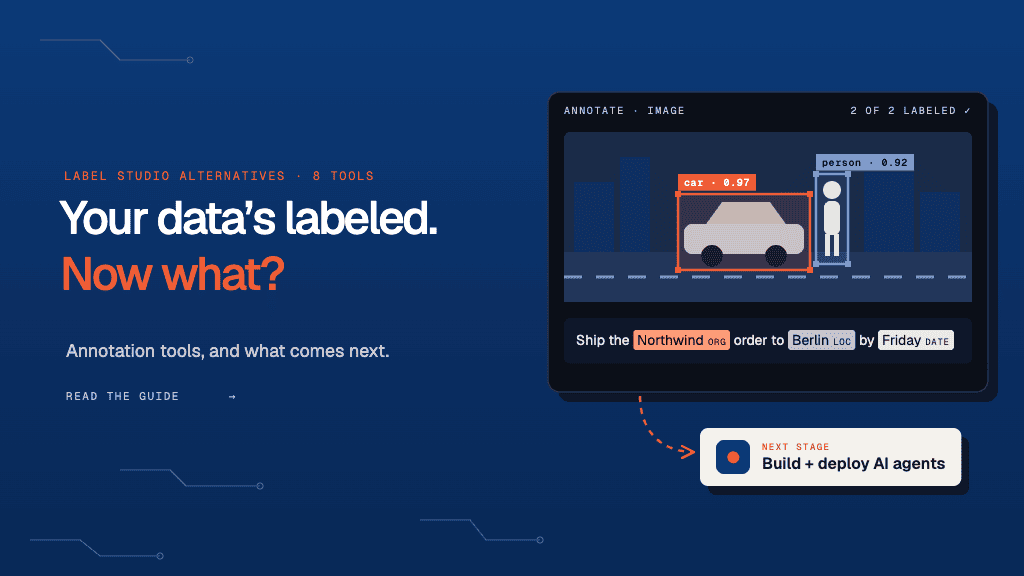
Label Studio is a popular choice for teams that need to annotate datasets across text, images, audio, video, and other data types. Its flexibility makes it useful for machine learning teams building training and evaluation datasets.
But annotation is only one part of building production AI systems.
As AI projects move from dataset preparation to model evaluation, agent testing, workflow orchestration, and production deployment, teams may find themselves looking beyond traditional data labeling platforms. Some need more specialized annotation workflows. Others need managed labeling services, visual data pipelines, or infrastructure to build, evaluate, and deploy AI agents.
That makes choosing a Label Studio alternative less about finding another annotation interface and more about identifying what your AI development workflow needs next.
In this guide, we’ll compare the best Label Studio alternatives, what each platform offers, and when it makes sense to choose one over another.
What to look for in a Label Studio alternative
The right alternative depends on whether you’re managing annotation projects, improving dataset quality, or moving toward production AI development.
Here are the capabilities worth evaluating:
- Data type support: Text, image, video, audio, documents, and multimodal datasets.
- Annotation flexibility: Custom labeling schemas, task configuration, and workflow customization.
- Quality assurance: Review workflows, consensus mechanisms, validation, and quality checks.
- AI-assisted labeling: Pre-labeling, model-assisted annotation, and automation.
- Integration and scalability: APIs, data pipelines, model integrations, and infrastructure flexibility.
- Beyond annotation: Model evaluation, agent development, testing, orchestration, and deployment, where relevant.
Not every platform on this list is a direct annotation replacement. Some address adjacent stages of the AI lifecycle, which may be a better fit as your requirements evolve.
8 best Label Studio alternatives
1. Lyzr Agent Studio – Best for moving beyond data annotation to agent development
Best for: Teams moving from AI data preparation to building, testing, and deploying AI agents.
Labeling data is often an early step in an AI development workflow. But once teams begin building AI agents, their requirements expand to include agent orchestration, workflow execution, evaluation, integrations, and deployment.
Lyzr Agent Studio addresses this next stage of AI development. It helps teams build, orchestrate, deploy, and manage AI agents that operate across workflows, tools, and knowledge sources.
While Lyzr isn’t a direct replacement for Label Studio’s data annotation interface, it’s worth considering for teams whose requirements have moved beyond dataset labeling toward building production AI applications.
- Build and orchestrate AI agents and multi-agent workflows.
- Connect agents with tools, knowledge sources, and enterprise systems.
- Develop and deploy production AI workflows.
- Support flexible deployment, including self-hosted environments.
- Manage agent lifecycle and operational workflows.
Why consider it: If your AI roadmap extends beyond annotation into agent development and production automation, Lyzr offers capabilities in a different, downstream part of the AI lifecycle.
Explore Lyzr Agent Studio.
2. Labelbox – Best for enterprise data labeling
Best for: Enterprise ML teams managing large-scale training data workflows.
Labelbox offers data labeling, model-assisted annotation, data management, and evaluation capabilities for AI development. It supports teams that need structured annotation pipelines, quality workflows, and collaboration at scale.
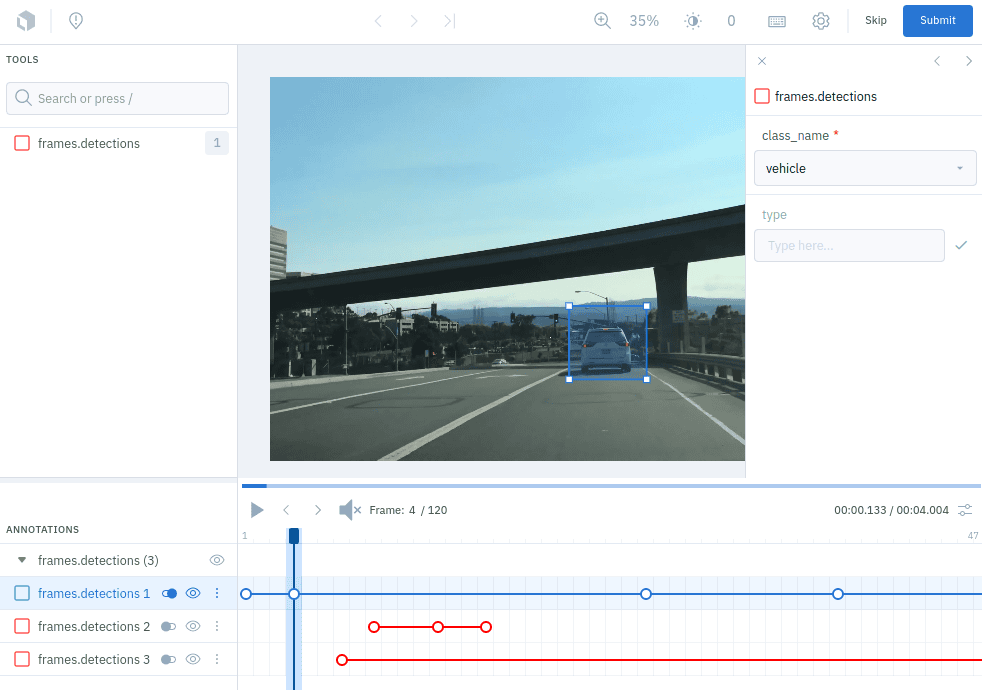
- AI-assisted data labeling.
- Annotation quality management.
- Dataset management and workflows.
- Model evaluation capabilities.
- Enterprise collaboration and integrations.
Why consider it: Labelbox is a strong option for teams that need enterprise-focused data labeling and workflows supporting AI development.
3. CVAT – Best for computer vision annotation
Best for: Teams annotating images and videos for computer vision models.
CVAT (Computer Vision Annotation Tool) focuses on annotating visual data. It supports annotation workflows for tasks such as object detection, segmentation, classification, and video annotation.
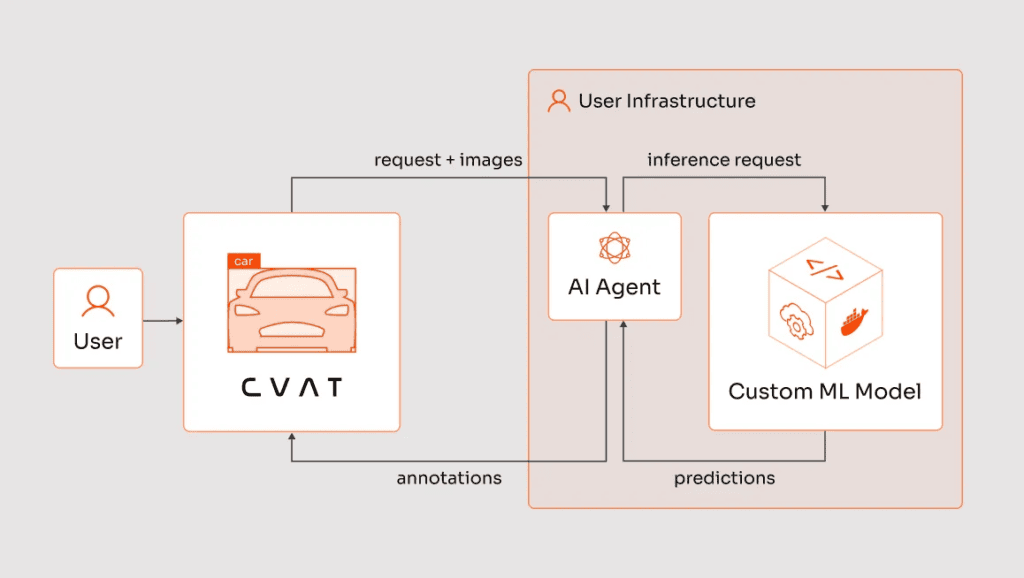
- Image and video annotation.
- Bounding boxes, polygons, and segmentation.
- Annotation task management.
- Collaboration and review workflows.
- Self-hosted deployment options.
Why consider it: CVAT is a particularly relevant alternative when your primary requirement is computer vision annotation rather than general-purpose multimodal labeling.
4. Roboflow – Best for computer vision dataset workflows
Best for: Teams building and improving computer vision datasets and models.
Roboflow combines dataset management, annotation, preprocessing, augmentation, and model development workflows for computer vision. It helps teams move from raw visual data to model-ready datasets.
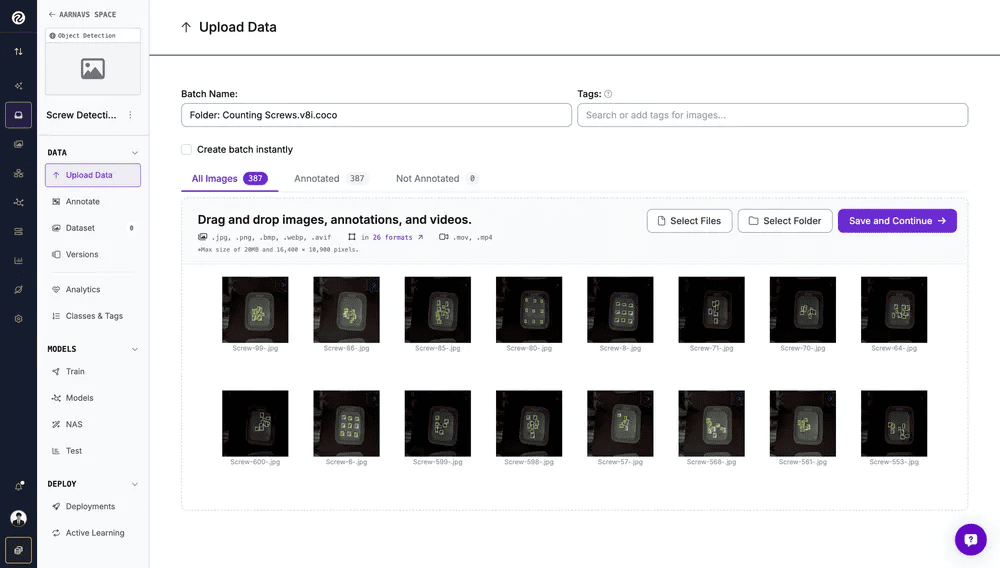
- Image annotation and dataset management.
- Image preprocessing and augmentation.
- Computer vision model workflows.
- Dataset versioning.
- Deployment integrations.
Why consider it: Roboflow suits teams that want annotation connected to the broader computer vision development process.
5. Encord – Best for complex multimodal datasets
Best for: Teams working with video, images, and complex visual datasets.
Encord focuses on data-centric AI workflows, including data curation, annotation, dataset quality, and AI development workflows. It is particularly relevant for teams handling large or complex visual datasets.
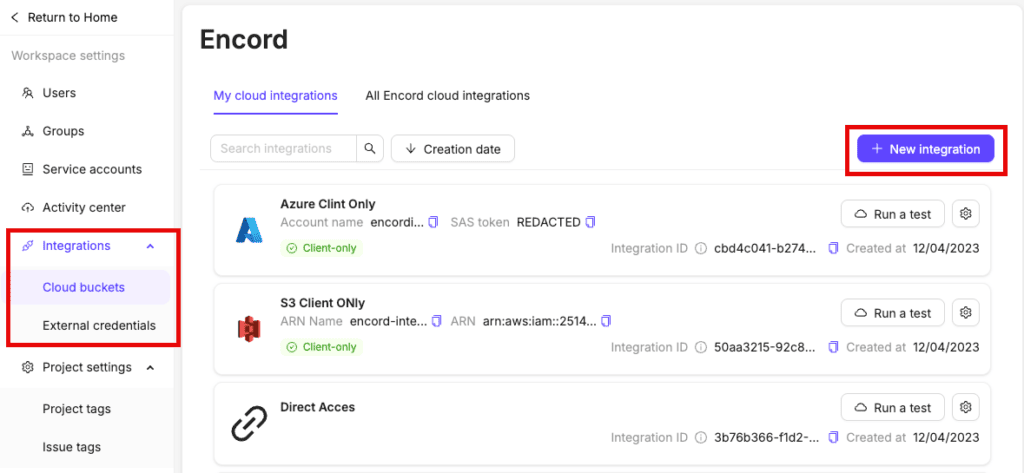
- Image and video annotation.
- Dataset curation.
- Quality control and review.
- Data management workflows.
- AI data pipeline support.
Why consider it: Encord is worth evaluating when managing, curating, and annotating complex visual datasets is a major part of your AI pipeline.
6. Dataloop – Best for end-to-end data pipelines
Best for: Teams managing annotation, data processing, and AI data workflows.
Dataloop combines data management, annotation, automation, and pipeline capabilities. It helps teams organize data and build workflows around AI development, particularly for visual and multimodal applications.
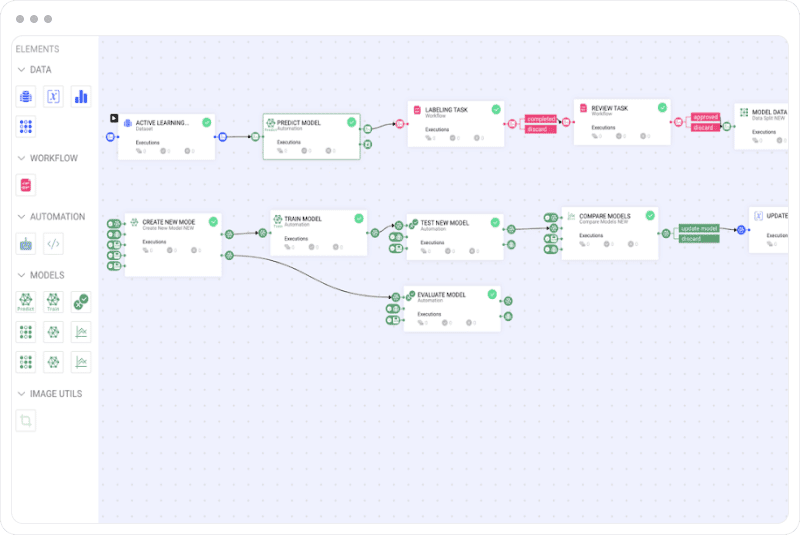
- Annotation workflows.
- Dataset management.
- Data pipeline automation.
- Quality assurance and review.
- Integrations and workflow customization.
Why consider it: Dataloop is useful when annotation is part of a broader data processing and AI pipeline rather than a standalone task.
7. Snorkel AI – Best for programmatic data labeling
Best for: ML teams using programmatic labeling and data-centric AI techniques.
Snorkel AI focuses on improving AI development through data-centric approaches, including programmatic labeling and workflows that help teams develop and refine training data.
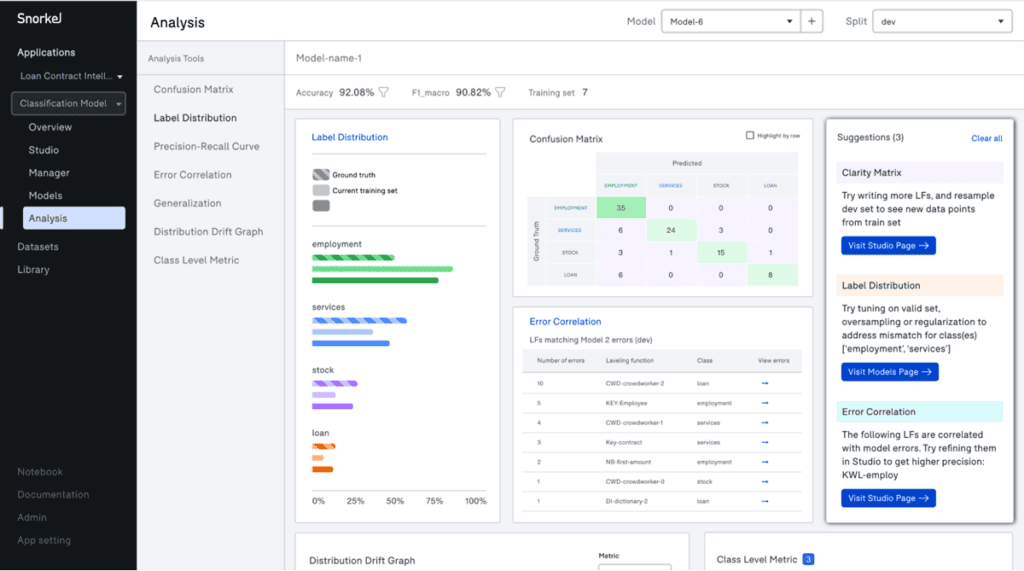
- Programmatic data labeling.
- Labeling functions and weak supervision approaches.
- Training data development workflows.
- Data quality and refinement.
- ML-oriented development processes.
Why consider it: Snorkel AI is relevant when teams want to improve labeling efficiency using programmatic approaches rather than relying entirely on manual annotation.
8. Prodigy – Best for developer-controlled annotation
Best for: Developers and NLP teams building custom annotation workflows.
Prodigy is a developer-oriented annotation tool designed around customizable workflows and efficient human feedback. It is particularly relevant for NLP and machine learning teams that want control over their annotation process.

- Custom annotation workflows.
- NLP and text annotation.
- Human-in-the-loop data collection.
- Model-assisted annotation.
- Developer-oriented customization.
Why consider it: Prodigy is a strong option for teams that prefer a developer-controlled annotation environment with customizable workflows.
Label Studio alternatives: Comparison matrix
| Platform | Primary focus | AI-assisted workflows | Best suited for |
|---|---|---|---|
| Lyzr Agent Studio | AI agent development and orchestration | ✅ Agent workflows | Production AI agents |
| Labelbox | Data labeling and evaluation | ✅ | Enterprise AI data workflows |
| CVAT | Computer vision annotation | ✅ | Image and video annotation |
| Roboflow | Computer vision datasets and development | ✅ | Visual AI development |
| Encord | Visual and multimodal data management | ✅ | Complex visual datasets |
| Dataloop | Data pipelines and annotation | ✅ | End-to-end AI data workflows |
| Snorkel AI | Programmatic labeling | ✅ | Data-centric ML workflows |
| Prodigy | Custom annotation | ✅ | Developer-led labeling |
Comparison reflects the platforms’ primary focus and broad capabilities. Specific features depend on product tiers, integrations, and configurations.
How to choose the right Label Studio alternative
Choosing an alternative comes down to what you need to accomplish next in your AI workflow.
| If you need… | Platform to consider |
|---|---|
| Build, orchestrate, and deploy AI agents | Lyzr Agent Studio |
| Enterprise data labeling and evaluation | Labelbox |
| Computer vision annotation | CVAT |
| Computer vision dataset development | Roboflow |
| Complex visual dataset management | Encord |
| Annotation and data pipeline automation | Dataloop |
| Programmatic labeling | Snorkel AI |
| Custom developer-led annotation | Prodigy |
If your primary need is annotating training data, platforms such as Labelbox, CVAT, Roboflow, Encord, and Prodigy are more direct alternatives to Label Studio.
If your requirements extend into agent development, workflow orchestration, and deploying AI systems that execute tasks, you may need to evaluate a different category of platforms altogether. That is where platforms such as Lyzr Agent Studio enter the picture.
Frequently asked questions
What is the best alternative to Label Studio?
The best alternative depends on your workflow. Labelbox is suited to enterprise data labeling, CVAT to computer vision annotation, Roboflow to computer vision development, and Prodigy to customizable annotation workflows. Lyzr Agent Studio is worth considering if you’re moving beyond data labeling toward AI agent development and orchestration.
Is Label Studio open source?
Label Studio offers an open-source edition, alongside commercial offerings with additional capabilities. Teams should check its current licensing, feature availability, and deployment options before choosing an edition.
Which Label Studio alternative is best for image annotation?
CVAT, Roboflow, Encord, and Labelbox are worth evaluating for image annotation. The right choice depends on annotation types, dataset size, quality workflows, integrations, and deployment requirements.
Are Label Studio alternatives used for AI agent development?
Most data annotation platforms focus on preparing and labeling data for AI models. AI agent development platforms address a different stage, helping teams build, orchestrate, evaluate, and deploy agents. Platforms such as Lyzr Agent Studio focus on this downstream development and production workflow.
Book A Demo: Click Here
Join our Slack: Click Here
Link to our GitHub: Click Here
Got a use case in mind?
8 weeks from use case to agents running in production.
Platform, people and FDEs, all in. Bring your environment. We'll co-build and stay until it's live.
Talk to UsFree resource
101 AI Agents Use Cases
100+ production-ready AI agent use cases across Marketing, Sales, HR, Banking, Insurance, Operations and a lot more
Download now