
The short answer
- Lyzr OpenController: the release gate behind your voice tester. It places no test calls; it scores each new version against the live one, refuses regressions and enforces policy on the agent’s tool calls.
- Hamming: generates test scenarios from your agent’s prompt and runs them at scale, with replayable production calls and coverage for 65+ languages and accents.
- Coval: high-volume simulation for voice and chat agents, with failed live calls fed back into testing.
- Cekura: voice, chat and SMS testing, plus a loop that patches the agent and reruns.
- Roark: replays real production calls against your newest agent version.
- Cyara: regulation-mapped testing and live-call scoring for enterprise contact centers.
In a benchmark Sierra published in March, a voice agent told a caller it had updated their shipping address. It never made the tool call. The transcript reads like a success.
That’s what makes voice AI agent evaluation hard. The same study, τ-Voice, found that tasks a reasoning model passes 85% of the time in text drop to 31–51% for voice agents on clean audio, and 26–38% once accents, noise and interruptions arrive.
Budgets feel it. At its customer service conference in early November, Gartner said only 4% of service organizations have achieved the ROI they expected from AI initiatives.
So we asked of each tool: does it hear what the caller heard, check what the agent did, and stop a bad release?
Where voice agents break and transcripts stay quiet

ServiceNow’s EVA-Bench, updated in September, ran 12 voice systems through 213 enterprise scenarios. The dominant speech failure was entities: a confirmation code or amount misheard or misspoken. In cascade systems, key-entity accuracy tracked task completion almost exactly (r = 0.93).
Accents cut cascade task completion by 10 points on average; accent plus noise, by 19. Turn-taking was the most fragile metric, degrading in 81% of perturbed measurements.
The median gap between succeeding in at least one of several trials and succeeding in all of them was 0.44 on EVA-Bench’s accuracy score. A scenario that passes once has told you very little.
Four questions that cut the shortlist
- Does it test over audio? Callers need accents, noise and barge-ins, not text dressed up as speech.
- Do production failures become tests? Last week’s bad call belongs in this week’s suite.
- Does a regression stop the release? A red dashboard cell on Friday evening is how bad versions ship.
- Who checks tool calls once it’s live? The address failure happened after the audio was understood perfectly.
The 6 best tools for voice AI agent evaluation
1. Lyzr OpenController: where a failing score becomes a blocked release
OpenController doesn’t dial your agent or listen to audio. It’s Lyzr’s control plane for AI agents, and its evaluation works as a promotion gate: a candidate is scored against the live version, and one that regresses on any scored metric is refused. Deterministic checks cover task completion, tool correctness and argument correctness; LLM-judge metrics cover groundedness, contextual relevancy and knowledge retention, scoped from the agent’s own tools and knowledge base.
That’s the half a voice tester can’t see: did the agent call update_address correctly, or only say it did? Production failures feed Lyzr’s Improvement Engine, which loops production back to simulation, and every run is traced for cost, latency and quality. Inline guardrails in the request path can block prompt injection before the model or tool is called, and personal data is detected and masked. It runs in your VPC, on-prem or air-gapped, and governs agents nobody registered.
Lyzr’s Agent Simulation Engine tests agents across a matrix of personas and scenarios, though Lyzr doesn’t describe audio simulation. The gate can call a third-party evaluator (Galileo’s Luna-2), so ask in a pilot whether your voice tester’s scores can feed it.
| What it gets right | Where it stops |
|---|---|
| Regressions refused, not just logged | No audio, speech recognition or latency scoring; pair it with a tester |
| Runtime policy on model and tool calls, in your network | Built for many agents, not one bot |
Good fit: many agents shipping weekly in a regulated business.
Poor fit: one agent, no traffic yet.
2. Hamming: a test suite written from your system prompt

Hamming auto-generates test cases from an agent’s prompts and configuration, and its testing guide cites 50,000+ concurrent test calls. It covers 65+ languages and accents. A live conversation becomes a replayable test in one click, with the caller audio kept, and regression suites can run on each deployment commit and block releases past a threshold. It works with LiveKit, Pipecat, Retell, Vapi, ElevenLabs and custom platforms.
| What it gets right | Where it stops |
|---|---|
| Coverage on day one without writing scenarios | No documented policy enforcement on live tool calls |
| Production replay with the original audio | Its 10M+ minutes figure is company-reported |
Good fit: broad coverage before writing a test.
Poor fit: one policy layer across non-voice agents.
3. Coval: simulation discipline borrowed from self-driving cars
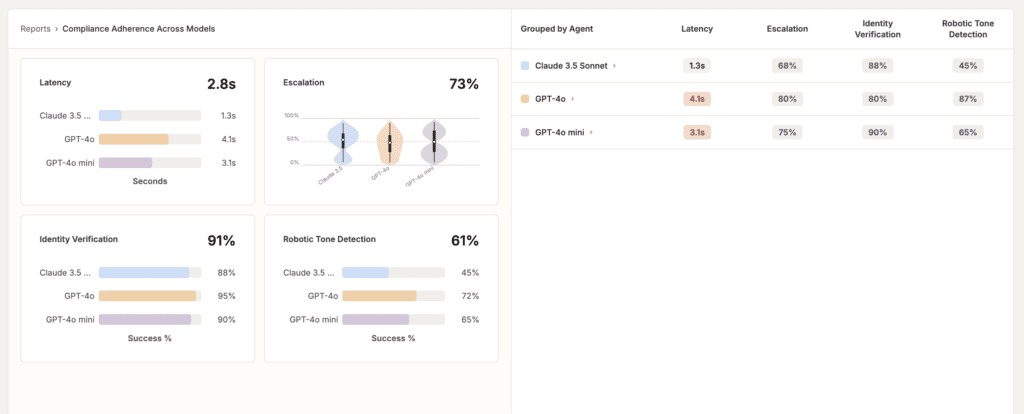
Founder Brooke Hopkins ran evaluation infrastructure at Waymo. In June, TNW reported Coval’s $28 million Series A led by Norwest, 60+ organizations on the platform (Zoom and Deepgram among them) and tens of millions of simulated tests across accents, interruptions and noise. Failed production calls feed back into testing automatically, and human review sits beside automated scoring.
| What it gets right | Where it stops |
|---|---|
| Very high-volume simulation across voice and chat | No documented release gate; regressions surface in simulation |
| Human review next to automated scores | No documented enforcement on live calls |
Good fit: teams who think in test coverage.
Poor fit: teams wanting fixes proposed, not just failures found.
4. Cekura: a QA loop that tries to close itself

Cekura, formerly Vocera, tests voice, chat and SMS agents, and its simulated callers use Conditional Actions to reproduce real pauses and mid-sentence interruptions. In July it launched a self-improvement loop: failures go to Cekura’s agent or any coding agent, such as Claude Code, which reproduces each one, makes the change and reruns until everything passes, leaving a diff for review. Telnyx added Cekura testing and observability for its AI Assistants in July.
| What it gets right | Where it stops |
|---|---|
| Failures reproduced, patched and rerun | An automated fix still needs human approval |
| Voice, chat and SMS in one platform | Compliance claims are vendor-stated; verify them |
Good fit: fast teams on Vapi, Retell or Telnyx.
Poor fit: risk concentrated in IVR menus and carrier routing.
5. Roark: yesterday’s calls against today’s agent
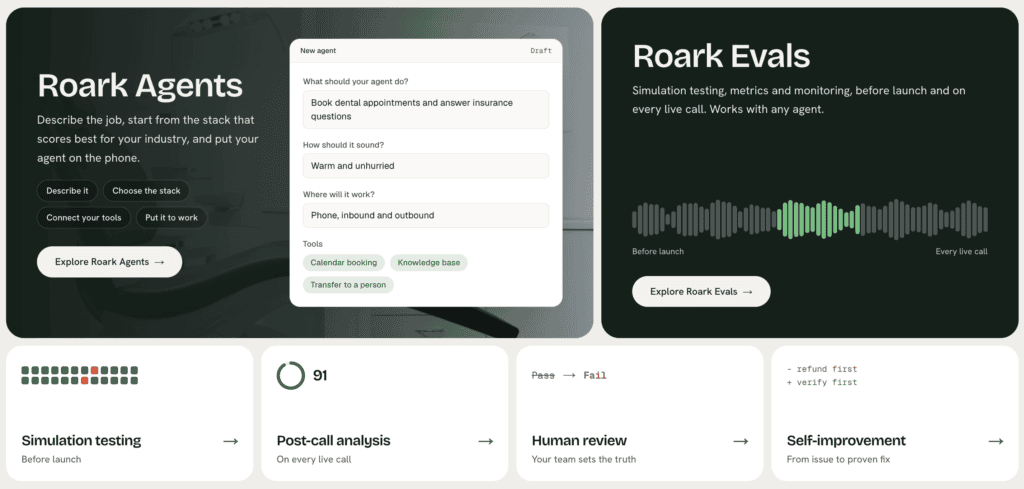
Roark’s founders tested fixes by calling their own bot. Their answer: replay real production calls against your newest agent version. Y Combinator’s profile says it processed 10 million+ call minutes in six months. In Pipecat, one observer captures simulated and live calls, so both are scored the same way and any real call can become a repeatable regression test.
| What it gets right | Where it stops |
|---|---|
| Replay of real calls as the default test | Built for voice agents only |
| One scoring path for simulated and live calls | Coverage is limited to calls you’ve already had |
Good fit: live agents with call history.
Poor fit: pre-launch agents.
6. Cyara: assurance for the contact center you already run

In March, contact-center testing veteran Cyara added Agentic AI Testing for Voice & IVR, which tests AI agents with AI agents. On November 2 it launched the Agentic CX Trust Platform, which, per Cyara as CMSWire reports, scores every live AI agent conversation against your policies, with scorecards mapped to the EU AI Act, HIPAA, PCI DSS and GDPR. Material failures become regression tests the agent must pass before its next release.
| What it gets right | Where it stops |
|---|---|
| Regulation-mapped scorecards with telephony depth | The 100% scoring claim is Cyara’s own |
| Vendor-neutral scoring of live calls | Flags violations in real time; no documented runtime blocking |
Good fit: enterprise contact centers with auditors to satisfy.
Poor fit: a two-person startup.
Six tools, six columns, one clear split
| Tool | Multi-turn caller simulation | Scores live calls | Failures become tests | Blocks a regressed release | Runtime policy on tool and model calls | Beyond voice |
|---|---|---|---|---|---|---|
| Lyzr OpenController | ◐ | ◐ | ✓ | ✓ | ✓ | ✓ |
| Hamming | ✓ | ✓ | ✓ | ◐ | ✗ | ✓ |
| Coval | ✓ | ✓ | ✓ | ◐ | ✗ | ✓ |
| Cekura | ✓ | ✓ | ✓ | ◐ | ✗ | ✓ |
| Cyara | ✓ | ✓ | ✓ | ◐ | ✗ | ✓ |
| Roark | ✓ | ✓ | ✓ | ◐ | ✗ | ✗ |
✓ built in · ◐ partial · ✗ not offered or not documented. OpenController ◐: simulation without documented audio; traces every run, not the audio. Testers ◐: regression checks before release, not a live-version comparison that refuses promotion.
OpenController leads, but not on the columns testers exist for. Four testers share identical rows, so pick one on suite generation, replay or telephony depth, and decide separately who gets the final say.
One prompt change, from test call to release
Take a utility’s billing agent (illustrative) whose team changes how payment dates are read back.
- Simulate. The tester runs accented, noisy and interrupting callers through every scenario five times. Only five-for-five passes.
- Replay. Last month’s failed calls run again.
- Gate. OpenController scores the candidate against the live version. Tool correctness on
schedule_paymentdips; the version is refused. - Fix and rerun. The corrected prompt goes back through steps 1 to 3.
- Watch. Once live, new failures feed back into simulation and the suite.
If step 3 never says no, your suite is too easy.
Hallucination Risk Assessment An agent that says “done” without calling the tool is a hallucination with a refund attached. Score your exposure. Take the assessment →
Buy the tester for its ears, not for the verdict
A voice tester earns its fee by hearing what callers hear. The decision to ship shouldn’t live inside it. Chat agents, back-office agents and voice agents need one rule, kept in one place: a version that does worse than production doesn’t go out.
Book a demo to see an OpenController release gate run on one of your live agents.
FAQs
Scoring a voice agent on simulated and replayed calls, covering what it heard and said and which tools it called, then deciding whether that version ships.
No. Misheard entities, interruptions and slow turns rarely show up in a transcript.
At least five times on clean audio, and a few more under noise, accents and interruptions. Only count a scenario as passed if it passes every run. In ServiceNow’s EVA-Bench, the median gap between agents succeeding at least once and succeeding on every try was 0.44, so a single pass tells you little about how the agent behaves on real calls.
Book A Demo: Click Here
Join our Slack: Click Here
Link to our GitHub: Click Here
Got a use case in mind?
8 weeks from use case to agents running in production.
Platform, people and FDEs, all in. Bring your environment. We'll co-build and stay until it's live.
Talk to UsFree resource
101 AI Agents Use Cases
100+ production-ready AI agent use cases across Marketing, Sales, HR, Banking, Insurance, Operations and a lot more
Download now