
Opencontroller vs Databricks
Opencontroller vs Databricks
Databricks governs what runs on Databricks. Opencontroller connects to Databricks and governs it alongside every other platform your agents run on. This Opencontroller vs Databricks comparison shows where each one fits.
- Databricks
- agents, one inventory
- Gate
- and roll back releases
- Contain,
- alert, quarantine, and stop agent activity


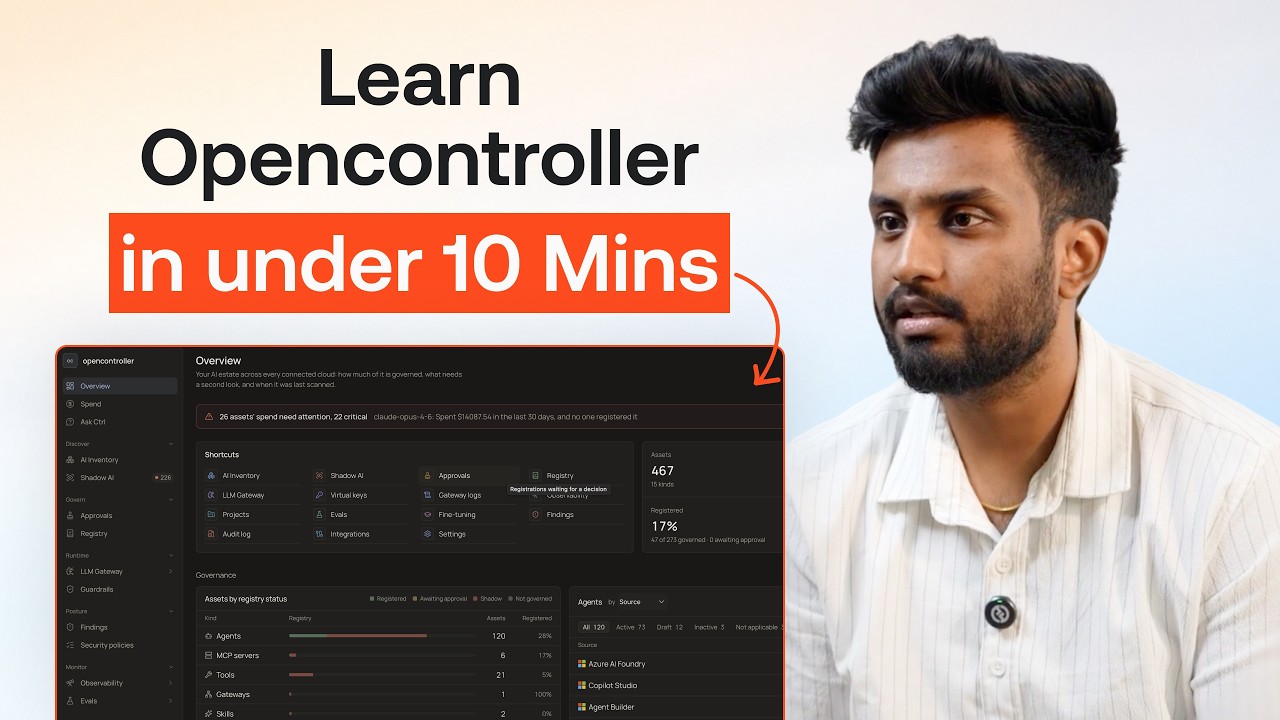
Opencontroller vs Databricks: See it in action
Business impact
Opencontroller vs Databricks: Business impact
| Feature | Opencontroller | Databricks |
|---|---|---|
| Agent discovery across platforms | Full Connects to Databricks, Salesforce, SAP, AgentCore, Foundry and Vertex AI, and puts every agent in one inventory | Partial Discovers and registers agents and AI assets in Unity Catalog |
| Governance of coding agents | Full Governs Claude Code, with policy, keys and budgets for coding agents | Full Governs Claude Code, Codex, Cursor and others routed through Unity Gateway |
| Cross-platform control | Full One control plane across AWS, Azure, GCP, Databricks and enterprise SaaS | Partial Covers what is registered in Unity Catalog or routed through Unity Gateway |
| Agent deployment governance | Full Eval gates, versioned releases, approvals and one-step rollback | Partial Governed deployment for Databricks-hosted AI applications |
| Runtime policy enforcement | Full Guardrails in the path for prompt injection, PII, secrets, groundedness and task adherence | Full Gateway policies, rate limits and guardrails |
| Quarantine, shutdown and human approval | Full Hold risky actions for human approval, or quarantine and shut down an agent automatically | Partial Request-level controls through the gateway |
| Cost per agent across every platform | Full Budgets and alerts per agent, user and team, across every platform, not just Databricks workloads | Partial Budgets and cost controls for traffic routed through Unity Gateway |
FullPartialNot offered
Developer’s perspective
Opencontroller vs Databricks: A developer’s perspective
| Feature | Opencontroller | Databricks |
|---|---|---|
| Framework flexibility | Any framework, any cloud runtime, no SDK lock-in | removeSupported integrations and endpoints |
| Multi-cloud agent governance | Deploys to and governs AWS AgentCore, Google Vertex and Azure Foundry | removeCovers Databricks workspaces and services routed through them |
| Agent inventory | One inventory that includes Databricks agents, plus agents and API keys from every other platform | checkAgents, models and MCP services registered in Unity Catalog |
| Deployment governance | Multi-turn and red-team evals gate releases, with versioned promotion and one-step rollback | checkGoverned AI application deployment on Databricks |
| Runtime enforcement | In-path guardrails, plus automatic quarantine and shutdown | checkGateway policies and request-level controls |
| Agent permissions and access | Agents act on behalf of the user who called them, with workload identity federation | checkUnity Catalog permissions and access controls |
| Fleet-wide operational visibility | LLM judges score production traffic across every platform | removeLineage, tracing, usage and audit within Databricks |
FullPartialNot offered
Built into the control plane
Opencontroller vs Databricks: The smarter choice
Connected platform
Databricks is one of the platforms we connect to
Opencontroller connects to Databricks and pulls its agents into the same inventory as your Salesforce, SAP, AgentCore, Foundry and Vertex AI agents.
Release control
From discovery to deployment
Eval gates, versioned releases, approvals and one-step rollback govern how agents reach production, wherever they run.
Spend
Spend across every platform
Budgets and alerts per agent, user and team, across every platform, not just Databricks workloads.
Containment
Control the agent, not just the request
Hold risky actions for human approval, or quarantine and shut down an agent automatically.
Why choose Opencontroller
Opencontroller vs Databricks: Why choose Opencontroller?
Five reasons to bring your enterprise AI agents under one control layer.
Opencontroller connects to Databricks and puts its agents in one inventory with agents from AWS, Azure, GCP, Salesforce, SAP, HubSpot, Claude Enterprise and OpenAI Enterprise.
Teams keep building with their preferred frameworks, models and infrastructure while Opencontroller provides one governance layer across all of them.
Multi-turn and red-team evals gate every release, with versioned promotion, approvals and one-step rollback.
Hold risky actions for approval, or quarantine and shut down an agent automatically when behaviour changes.
Continue using Databricks for data, analytics, model development and the agents you build there. Opencontroller governs them alongside the rest of your agent estate.

FAQ
Opencontroller vs Databricks: Frequently asked questions
Databricks governs agents, models, coding agents and MCP services that are registered in Unity Catalog or routed through Unity Gateway. Opencontroller connects to Databricks and governs it as one of many platforms, with discovery, releases, runtime control and spend in one control plane.
No. Databricks is a data and AI platform. Opencontroller is a control plane that governs agents across platforms, Databricks included.
Yes. Unity Catalog governs agents, models and MCP services, and Unity Gateway governs model and MCP traffic, including coding agents such as Claude Code, Codex and Cursor routed through Databricks.
Yes. Opencontroller connects to Databricks and pulls its agents into the same inventory as the rest of your estate.
No. Unity Catalog governs data and AI assets on Databricks, including permissions, lineage and auditing. Opencontroller governs agents across every platform, Databricks included.
Databricks applies gateway-level controls, including access policies, rate limits and guardrails, to traffic routed through it. Opencontroller applies in-path guardrails across every platform and can hold risky actions for approval or quarantine and shut down an agent automatically.
Yes. That’s the point. Databricks is one of the platforms we connect to.
Opencontroller runs one control plane across AWS, Azure and GCP, plus Databricks, Salesforce, SAP and other platforms, and deploys to each cloud’s own agent runtime.
Yes. Databricks offers usage monitoring, cost attribution, audit logging, lineage and tracing across its services. Opencontroller adds LLM judges that score production traffic across every platform.
Choose Opencontroller when your agents run on Databricks and elsewhere, and you want one inventory, one release process, one set of runtime controls and one view of spend across all of them.
Ready when you are
Got a use case in mind? Let’s make it real.
Bring Databricks and the rest of your AI stack. See Opencontroller govern every agent across clouds, frameworks and platforms. See Opencontroller vs Databricks side by side in your own environment.
Talk to Us