
Businesses have spent years automating repetitive tasks. Bots copy data between applications, generate reports, process invoices, and update customer records. Yet many business processes still require employees to interpret documents, handle exceptions, make decisions, and move work between disconnected systems.
This is where AI-powered robotic process automation (RPA) changes the equation.
Traditional RPA follows predefined instructions. AI-powered automation combines RPA, machine learning, natural language processing, and AI agents to handle more complex workflows that involve unstructured information and decision-making.
But which platforms actually deliver these capabilities?
Let’s compare the best AI-powered RPA and process automation tools in 2026 and understand where each one fits.
What Is AI-Powered RPA and Process Automation?
AI-powered RPA combines robotic process automation with artificial intelligence to automate workflows that go beyond repetitive, rule-based tasks.
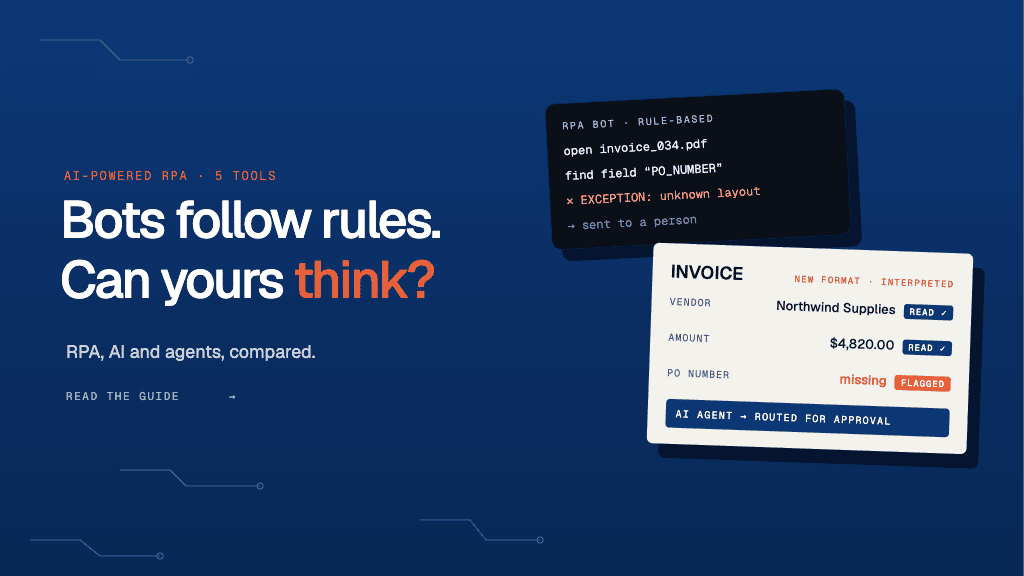
For example, a traditional RPA bot can extract information from a structured invoice and enter it into an ERP system. An AI-powered automation system can also interpret an unfamiliar invoice format, identify missing information, flag inconsistencies, and route the invoice for approval.
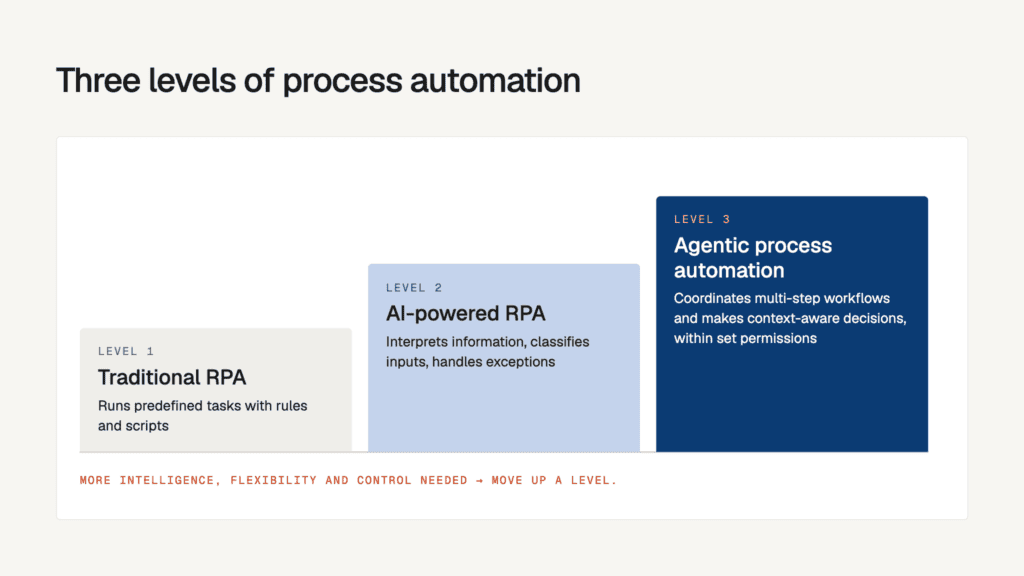
The distinction is important:
- Traditional RPA: Executes predefined tasks using rules and scripts.
- AI-powered RPA: Uses AI to interpret information, classify inputs, and handle exceptions.
- Agentic process automation: Uses AI agents to coordinate multi-step workflows, interact with systems, and make context-aware decisions within defined permissions.
The right solution depends on how much intelligence, flexibility, and control your processes require.
Best Tools for AI-Powered RPA and Process Automation
Here are five platforms worth evaluating based on their automation capabilities, AI integration, enterprise readiness, and use cases.
Quick Comparison: Best AI RPA Tools
| Platform | Best For | AI & Intelligent Automation | RPA / Workflow Automation |
|---|---|---|---|
| UiPath | Enterprise RPA | ✅ | ✅ |
| Automation Anywhere | Intelligent enterprise automation | ✅ | ✅ |
| Microsoft Power Automate | Microsoft ecosystem | ✅ | ✅ |
| SS&C Blue Prism | Governed enterprise automation | ✅ | ✅ |
| Lyzr Agent Studio | Agentic process automation | ✅ | ⚠️ Requires integration with RPA where UI bots are needed |
1. UiPath
Best for: Enterprise-scale robotic process automation
UiPath is one of the established platforms for organizations looking to automate repetitive business operations across applications.
Its Business Automation Platform combines RPA, AI, document processing, process mining, and orchestration. Organizations can build attended and unattended bots to handle workflows across enterprise systems.
Key capabilities:
- Visual workflow and bot development.
- Document understanding and intelligent data extraction.
- Process discovery and automation orchestration.
- AI-powered automation through its broader agentic capabilities.
Where it fits: Finance operations, invoice processing, employee onboarding, and repetitive back-office workflows.
2. Automation Anywhere
Best for: AI-driven enterprise automation
Automation Anywhere combines robotic process automation with intelligent document processing, generative AI, and agentic automation capabilities.
Its Automation 360 platform helps organizations automate workflows across business applications, including processes that involve unstructured documents and multiple systems.
Key capabilities:
- Cloud-based RPA.
- Intelligent document processing.
- AI Agent Studio and agentic automation.
- Centralized bot management and orchestration.
Where it fits: Financial services, document-heavy operations, customer service, and enterprise back-office automation.
3. Microsoft Power Automate
Best for: Organizations using Microsoft 365 and Azure
Microsoft Power Automate makes workflow automation accessible through low-code and no-code capabilities.
It supports cloud flows, desktop flows, robotic process automation, and AI Builder. Users can automate tasks across Microsoft applications and connected third-party services.
Key capabilities:
- Desktop and cloud-based automation.
- AI Builder for document processing and classification.
- Copilot-assisted workflow creation.
- Integration with Microsoft 365, Dynamics 365, and Azure services.
Where it fits: Employee onboarding, approval workflows, document processing, and Microsoft-centric business operations.
4. SS&C Blue Prism
Best for: Governance-heavy enterprise automation
SS&C Blue Prism focuses on enterprise-grade automation, helping organizations manage digital workers and complex business processes.
Its platform combines RPA with intelligent automation and AI capabilities, making it relevant for businesses that need centralized control over large automation programs.
Key capabilities:
- Centralized bot management.
- Attended and unattended automation.
- Process orchestration.
- Enterprise governance and audit capabilities.
Where it fits: Banking, insurance, healthcare operations, and regulated enterprise environments.
5. Lyzr Agent Studio
Best for: AI agent-driven process automation
Lyzr Agent Studio takes a different approach to process automation by focusing on intelligent AI agents rather than relying exclusively on traditional bots.
Instead of simply following fixed instructions, AI agents can interpret requests, retrieve information, interact with connected systems, and coordinate multiple workflow steps.
For example, an employee onboarding workflow could involve an agent reviewing submitted information, checking internal records, initiating access requests, and coordinating follow-ups.
Key capabilities:
- Build and deploy AI agents using low-code and developer-friendly capabilities.
- Create multi-agent workflows using SuperFlow.
- Connect agents to APIs, databases, and enterprise applications.
- Add guardrails and monitor agent execution.
- Support deployment in private VPC and local environments.
Where it fits: Multi-step business workflows, enterprise operations, internal process automation, and workflows requiring contextual decision-making.
Unlike conventional RPA platforms, Lyzr is not a dedicated desktop-bot replacement. It can complement existing RPA infrastructure by adding an intelligent decision-making and orchestration layer.
Explore AI Agents for Process Automation to learn more.
How to Choose the Right AI RPA and Process Automation Tool
A platform that works for invoice processing may not be the right choice for coordinating an entire customer onboarding journey.
Use this decision matrix to narrow down your options:
| Your Requirement | Recommended Platform |
|---|---|
| Automating repetitive desktop tasks | UiPath |
| AI-driven document processing at scale | Automation Anywhere |
| Automating Microsoft 365 workflows | Power Automate |
| Centralized automation governance | SS&C Blue Prism |
| Context-aware, multi-step AI workflows | Lyzr Agent Studio |
| Combining AI agents with existing RPA bots | Lyzr + existing RPA platform |
Before making a decision, evaluate these five factors:
- Process complexity: Are you automating predictable tasks or workflows involving multiple decisions?
- Integration requirements: Can the platform connect to your existing ERP, CRM, databases, and APIs?
- Exception handling: Can it identify errors and route unusual cases for human review?
- Security and governance: Does it support access controls, auditability, and your deployment requirements?
- Scalability: Can it handle increasing workflow volumes without making automation difficult to maintain?
Final Thoughts
AI-powered RPA is moving process automation beyond predefined instructions. Businesses can now combine traditional bots, AI models, and autonomous agents to manage workflows that previously required significant manual intervention.
The right platform depends on the problem you’re solving. UiPath and Automation Anywhere are strong choices for established RPA programs, Power Automate fits Microsoft-centric environments, and Blue Prism addresses governance-heavy enterprise requirements.
For organizations looking to introduce contextual reasoning and multi-step execution into business processes, Lyzr Agent Studio offers an agent-based approach that can complement existing automation infrastructure.
The bigger question is no longer how many tasks you can automate. It’s how much of an end-to-end business process you can reliably automate.
Book A Demo: Click Here
Join our Slack: Click Here
Link to our GitHub: Click Here
Got a use case in mind?
8 weeks from use case to agents running in production.
Platform, people and FDEs, all in. Bring your environment. We'll co-build and stay until it's live.
Talk to UsFree resource
101 AI Agents Use Cases
100+ production-ready AI agent use cases across Marketing, Sales, HR, Banking, Insurance, Operations and a lot more
Download now